
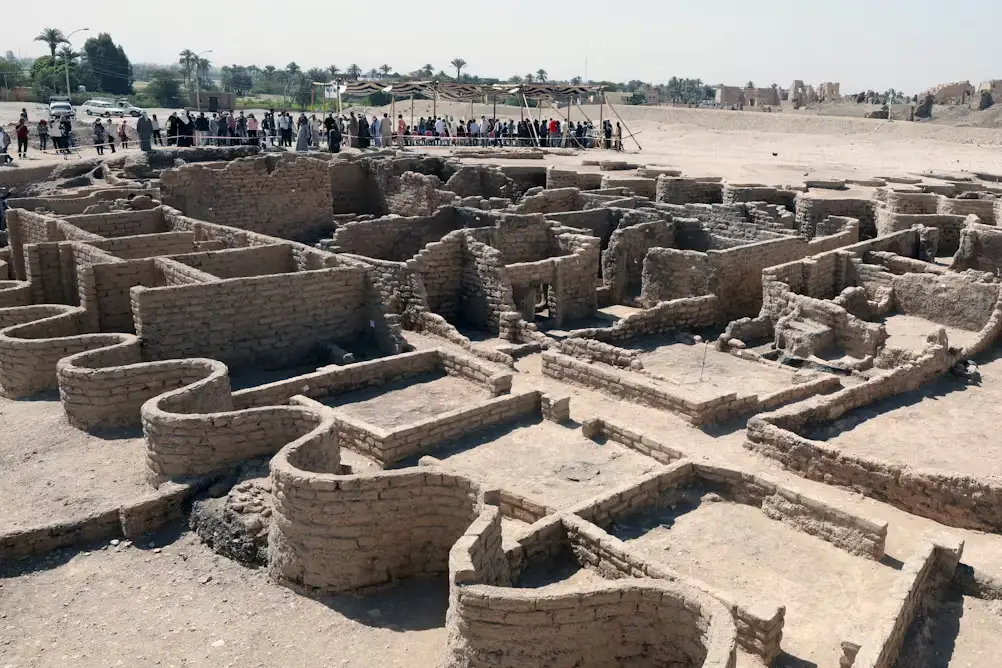
In September 2020, a team of Egyptian archaeologists, began digging near Luxor. Their goal was to find the mortuary temple of the boy king Tutankhamun (opens in new tab). Instead, they made an unexpected discovery. Just weeks after starting, they uncovered mud brick walls that extended in every direction. Rather than a temple or a tomb, they found an entire city, remarkably well‑preserved, as if its residents had just stepped out for a moment and never returned.
On April 8, 2021, this discovery was officially announced. Betsy Bryan, a professor of Egyptology at Johns Hopkins University, called it the second most important archaeological find in Egypt since Tutankhamun’s tomb was discovered in 1922 (opens in new tab). This comparison shocked the academic community, and justifiably so. This was not just a discovery; it was a significant revelation.
What Exactly Is the Lost Golden City?
The city, called Aten, is located on the west bank of the Nile in the Theban Necropolis (opens in new tab), near modern Luxor. It was founded during the reign of Amenhotep III (opens in new tab), a powerful ruler of ancient Egypt, who ruled from about 1386 to 1353 BCE. This time is seen by historians as the peak of Egypt’s power and wealth.
Records, including writing on clay lids of wine vessels, show that the settlement had three royal palaces for King Amenhotep III. It also served as the administrative and industrial center of the empire. This was not just a small village; it was the economic heart of the ancient world’s most powerful civilization, which had been hidden under sand for a long time.
Frozen in Time: What the Archaeologists Found
The most remarkable thing about the Lost Golden City is not its size, but its condition. Salima Ikram, an archaeologist from the American University in Cairo, described it as “a snapshot in time — an Egyptian version of Pompeii.” This comparison is fitting because, like Pompeii, Aten seems to have been abandoned during its prime, leaving everyday life preserved just as it was.
Archaeologists have found houses filled with everyday items such as ceramic vessels, children’s dolls, and limestone gaming pieces. They also discovered bakeries, kitchens, and other areas related to food preparation. One notable find was a vessel with over 20 pounds of dried meat, prepared by a butcher named Luwy. This detail, a butcher’s name preserved for 34 centuries, connects us to the people who lived there.
The city is divided into different functional areas. In the southern part, the team found a bakery and a cooking area with ovens and storage pottery, indicating it served many workers. The second area, still partly uncovered, includes administrative and residential spaces, featuring larger and well‑organized units surrounded by a zigzag wall. This wall, common in the reign of Amenhotep III, helped archaeologists date the city and its builder. They found clay bricks with the pharaoh’s name, along with rings, scarabs (opens in new tab), and colored pottery, which further confirmed the city’s age.
Some mysteries remain unsolved, like an unusual burial where a person was found with arms stretched out and a rope around their knees. Archaeologists are still investigating this detail. It is unclear whether it was a ritual, a punishment, or something else. This question keeps archaeologists curious and draws the interest of the public.
The Great Mystery: Why Was the City Abandoned?
Three thousand four hundred years ago, an ancient Egyptian king named Akhenaten (opens in new tab) made a bold move. He abandoned his name, his religion, and his capital in Thebes. Akhenaten built a new city called Akhetaten, where he ruled with his wife Nefertiti (opens in new tab) and worshipped the sun god Aten. After he died, his young son Tutankhamun took over and rejected his father’s ideas.
Akhenaten was born Amenhotep IV, the son of the king who built the Lost Golden City. During his 17‑year reign, he changed Egyptian culture dramatically. He focused on only one god, Aten, and stopped worshipping the traditional Egyptian gods. He changed his name to Akhenaten, meaning “devoted to Aten,” and moved the royal court to Akhetaten, a city we now call Amarna.
This has significant implications for the Lost Golden City. When Akhenaten moved north, he left behind the entire city built by his father, including its workshops and neighborhoods. An inscription found at the site dates to 1337 BCE, which aligns with Akhenaten’s reign. He likely shifted his capital to Akhetaten the following year. The city was briefly used under Tutankhamun but was soon covered by desert sands and remained hidden for over three thousand years.
We still don’t know why Akhenaten made such a big break from his father’s legacy. Betsy Bryan suggests that studying the city may not answer all our questions, but could help us learn more about Amenhotep III and Akhenaten, and the lives they chose. Sometimes, the biggest discoveries lead to more questions rather than clear answers.
Why This Discovery Matters Beyond the Headlines
The Lost Golden City is not just an impressive headline — it has deep significance. This city is the largest ancient city found in Egypt and was the biggest administrative and industrial settlement of its time. Only about one‑third of the site has been excavated so far, so most of its secrets are still hidden underground.
This site provides a rare view into the daily life of ordinary people during the height of the Egyptian empire. Most major discoveries, such as Tutankhamun’s tomb and the temples at Karnak (opens in new tab) and Luxor (opens in new tab), focus on the divine and the dead. In contrast, the Lost Golden City shows us the lives of everyday people — bakers, butchers, jewelers, and children playing with clay dolls on streets that have been buried since the Bronze Age.
This discovery not only offers a unique look at ancient Egyptians during the empire’s wealthiest time but may also help solve one of history’s mysteries: why did Akhenaten and Nefertiti move to Amarna? The treasures buried in Luxor reveal a thriving civilization and provide clues about a critical moment in history.
The Story Is Far From Over
Excavations at the Lost Golden City are still happening, and each season reveals more findings. Egypt’s Ministry of Tourism and Antiquities plans to develop the site into a major heritage destination, which could make it one of the most visited archaeological sites in the world. Meanwhile, researchers are mapping, documenting, and preserving what remains. This work could take decades because so much lies beneath the surface.
The Lost Golden City is more than just an archaeological find. It reminds us that the past is still relevant. Beneath our feet, ancient civilizations are waiting to share their stories. When they do, they help us understand who we are, where we come from, and how much we have to learn.