
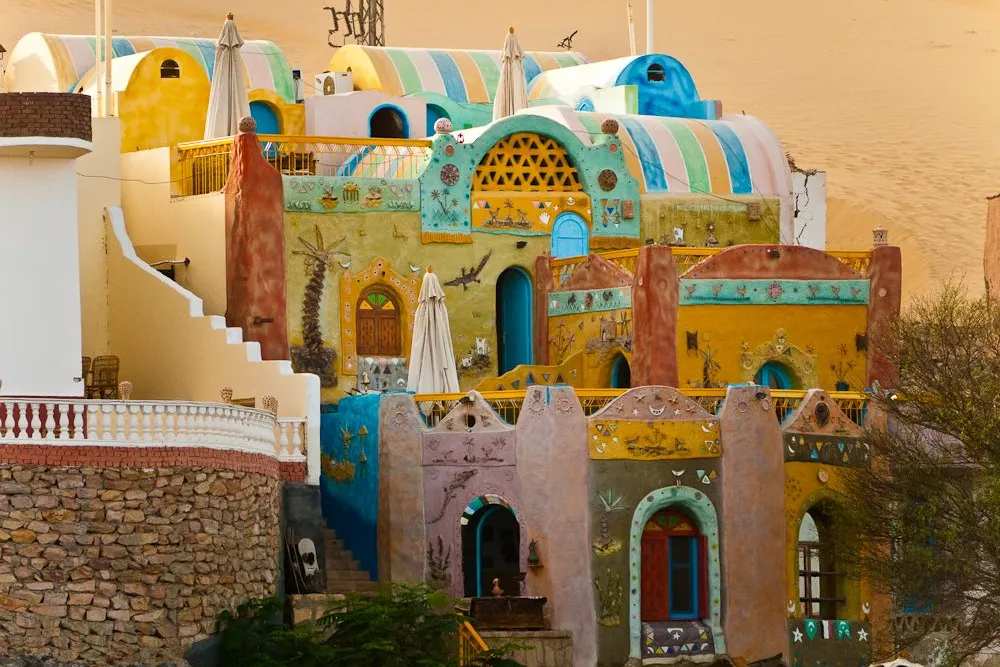
As you walk down a narrow road in Gharb Soheil, a tranquil village just south of Aswan, you find every wall you pass vibrant with color. Bold blues and ochres depict scenes of women balancing water jugs, men sailing feluccas on the Nile, and children skipping rope in the afternoon sun. You haven’t entered a gallery; you’ve stepped into a Nubian neighborhood where art is simply life made visible.
Nubian art and culture in Upper Egypt are among the world’s most overlooked cultural treasures. It is not a relic preserved behind glass; it breathes, evolves, and demands to be seen—despite considerable challenges. This is the story of the Nubian people, what they have created, and why the rest of the world is only now beginning to pay proper attention.
Who Are the Nubian People?
The Nubian people are one of Africa’s oldest civilizations. Their homeland stretches along the Nile Valley from Aswan in southern Egypt to Khartoum in Sudan. This area was once called Ta‑Seti, or “Land of the Bow,” because of the famous skill of Nubian archers. Nubian culture dates back to at least 2,500 BC and originated in ancient Africa. Estimates of how many Nubians live in Egypt today range from 100,000 to five million, showing how often this community is overlooked.
Nubians have a distinct identity separate from broader Egyptian culture. They speak Nubian languages, mainly Kenzi and Nobiin, which come from Old Nubian. These languages have a musical quality that lends itself well to poetry and songs. However, their language and culture faced serious threats after the Aswan High Dam was built in the 1960s. The dam flooded Nubian villages under Lake Nasser and forced many families to move. Despite this, Nubian identity has not only survived but has also become a source of pride for the people.
The Nubian Diaspora: A People in Motion
The Aswan High Dam in the 1960s caused significant migration among the Nubian people. This was not the first time they were forced to leave their homes. Many Nubians lost their ancestral villages when Lake Nasser was created, leading to the relocation of tens of thousands to new areas far from their traditional lands. This displacement pushed many young Nubian men to look for better opportunities outside of Egypt, migrating to Cairo, the Gulf states, and later to Europe and North America. While this emigration was necessary, it changed the Nubian community greatly.
Despite these challenges, the Nubian community has shown strong cultural resilience. In Cairo, especially in Ain Shams, Nubians have kept their language, music, and traditions alive. Internationally, Nubian groups in cities like London and New York hold festivals and language classes. Social media also helps them stay connected, share their culture, and advocate for their heritage. What began as forced displacement has turned into a global celebration of Nubian culture.
A Civilization That Built Empires
Before exploring the art, it’s important to understand the significance of this civilization. In the mid‑eighth century BCE, Nubians from the kingdom of Napata took control of Egypt, uniting the area from modern‑day Khartoum to the Mediterranean Sea. These rulers, known as the Kushite kings of Egypt’s 25th Dynasty, were Nubian pharaohs who didn’t just rule Egypt but also revived its traditions, including pyramid building and the worship of the god Amun.
Today, you can see Nubian pyramids, which are shorter and have steep sides, in the desert near Meroë. In fact, Sudan has more pyramids than Egypt. The Kingdom of Kush also built temples, palaces, and royal baths. Gold, along with ivory, incense, and ebony, was one of Nubia’s key exports, making this area an important trade route in ancient times. This was not a minor culture; it played a major role in shaping the ancient world.
The Visual Language of Nubian Art
Nubian art is easy to recognize because it uses bold colors and tells stories about the community. In Nubian culture, artists paint the outside walls of homes. This painting is not just decoration — it is a way to express identity, belonging, and memory.
The subjects painted on Nubian walls often show everyday life and joy. They include felucca boats on the Nile, women in flowing robes, children playing, and musicians with the bendir, a traditional drum important in Nubian ceremonies. The color palette varies from earthy tones like ochres and terracotta to bright colors like turquoise, cobalt, and cherry red. Both ends of the palette clearly represent Nubian culture.
Nubian art goes beyond just wall painting. It includes:
- Pottery: Nubians were among the first to fire clay and create handmade ceramics with impressive skill. Their pottery often has patterns that look like basket weaves and dates back thousands of years before Egypt conquered the region.
- Jewelry: Nubian goldsmiths became well‑known for their craftsmanship. Large faience pectorals, often worn on beaded necklaces by royal women, combined local designs with Egyptian styles, showing great creativity.
- Woven textiles and silver jewelry: These are still made today in Nubian villages and markets around Aswan.
Ancient Nubian art was never just a copy of Egyptian art, even when Egypt had control.
Nubian Architecture: The Art of Building a Home
A Nubian village is not only visually unique but also offers a distinct experience. The mud‑brick homes with domed ceilings, arched doorways, and colorful decorations line the riverbanks near Aswan. This architecture combines African building traditions with Islamic designs, creating a style that is entirely its own.
These homes focus on hospitality. The communal courtyards, open rooms, and shaded terraces show a culture that values gathering together. Nubian art is especially evident in pottery, paintings, and architecture. The way creative expression blends into everyday life is clear in every painted doorway and decorated facade you see today.
Sacred Spaces in Nubia
Nubia has some of the most amazing sacred sites in the world. Many of these sites were moved during a UNESCO rescue effort to protect them from the rising waters caused by the Aswan High Dam. This is bittersweet because the dam also flooded the homes of the very people these temples belonged to. Here are the key sites to know:
- Abu Simbel (opens in new tab): This is a giant monument built by Ramesses II on Nubian land. It was moved to save it from Lake Nasser’s waters.
- Kalabsha Temple: This temple comes from the Ptolemaic era and is dedicated to Mandulis, the Nubian sun god. It mixes Egyptian, Greek, and Nubian art styles.
- Wadi es‑Sebua: Known as the “Valley of the Lions,” this site has sphinx‑lined pathways built by Amenhotep III and Ramesses II.
- Beit al Wali Temple: This temple shows the blend of Egyptian and Nubian religions and is covered in colorful relief art.
Each site shares a part of a larger story: two great civilizations that influenced each other, competed with each other, and ultimately created something unique together. For those planning to visit these sites from Luxor, our Luxor and Aswan itinerary (opens in new tab) can help you combine both regions.
Music, Food, and Oral Tradition: Culture as Daily Life
Nubian culture is alive in its people as much as in its monuments. Music is central to community life and is performed at weddings, harvests, and religious festivals using traditional instruments like the tar (a frame drum), the oud, and the simsimiyya. Nubian dance is a shared ritual that strengthens community bonds rather than a performance for an audience. Elders tell stories to preserve history, values, and identity across generations, especially since much of Nubia’s early history is not written down.
Food also plays an important role in bringing people together. Nubian meals focus on fresh Nile fish, fava bean stews, kisra (sorghum flatbread), and date sweets. These dishes are simple, local, and very satisfying. Eating from a shared dish highlights the culture’s values of togetherness and hospitality.
Nubians in Luxor: A Quieter Presence With Deep Roots
Nubian workers and craftsmen have lived and worked in Luxor for centuries. They were drawn to the city because it is a center for trade, tourism, and archaeology along the Upper Nile. Many Nubian families settled on the West Bank of Luxor and in nearby neighborhoods. There, they formed small communities that kept their language, cooking traditions, and social customs while also adapting to a mixed urban environment. Today, visitors can still find Nubian‑inspired handicrafts and hospitality in Luxor, especially in artisan workshops near the Valley of the Kings (opens in new tab).
Nubian Culture Today: Resilience and Revival
Nubians stay connected to their culture and traditions despite being displaced from their original villages. They encourage younger generations to respect their heritage and help revive it. Many young Nubian artists, musicians, and writers express their cultural inheritance through digital storytelling, modern music, and advocacy work.
The Nubian Museum in Aswan, which opened in 1997 and is recognized by UNESCO, gives a physical home to a culture that has lost its original land. The museum displays pottery, jewelry, tools, and archaeological finds that reflect the history and people of Nubia.
Cultural tourism in Aswan lets visitors engage with living Nubian culture through village homestays, craft workshops, felucca rides, and guided museum visits. It is important to approach this with respect—buy from local artisans, listen more than take photos, and recognize that what you see is a real community living on its own terms, not a performance for tourists.