
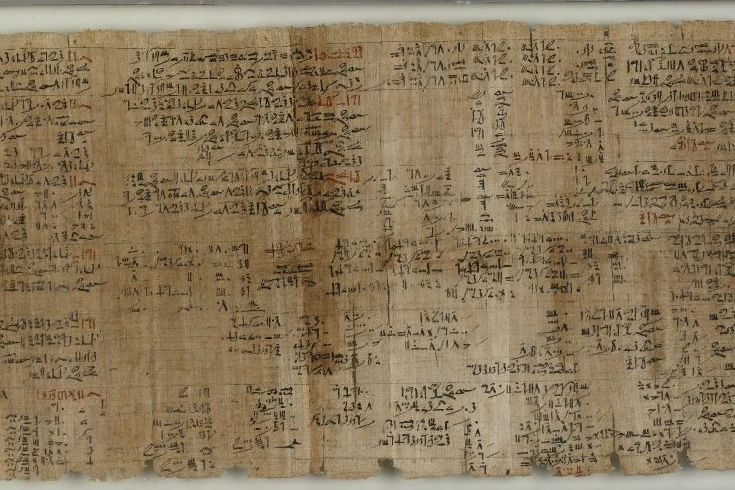
Around 1550 BCE, a scribe named Ahmose copied a mathematical text onto a papyrus scroll more than five meters long. The problems are practical: how do you share six loaves of bread among ten people, how much grain fits in a round granary, what slope should a pyramid have? Egyptian mathematics was not built on abstract proofs. It grew out of farming, construction and administration, and it is one of the earliest mathematical traditions we can read.
Luxor has a direct link to the story. The scroll Ahmose copied, now called the Rhind Papyrus, was bought in Luxor in 1858 and is reported to have been found near the Ramesseum.
The Rhind Papyrus and Its Luxor Connection
The Scottish antiquarian Alexander Henry Rhind bought the papyrus in Luxor in 1858. It was said to have come from one of the small buildings near the Ramesseum on the West Bank. The British Museum acquired it in 1864, with a smaller part held in the Brooklyn Museum.
Ahmose states that he copied it from an older text, probably from the reign of Amenemhat III (Twelfth Dynasty). He presents it as a guide for “accurate reckoning,” for understanding things and uncovering their secrets, which is a large claim for a document that mostly deals with bread rations, field areas and granary volumes. Older sources often date it to about 1650 BCE, while many current sources place it nearer 1550 BCE.
Numbers: A Decimal System Without Place Value
Egypt’s number system goes back to about 3200 BCE, with early evidence on ivory labels from Tomb U-j at Abydos. The Narmer Macehead (c. 3100 BCE) records large tallies of cattle, goats and captives, such as 400,000 oxen and 1,422,000 goats. Scholars often read these as ceremonial exaggeration, not a census, but the inscription shows the notation could already express very large numbers.
The system was base 10 but had no place value. Each power of ten had its own hieroglyph, repeated as many times as needed:
| Value | Hieroglyphic symbol |
|---|---|
| 1 | A single stroke |
| 10 | A heel bone (cattle hobble) |
| 100 | A coiled rope |
| 1,000 | A lotus flower |
| 10,000 | A bent finger |
| 100,000 | A tadpole or frog |
| 1,000,000 | The god Heh, kneeling with arms raised |
Papyri such as the Rhind were written in the cursive hieratic script, which has its own numeral forms; the hieroglyphic signs above are the monumental versions. There was no positional zero, but accounting texts used the nfr sign to mark a zero balance. For the script itself, see Ancient Egyptian Hieroglyphs.
The Papyri That Survived
Most of what we know comes from a handful of documents, preserved by Egypt’s dry climate:
- Rhind Mathematical Papyrus. About 84 problems on arithmetic and geometry, plus a table of fractions of the form 2/n.
- Moscow Mathematical Papyrus. Older than the Rhind, with 25 problems, including a correct method for the volume of a truncated pyramid (a frustum).
- Egyptian Mathematical Leather Roll, Berlin Papyrus 6619 and the Lahun Mathematical Papyri. Fraction tables, problems and administrative mathematics.
- Ostraca from Deir el-Medina. Pottery and stone flakes used as scrap paper by the royal tomb workers, recording rations, absences and disputes.
Our understanding is limited by how few sources survive, so some interpretations are debated.
Multiplication by Doubling
Scribes did not memorize multiplication tables. To multiply 13 by 17, start with 1 and 17, then keep doubling: 2 and 34, 4 and 68, 8 and 136. Add the rows whose left-hand numbers total 13 (1 + 4 + 8), and you get 17 + 68 + 136 = 221. The method rests on the same idea as binary numbers, breaking a number into powers of two. Division reversed the process: what do you double to reach the number?
“False Position” Problems
Problem 24 of the Rhind Papyrus asks for a quantity which, with its seventh added, makes 19. The scribe guesses 7, finds that 7 plus its seventh is 8, then scales the guess by 19 ÷ 8 to get 16 + ½ + ⅛. This is not symbolic algebra, but it is a systematic way to solve for an unknown. The Berlin Papyrus includes a problem that amounts to a simple quadratic system.
Unit Fractions
Egyptians wrote nearly all fractions as sums of unit fractions, with a numerator of 1. The one regular exception was ⅔. So six loaves shared among ten people, which is ⅗ of a loaf each, was written as ½ + 1/10. The Rhind Papyrus includes a table that converts 2/n for odd n into unit fractions, which served as a reference for these calculations. It looks awkward to us, but it fit a world of rations, shares and measures.
Geometry: Circles, Pyramids, and the Seked
Egyptian geometry focused on solving specific problems rather than proving general rules. Scribes could find the areas of rectangles, triangles and circles. Problem 48 of the Rhind Papyrus effectively treats a circle’s area as (8/9 of its diameter) squared, which corresponds to a value of π of about 3.16, within 1% of the true value. Problems 41–43 compute the volume of round granaries, and the Moscow Papyrus gives the frustum volume.
The seked describes the slope of a pyramid as the horizontal run, measured in palms, for each cubit of height. Problem 56 of the Rhind Papyrus works out a seked from a pyramid’s base and height. The Great Pyramid’s slope is often cited as close to 5½ palms. One caution: the surviving papyri are roughly a thousand years younger than the Great Pyramid, so they show how later scribes calculated slope, not necessarily how Old Kingdom builders planned the monument.
The Great Pyramid is also very accurately aligned to true north, within a fraction of a degree in Flinders Petrie’s survey. For how Egyptians used the sky for direction and timekeeping, see Ancient Egyptian Astronomy.
Mathematics in Daily Life
Mathematics served the state. Scribes calculated field areas, grain stores, rations and labor, and set standard weights and measures. Greek writers later described Egyptian surveyors re-measuring fields after the Nile flood, though how widely that practice applied is debated. The 365-day civil calendar also depended on counting and careful observation.
Legacy
Greek authors credited Egypt with the origins of geometry. Herodotus wrote that it began there with land measurement and passed to Greece, and later writers claimed that Thales, Pythagoras and Plato studied in Egypt. Modern historians treat those stories with caution. Egypt’s lasting contribution is better described as one of the first documented mathematical traditions, with distinctive methods such as doubling and unit fractions. The base-10 place-value system we use today developed later, mainly in India and the Arab world.
See the Evidence
- Ramesseum, Luxor West Bank. The reported findspot area of the Rhind Papyrus. See Ramesseum.
- Deir el-Medina, Luxor West Bank. The workers’ village where record-keeping ostraca were found. See Deir el-Medina.
- British Museum, London. Holds the Rhind Papyrus. Check the museum’s collection page to see whether it is currently on display.
- Giza. The Great Pyramid shows the scale of Egyptian construction, though the papyri do not describe how it was planned.
For tickets and hours in Luxor, see Luxor Entrance Fees.