
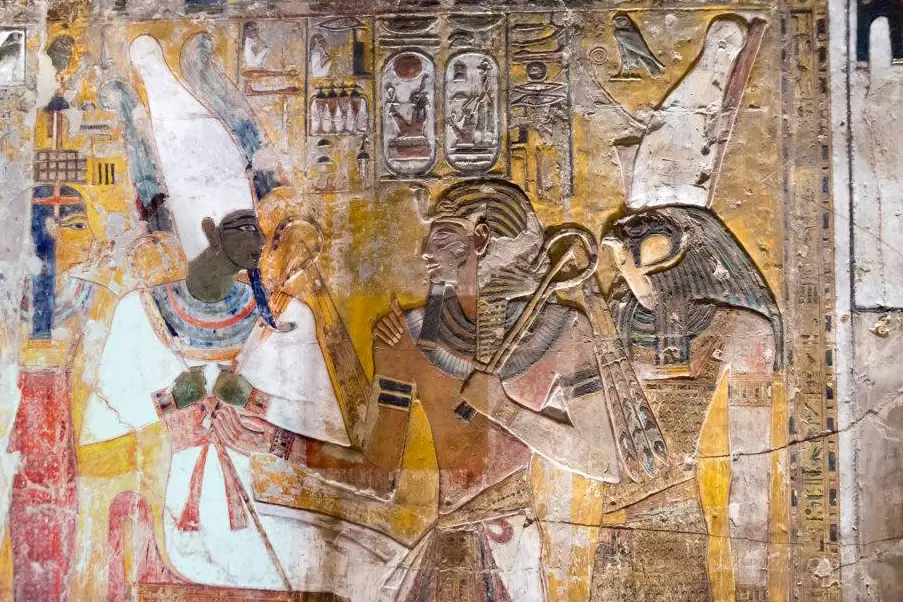
When archaeologists enter a chamber carved into the desert rock that has been sealed for three thousand years, they see walls that still shine with bright blues, greens, and reds. These colors have not faded or crumbled. They look as fresh as the day they were painted. This discovery happens often in ancient Egyptian tombs, raising an interesting question: how did they achieve this?
The answer is not magic. It comes from careful craftsmanship, the chemistry of minerals, spiritual beliefs, and a creative process that is surprisingly human. The painting techniques used by tomb artists in ancient Egypt were advanced, organized, and designed to last through time.
Why Egyptians Painted Their Tombs: Art as a Spiritual Lifeline
To understand how the tombs were painted, it’s important to know why they were created. These paintings were not just for decoration to impress visitors. Many chambers were sealed immediately after the burial and were never intended to be seen by the living.
The paintings served the dead. Ancient Egyptians believed that images had power. For example, a painting of the deceased enjoying a feast, hunting, or doing daily activities could help those experiences happen in the afterlife. Painted food provided nourishment. Painted servants offered assistance. Painted weapons gave protection. The tomb was a carefully planned eternal life, brought to life with colors on stone.
The artwork followed the idea of Ma’at, which means cosmic order and truth. This idea changed over different dynasties. The 18th Dynasty featured lively scenes of daily life, while the 19th Dynasty focused more on formal religious images. However, the main purpose remained the same: to help the soul of the deceased live well forever.
Who Were the Tomb Artists? The Skilled, Anonymous Craftsmen
Even though Egyptian tomb painters did excellent work, they were not well‑known. They were skilled craftsmen who usually did not sign their work. They worked in guilds or state‑run workshops, where their personal identities were less important than the art itself.
A key site that helps us learn about their lives is Deir el‑Medina (opens in new tab), a village near Luxor on the west bank of the Nile. This village housed the artists who created the royal tombs in the Valley of the Kings (opens in new tab). Excavations have found records, letters, and even documents about labor strikes, giving us a close look at the lives of these artists.
In each workshop, everyone had a clear role. Draftsmen made the designs, senior painters made corrections, and color specialists added the paint to large areas. Contrary to the common belief that Egyptian art was strict and unchanging, modern science shows a different picture.
Using portable X‑ray technology, researchers found proof that artists made significant changes during the painting process. For example, in the Theban Necropolis, a portrait of Ramesses II showed an earlier version underneath with a shorter crown, a different scepter, and a changed necklace. In the Tomb of Menna (opens in new tab), a ‘phantom arm’ revealed a pose that was reconsidered and repainted. These artists did not follow a strict formula. They revised and rethought their work, just like artists have always done.
Preparing the Canvas: How Tomb Walls Were Made Ready for Paint
Before artists could begin painting, they had to prepare the raw limestone or sandstone walls of a tomb. This process was careful and is a key reason why the paintings have survived over time.
First, they filled in any rough spots in the rock with a thick mud plaster mixed with chopped straw for strength. Next, they added a finer layer of white plaster, often made from gypsum or calcium carbonate, which created a smooth, bright surface for the paint. Sometimes, they also applied a final whitewash coat before starting the color work.
Egyptian tomb painting used a technique called fresco a secco, which means the paint was applied to dry plaster instead of wet plaster. This is different from the Italian Renaissance technique, where pigments mix into wet plaster and bond as it dries. Instead, Egyptian painters added an adhesive, like gum arabic or sometimes egg white, into their paint. They often finished the painting with a layer of varnish or resin, which helped protect the artwork over the centuries.
The Grid System: Ancient Egyptian Proportion and Layout
Artists did not start painting right away after preparing the surface. Instead, they used a smart system called the grid, which has been used since ancient times. They stretched cords soaked in red pigment across the wall and snapped them to create straight lines, similar to using a chalk line. This grid generated a series of horizontal and vertical guidelines.
These grids helped artists accurately copy a small, detailed sketch onto a large wall without distortion. They also enforced strict rules about proportions that were important in Egyptian art. During the Old and Middle Kingdoms, a standing figure was measured across 18 grid squares, from the bottom of the feet to the hairline. Later, in the Late Period, this number changed to 21 squares. This strict system was not just about looks; it was about spiritual correctness. Figures needed to be whole and properly shaped to serve their purpose in the afterlife.
Egyptian Pigments: The Colors That Conquered Time
Egyptian tomb paintings have lasted a long time because of the pigments used. Most of these pigments come from minerals, making them stable, resistant to fading, and less affected by environmental changes that can ruin organic dyes.
Each color had its own symbolic meaning. White, made from gypsum or calcium carbonate, stood for purity. Black, created from carbon soot or charcoal, paradoxically represented fertility and the life‑giving power of the dark Nile floodplain. Red and yellow came from iron oxide ochres: red symbolized power and danger, while yellow represented the warm sun. Blue, one of the most famous Egyptian colors, was made from azurite or a special synthetic compound known as Egyptian Blue, which is one of the first synthetic pigments in the world. Green, made from malachite, signified rebirth and was linked to Osiris, the god of the dead. A bright golden yellow came from orpiment, an arsenic sulfide mineral that had an almost glowing quality.
Artists ground the pigments in stone mortars, mixed them with water, and added an adhesive to create paint similar to modern tempera. They applied the colors in a careful, layered method—one color per scene before adding the next. This approach helped keep the colors consistent over large wall surfaces.
The Step‑by‑Step Tomb Painting Process
The process of painting ancient Egyptian tombs was a complicated and well‑coordinated craft. It began with preparing the surface using mud plaster, fine plaster, and whitewash. Next, artists made a grid in red pigment on the wall. A draftsman drew the basic design in red paint, including figures, scenes, and hieroglyphics, using smaller sketches for reference. A senior artist then reviewed this draft and made changes in black to improve proportions and poses.
Once the design was approved, painters filled in each color across the designated areas, completing one color at a time. They added details and outlines in black at the end. In tombs with raised or sunk relief work, sculptors carved the figures into the wall before the painting began. The painters then colored the carved figures. Overall, decorating a single tomb chamber could take years of coordinated effort.
Art Built for Forever — and What It Tells Us
Ancient Egyptian tomb artists used impressive painting techniques that stood the test of time. They selected durable mineral pigments and created stable plaster layers. The dry climate helped to seal and preserve their work. As a result, these images have survived for over 3,000 years.
What stands out most is the human story behind these walls. The artists made mistakes and corrected them. They changed their ideas while working. They toiled in small, dark rooms, inhaling dust and pigment, driven by the belief their art mattered — that it could support a human soul for eternity.