
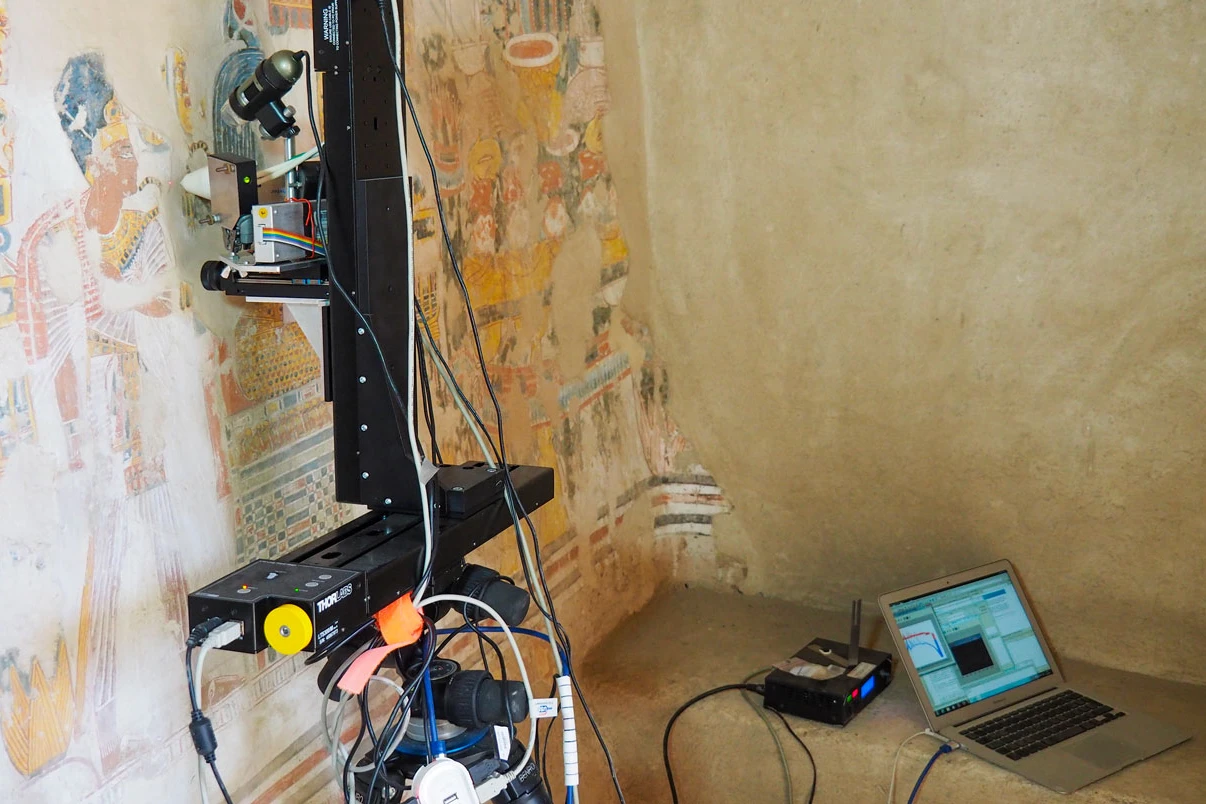
In the past, exploring these tombs involved using pickaxes, brushes, and considerable guesswork. Today, that same researcher is more likely to use a laser scanner or look at radar images on a laptop. The tools have dramatically changed, along with what researchers can do.
Rising groundwater, salt damage to the painted plaster, humidity from visitors, and the passage of time all threaten these monuments. This urgency has led to a new approach in studying them: record everything and damage nothing.
From Pickaxes to Pixels: A Brief History of Egyptology in Luxor
In the early 1800s, Napoleon’s scholars began drawing the ruins of Thebes. They only used what they could see and touch. Their records were impressive for the time, but they were often incomplete and sometimes wrong. When Howard Carter opened Tutankhamun’s tomb in 1922, he documented everything carefully, setting a new standard. Still, his work was limited by what people could see and photograph.
A key change happened when researchers realized that digging up sites changes them forever. Once something is excavated, its context is lost. This shift in thinking — from merely finding artifacts to truly understanding them — led to the use of modern technology that allows for less disruptive study. Today, this approach defines how Egyptologists work in Luxor.
3D Laser Scanning and LiDAR: Mapping Every Millimeter
One of the most important technologies used in Luxor’s tombs is LiDAR, which stands for Light Detection and Ranging. This technology uses portable 3D laser scanners that send out pulses of light and measure how long it takes for each pulse to return. It can gather up to 100 million data points for every square meter. This creates a detailed digital model of a tomb’s interior, capturing every groove, crack, and chisel mark.
Using this technology, a replica of Tutankhamun’s burial chamber was made. The replica includes details like plaster chips and even patches of fungus from the ancient wet plaster. Now, visitors can explore the tomb without harming the fragile original, which is protected from many visitors. Researchers plan to use the same technology for other endangered sites in Luxor’s West Bank. They are also looking into virtually reassembling tombs, like the Tomb of Seti I, which have pieces scattered in museums around the world.
Ground-Penetrating Radar: Seeing Through the Sand
No technology has generated more excitement in Luxor than ground-penetrating radar (GPR). This tool sends electromagnetic pulses into the ground and measures the signals that return. It creates a map of hidden chambers, passages, and voids without disturbing the soil.
In 2015, archaeologists scanned Tutankhamun’s tomb with radar, hoping to find a hidden chamber. This idea came from British Egyptologist Nicholas Reeves, who suggested that Queen Nefertiti might be buried in a secret room behind the walls. The results were unclear, but the search continued. A team from Politecnico University in Turin planned another investigation using tomography, the same method found in medical scans, along with magnetometry. Magnetometry measures underground magnetic fields to find unusual patterns.
Ground-penetrating radar has already found several promising sites in the Valley of the Kings where undiscovered tombs may still be hidden. This shows that even one of the most explored areas in the world still has secrets.
CT Scans and X-Ray Technology: Looking Inside Mummies
Researchers can now study mummies without unwrapping them. They use CT scanning, the same technology found in hospitals, to look inside the wrapped mummies. This method gives Egyptologists detailed information about a mummy’s age, health, diet, bone structure, and cause of death without any physical contact. Mummies found near Luxor have been studied this way, providing data that invasive methods could not have gathered.
One impressive example of non-invasive analysis is the ancient prosthetic toe found at the necropolis of Sheikh Abd el-Qurna on Luxor’s west bank. By using microscopy, X-ray, and computer tomography, researchers discovered that this wooden prosthetic had been adjusted multiple times during its owner’s life, making it one of the oldest working prosthetics ever identified. No cutting or chemical treatment was needed—just light and data.
Digital Epigraphy: Preserving Hieroglyphs Before They Vanish
Luxor’s tomb walls have some of the most detailed painted inscriptions created by humans. Preserving these inscriptions is urgent. Digital epigraphy, which means recording these texts accurately, has improved with tools like Reflectance Transformation Imaging (RTI). RTI takes pictures of objects under different angles of light, revealing details that are not visible to the naked eye. Multispectral imaging helps uncover faded or covered inscriptions by capturing light wavelengths that we cannot see.
The University of Chicago’s Epigraphic Survey, located at Chicago House in Luxor, has been documenting Egyptian inscriptions for over a hundred years. They use a careful process that combines photography, hand drawing, and expert review. Today, digital tools enhance their work, allowing researchers to compare thousands of inscriptions at once across large shared databases. Egyptologists call this a true breakthrough for their field.
To learn more about reading these ancient texts, see our guide to Ancient Egyptian Hieroglyphs.
Drones, AR, and What Comes Next
Drone technology has greatly changed archaeology in Luxor. Drones equipped with high-resolution cameras fly over the Theban Necropolis. They take thousands of aerial photos and combine them to create detailed 3D models using a method called photogrammetry. These models allow researchers and the public to virtually explore tombs, showcasing their impressive architecture and the damage from desert flooding and years of erosion. Aerial surveys also help teams find unknown tomb shafts and plan their excavations better.
Augmented and virtual reality tools are further enhancing preservation efforts. Researchers are creating digital replicas of entire tomb complexes, showing how they looked when first sealed, with bright colors and clear inscriptions. These replicas engage the public but also help researchers test ideas about rituals, decoration, and space without disturbing the actual sites.