
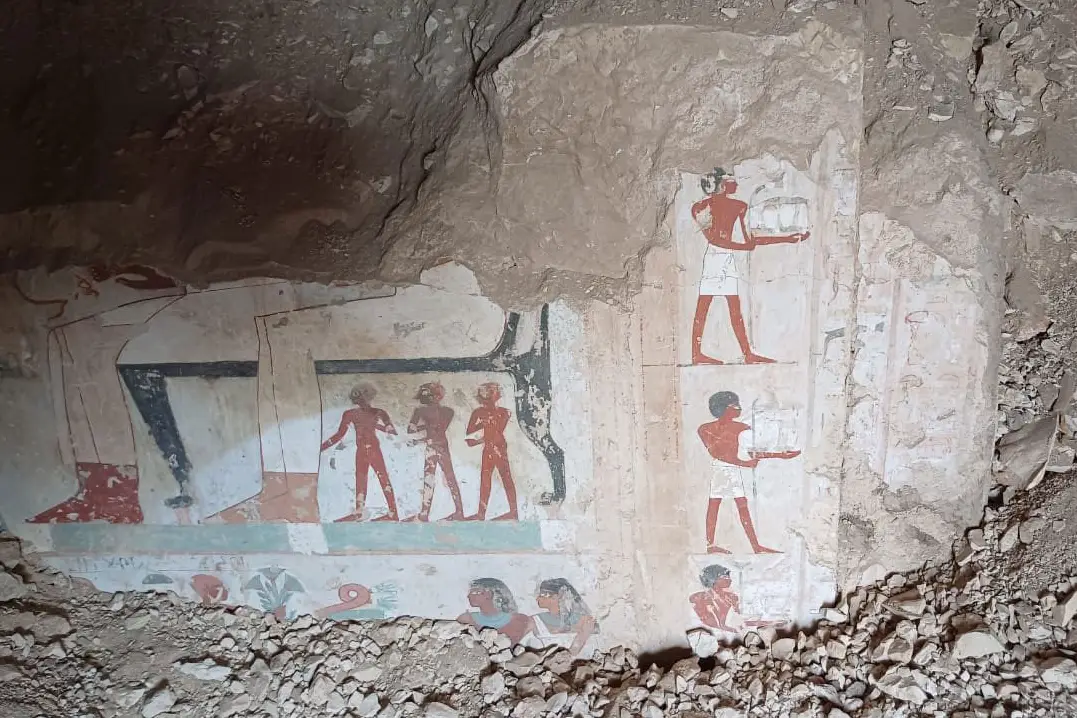
A national mission from the Ministry of Tourism and Antiquities announced the discovery of three ancient tombs at the Dra Abu el‑Naga necropolis (opens in new tab). This site is one of the most famous burial grounds in the ancient world. The tombs date back over 3,000 years to the New Kingdom period (c. 1550–1070 BCE) and were found near the well‑known Valley of the Kings (opens in new tab). What makes this discovery exciting is that these tombs do not belong to a pharaoh. They belonged to important figures who helped run Egypt, such as administrators, scribes, and logistical overseers. For the first time, we now know their names, which had been buried under centuries of sand.
Dra Abu el‑Naga: What It Is and Its Importance
Dra Abu el‑Naga is a busy burial site located in the limestone hills on the west bank of Luxor, Egypt. It is right across the Nile from the famous temples of Karnak (opens in new tab) and Luxor (opens in new tab), and is close to the Valley of the Kings and the Valley of the Queens (opens in new tab). This site historically served for high‑status burials linked to temples and palace officials—not for royalty but for those who helped carry out royal wishes.
This site has been providing amazing discoveries for nearly 200 years, and it continues to do so. A notable find in 2025, led by Egyptian archaeologists, adds new insights into the lives of ancient Egyptians.
The Discovery: A Proud Moment for Egypt
Sherif Fathy, the Minister of Tourism and Antiquities, praised this find as a cultural achievement that showcases Egypt’s role as a global tourist destination. He stated that these tombs give us a glimpse into the lives and beliefs of important figures in ancient society.
This discovery is significant because it highlights a shift in leadership for excavations. Unlike many previous digs, which were mainly led by foreign teams, this excavation was entirely conducted by Egyptian archaeologists under the Ministry of Tourism and Antiquities. Dr. Abdel Ghafar Wagdy, the Director General of Luxor Antiquities, led the effort. The announcement of the discovery took place on May 26, 2025, and quickly gained international attention.
Mohamed Ismail Khaled, the Secretary‑General of the Supreme Council of Antiquities, pointed out that further analysis of the tombs’ inscriptions is needed to better understand who the tomb owners were. This means the work is just beginning.
Meet the Three Men Buried at Dra Abu el‑Naga
This story focuses on three men from ancient Egypt, each with different jobs and tombs. Their lives show how a civilization relied on both skilled workers and powerful leaders.
Amun‑em‑Ipet — The Temple Estate Servant (Ramesside Period, c. 1295–1186 BCE)
Amun‑em‑Ipet lived during the 19th Dynasty and worked at the temple of Amun, a key god in Theban religion. His tomb has a small courtyard leading to a square hall with a damaged niche at the end. Many decorations have been lost over time, but some paintings still show a funerary procession and a banquet, common at the Beautiful Festival of the Valley. The tomb’s niche was later changed when someone created a new hall by breaking through the western wall. This suggests that someone thought the tomb was worth reopening, raising questions about the political and social situation at that time. Researchers are investigating this.
Baki — The Grain Silo Supervisor (18th Dynasty, c. 1550–1292 BCE)
Baki’s job was more important than it sounds. As the grain‑silo supervisor, he played a key role in the temple’s economy since grain was crucial for feeding priests, workers, soldiers, and officials. Baki’s tomb includes a long courtyard and an entrance to a transverse hall and a longitudinal hall, which ends with an unfinished chapel and a burial shaft. Inscriptions in his chapel confirm his name and role, helping archaeologists date the style of the architecture and paintings.
“S” — The Multi‑Titled Administrator (18th Dynasty)
The most fascinating of the three is a man called “S.” He was a scribe and supervised the Temple of Amun in the oases while also serving as the mayor of the northern oases. His work linked him to Egypt’s desert regions, where he managed resources, trade routes, and security. His tomb is simpler, starting with a small courtyard and burial shaft, then a transverse hall connects to an unfinished longitudinal hall. This simplicity contrasts with the complexity of his roles. The unfinished burial chambers raise questions: Did he die unexpectedly? Was the construction stopped? These questions make archaeology feel more like detective work.
What the Tombs Tell Us About New Kingdom Egypt
The three men buried in these tombs were important figures, not just ceremonial ones. The writing found inside the tombs includes useful information, not just symbols. Each title and role recorded helps us understand how the state operated. These men played key roles in managing religious estates, regional tax systems, and administration between different oases.
Together, the three tombs give us a unique look at how New Kingdom Egypt functioned. We see it from the mid‑level down, through the lives of those who put pharaoh’s commands into everyday actions.
Signs of Later Use: Layers of History
One of the most interesting findings from the 2025 discovery is how these tombs were used after their original owners were buried. Many tombs in Dra Abu el‑Naga show signs of reuse. This often means changes to the structure, damage to decorations, or major rebuilding. Researchers are studying these later uses along with the new findings to see how burial practices changed during unstable times.
These tombs show us how ancient Egyptians repurposed spaces across centuries. They remind us that even sacred places were affected by historical events.
What Comes Next for These Tombs
The work on these tombs is not finished. The team will continue to clear debris and stabilize surfaces, making it easier to read the inscriptions. This careful process will allow them to check titles, map paint layers, and record damaged areas for conservation.
Mohamed Ismail Khaled emphasized that further study of the inscriptions will enhance our understanding of the tomb owners and their historical context. He also highlighted Egypt’s dedication to sharing scientific findings, ensuring that these discoveries increase appreciation for Egypt’s archaeological treasures.