
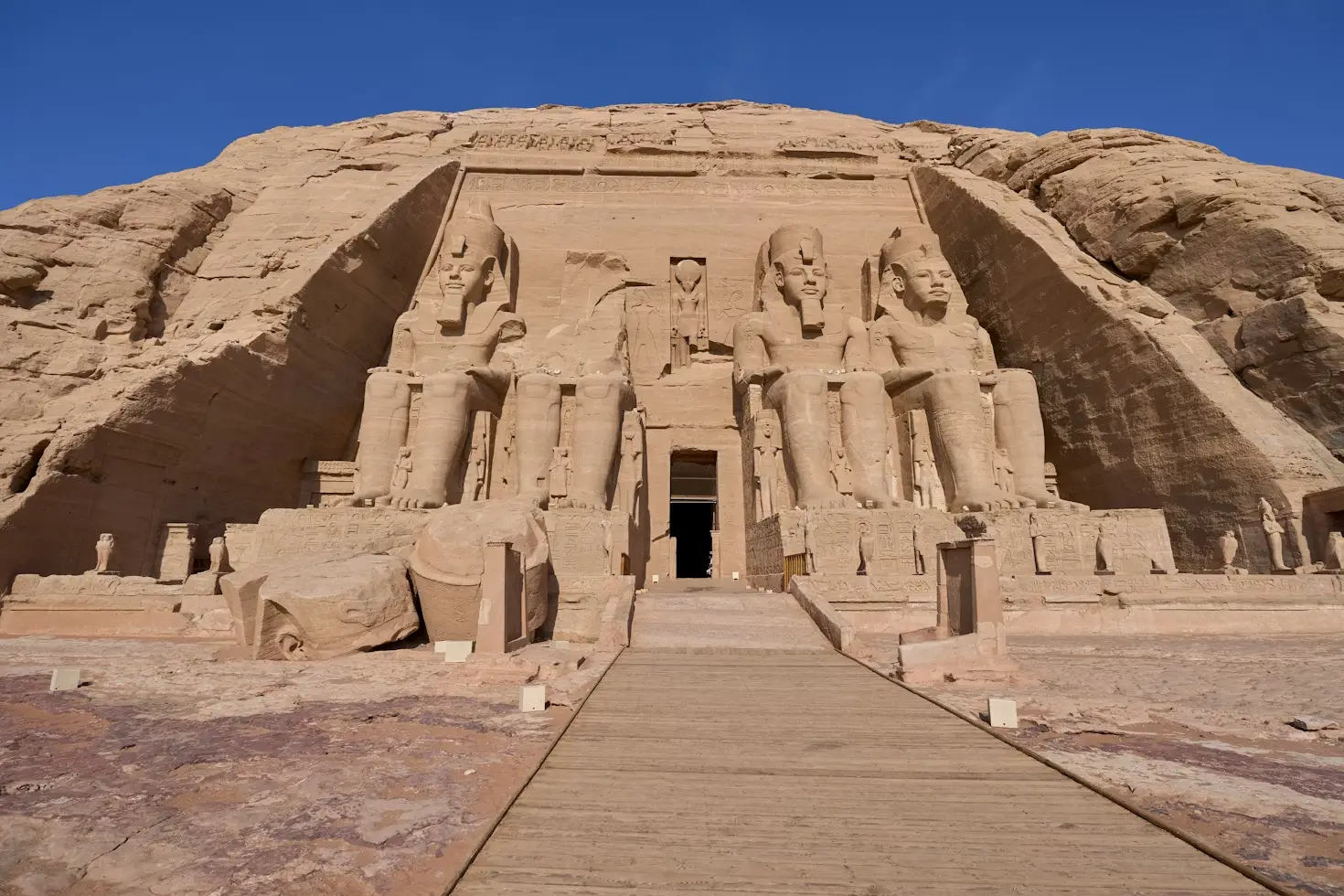
As you approach Abu Simbel, four massive stone faces, each taller than a four‑story building, slowly appear before you. No photograph can prepare you for this moment. Abu Simbel is a place that makes you feel you are standing somewhere truly special. If you are in Luxor and wondering if the long trip south is worth it, the answer is a resounding yes.
Who Built Abu Simbel, and Why?
Abu Simbel is the greatest architectural work of Ramesses II, Egypt’s most famous pharaoh, who ruled for 66 years during the 19th Dynasty (1279–1213 BC). Known as Ramesses the Great, he was a warrior and a diplomat, and he promoted himself relentlessly. He built more statues, temples, and monuments in his honor than any other pharaoh.
Ramesses II built Abu Simbel for two primary reasons: to commemorate his military victory at the Battle of Kadesh and to demonstrate Egypt’s power over the Nubian people to the south. The complex is carved into a sandstone cliff on the western bank of the Nile. It also honors his beloved wife, Queen Nefertari, a rare gesture that highlights the strength of their relationship. In ancient Egypt, building a temple to honor your queen as a goddess was the highest honor a pharaoh could give.
A History Written in Stone (and Almost Swallowed by Water)
Construction of the two temples began around 1264 BC and was completed about 20 years later. Over the centuries, sand from the desert slowly covered the temples until they were almost completely buried and forgotten by the outside world. In 1813, Swiss scholar Johann Ludwig Burckhardt discovered the top of the temple facade peeking out from the dunes, which sparked great interest in archaeology.
The most dramatic event for the temples occurred in the 1960s when the Egyptian government built the Aswan High Dam. The rising waters of Lake Nasser threatened to cover Abu Simbel forever. In an impressive engineering project, UNESCO and the Egyptian government worked together to rescue the temples between 1964 and 1968. They cut the temples into about 16,000 numbered blocks and rebuilt them on higher ground, 65 meters above and 200 meters back from their original location. Today, it’s hard to tell that they were moved, thanks to the remarkable precision of the work.
The salvage of Abu Simbel is considered one of the greatest archaeological rescue operations in history. It remains a symbol of international cooperation to preserve cultural heritage.
What You’ll Actually See at Abu Simbel
The Great Temple of Ramesses II is a popular attraction that certainly impresses visitors. The front of the temple has four giant statues of Ramesses II, each about 20 meters tall, with smaller statues of his family nearby. Above the entrance, you can see the sun god Ra‑Horakhty. Along the top of the temple, there is a row of 22 carved baboons, which are thought to greet the rising sun.
Inside, the hypostyle hall features eight Osiris‑form statues of Ramesses, and the walls are decorated with detailed reliefs showing the Battle of Kadesh, full of energy. Further inside, the innermost sanctuary has four seated gods: Amun‑Ra, Ra‑Horakhty, Ptah, and a deified Ramesses II. Twice a year, on February 22nd and October 22nd, the rising sun shines through the temple and illuminates three of the four statues, leaving only Ptah, the god of the underworld, in shadow. These solar events attract large crowds and are considered magical moments in Egypt.
The Small Temple of Queen Nefertari, which is a short walk away, is more impressive than its name suggests. Its front features impressive statues of both Ramesses and Nefertari, which are the same height, showcasing equality in a society that usually values hierarchy. Inside, the Hathor sanctuary displays delicate reliefs that are among the best examples of New Kingdom art.
How to Get to Abu Simbel from Luxor
When planning a visit to Abu Simbel, consider that it’s about 480 km south of Luxor. The most efficient route is to fly from Luxor to Aswan, then take a 45‑minute EgyptAir flight to Abu Simbel airport, which operates twice daily. For those on a Nile cruise, a 5‑day Luxor‑to‑Aswan cruise allows you to book an Abu Simbel excursion from Aswan, providing comfort and scenic views along the way. Alternatively, a Lake Nasser cruise offers a unique experience, mooring near the temples and visiting lesser‑known sites. If you prefer land travel, the road from Aswan is open from 5 AM to 5 PM. Just remember to bring your passport, water, sunscreen, and snacks for the journey.
For a comprehensive itinerary that combines Luxor, Aswan, and Abu Simbel, see our guide on Luxor and Aswan and GEM to Luxor travel options.
Best Time to Visit: Seasons, Timing & the Solar Festival
The best time to visit Abu Simbel is from October to April, when the weather is milder in this remote desert area. If you can visit on February 22nd or October 22nd, you can enjoy the solar alignment festival, which has a festive atmosphere but also brings larger crowds. Be sure to book your accommodation and transportation early for those dates.
For a great experience, arrive right when the site opens at 6:00 AM. Many tour groups visit Abu Simbel in the morning and then go to the Temple of Isis at Philae in the afternoon. This makes the time between noon and 2 PM especially busy at both places. By arriving early, you can enjoy the giant statues in the beautiful morning light without the crowds.
Practical Information Before You Go
Abu Simbel is open every day from 6:00 AM to 5:00 PM. Plan to spend about 90 minutes to explore both temples comfortably, but photography lovers might want more time. You can take photos outside for free, but if you want to take pictures inside the temples, you need to buy an additional photography pass. Dress in light, breathable clothes because the desert heat can be very intense, and you must protect yourself from the sun.
If you plan to stay overnight, the evening Sound and Light Show happens three times: at 6:00 PM, 7:00 PM, and 8:00 PM. Flying to Abu Simbel, staying overnight, and visiting early the next morning is one of the best ways to see the temples without crowds. Many tourists do not take this opportunity, but it is worth considering. For more practical tips on visiting Egypt, see our visa and passport guide and what to wear in Egypt.
Is Abu Simbel Worth the Journey from Luxor?
Abu Simbel is more than just a tourist spot; it is a true marvel of human achievement. These temples have endured 3,300 years of history, survived being buried in desert sand, almost drowned by a lake created by humans, and were then cut apart and reassembled by a team of engineers from different countries. The fact that these temples still stand today, perfectly aligned with the sun and well‑preserved in the Nubian heat, is truly impressive.
For travelers based in Luxor, adding Abu Simbel typically requires at least two extra days, but the effort is rewarded with one of Egypt’s most awe‑inspiring sights. Whether you fly directly from Luxor or combine it with a Nile cruise and an Aswan extension, the journey becomes a highlight of your Egyptian adventure. For a complete comparison of travel options, check our guide on Luxor vs. Aswan to help you plan.