
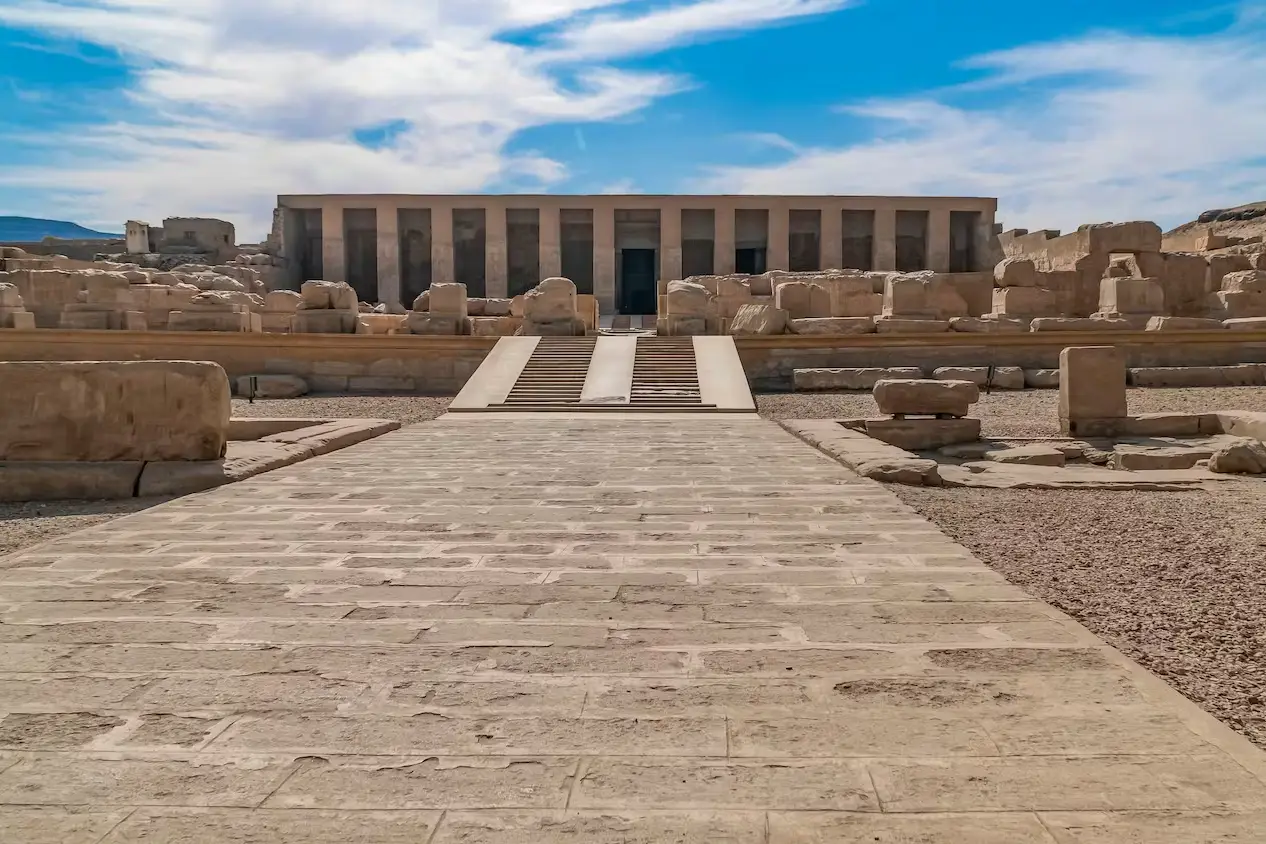
Standing inside the Temple of Seti I at Abydos, there’s a moment that captures your attention. The colors on the walls—rich blues, terracotta reds, and leafy greens—were painted more than 3,000 years ago, yet they appear so vivid that they look freshly applied. A hawk‑headed god receives offerings from a pharaoh, while Isis stretches her wings. You suddenly realize, almost with a jolt, that virtually no one else is here—just you and some of the finest ancient art ever created.
That is the magic of Abydos, making it one of Egypt’s best‑kept secrets.
What Is Abydos? Egypt’s Most Sacred Ancient City
Abydos, known in ancient times as Abdju, is about 160 km north of Luxor, near the town of El‑Balyana in Upper Egypt. Its name means “Hill of the Temple.” For thousands of years, it truly lived up to this name. Abydos was the center for the worship of Osiris, the god of the afterlife. Ancient Egyptians believed the head of Osiris was buried here, making it the nearest place to the land of the dead.
The city dates back to before the dynasties, before the pyramids, and even before the great pharaohs. It served as the royal burial site for Egypt’s earliest kings. Over many years, it became the most important pilgrimage site in Egypt. Just like Mecca is for Muslims, every ancient Egyptian felt they should visit Abydos at least once in their life. To be buried here or to have a symbolic monument nearby was the greatest spiritual honor.
The Top Things to See at Abydos
The Temple of Seti I — The Crown Jewel of Abydos
The Great Temple of Abydos was built around 1290 BC by Pharaoh Seti I of the 19th Dynasty and completed by his son, Ramesses II, after Seti I died. This temple is the main attraction of the site and is unique in Egypt because of its L‑shaped floor plan. One interesting theory suggests that Seti I changed the original design mid‑build after discovering the Osireion, which was buried beneath the foundation.
Inside, the temple contains seven sacred chapels for different gods: Osiris, Isis, Horus, Amun‑Ra, Ra‑Horakhty, Ptah, and even Seti I himself. As you walk through the temple, you can see a clear change in artistic style between father and son. Seti I preferred elegant raised relief artwork, while Ramesses II liked bolder sunk relief. This difference is easy to spot once you know what to look for.
Many Egyptologists consider the reliefs in this temple to be the best in all of Egypt. The walls and ceilings are covered in vibrant colors that have lasted thousands of years. These images tell stories of kingship, divine ceremonies, and resurrection in a way that is much more personal than the more famous temples at Karnak.
The Temple of Seti I at Abydos contains the famous “Abydos King List,” a chronological list of 76 pharaohs that is one of the most important sources for reconstructing Egypt’s ancient history.
The Abydos King List — History Carved in Stone
Tucked away in the Hall of Records is a very important artifact from the ancient world: a list that names 76 pharaohs, starting with Narmer from the First Dynasty and ending with Seti I. This “king list” is crucial for Egyptologists as it helps them piece together Egyptian history. However, it is also interesting for what it leaves out. Pharaohs seen as illegitimate or controversial, like Hatshepsut, the female pharaoh, and Akhenaten, the king who changed Egypt’s gods, were left off the list. This shows that history is often written by those in power.
The Osireion — Egypt’s Most Mysterious Structure
Beneath the Temple of Seti I is the Osireion, a structure that has confused archaeologists for over a century. Built with large granite blocks, it looks more like Old Kingdom architecture than New Kingdom construction. The Osireion was created as a symbolic tomb for Osiris, serving as a grand cenotaph. Its central island is surrounded by a channel that used to be filled with water, representing the ocean of creation. This design connects to the Osiris resurrection myth. The structure often has water in it, which can limit access. Even viewing it from the entrance is a powerful and unforgettable experience.
Umm el-Qa’ab — The Cemetery of Egypt’s First Kings
A short walk from the main temple complex, the ancient necropolis of Umm el‑Qa’ab (“Mother of Pots”) holds the burial tombs of Egypt’s earliest rulers. Ongoing excavations have uncovered important finds, such as inscribed ivory tags, pottery, and royal seal impressions that help us learn more about Egypt’s origins. Recently, archaeologists discovered the tomb of Queen Merytneith, one of Egypt’s first female rulers, adding new details to the site’s remarkable history.
Getting to Abydos from Luxor: Your Transport Options
Abydos is about 160 km north of Luxor, so visiting it takes a full day. Here are the main ways travelers get there:
- Private car with driver: This is the most comfortable choice. It takes about 2.5 to 3 hours each way, and you can stop whenever you want.
- Organized day tour: This is the most common option. A good tour includes a licensed guide, an air‑conditioned vehicle, and entry fees. Prices for private tours range from $80 to $150 USD per person, depending on the group size.
- Public transport: You can take a train to El‑Balyana and then a local taxi or microbus. However, it is tricky to handle police checkpoints and rural roads if you are a first‑time visitor.
One important thing to note: The road to Abydos has several security checkpoints. Tourist vehicles may get a police escort for part of the trip. This is normal in Upper Egypt and is meant to keep travelers safe on longer drives.
A Suggested Itinerary for Your Abydos Day Trip from Luxor
Abydos rewards visitors who focus on it fully. The site is bigger and more impressive than many expect. The 160 km drive from Luxor means you should plan your day carefully to make the most of your visit.
Here’s a suggested itinerary:
- 6:30–7:00 AM — Depart Luxor. An early start helps you avoid the heat and the few tour groups that visit.
- ~10:00 AM — Arrive at Abydos. Start with the Temple of Seti I while you still have energy.
- ~12:00 PM — Walk to the Osireion and take time to enjoy its eerie underground atmosphere.
- ~1:00 PM — Have a picnic lunch on‑site or take a short drive to El‑Balyana for a local meal.
- ~2:00 PM — Explore Umm el‑Qa’ab, the early dynastic tombs, at a relaxed pace.
- ~3:30 PM — Begin the drive back to Luxor.
- ~6:00–6:30 PM — Arrive back in Luxor.
Taking your time at Abydos lets you enjoy the painted reliefs and listen to your guide explain the scenes in the seven sacred chapels without feeling rushed. You can also walk through the necropolis at the pace of ancient pilgrims who made this journey on foot. For a site with such depth and historical significance, it deserves that kind of time and attention.
The light inside the Temple of Seti I is best in the morning, when the sun streams through the doorways and illuminates the reliefs. Arriving around 10 AM gives you both good light and a cooler temperature before the midday heat.
For those planning a longer stay, consider combining Abydos with the magnificent Temple of Hathor at Dendera — both sites can be visited in a single long day trip from Luxor. Luxor and Aswan. However, Abydos alone deserves a full day to truly appreciate its artistry and spiritual significance.