
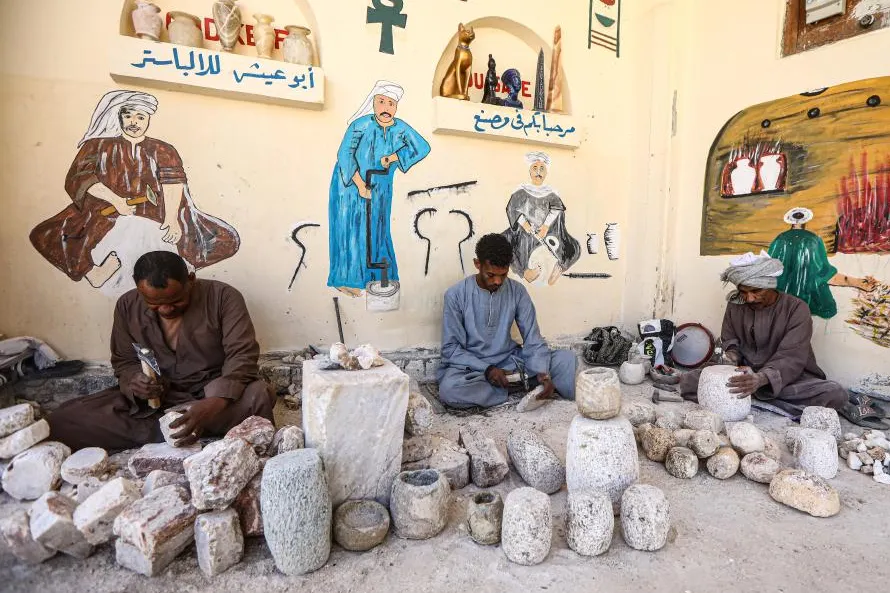
When you visit an alabaster workshop on Luxor’s West Bank, you first hear the sound of chiseling. Skilled craftsmen chip away at stone, creating a steady rhythm in the warm Egyptian air. Fine dust fills the air as they work. The artisans have practiced these techniques since childhood, long before they learned to read. On the shelves behind them, you can see many vases, lamps, and pharaoh figurines that shine like sunlight. This process is not just for tourists; it is an ongoing tradition that has existed for about 5,000 years.
What Exactly Is Egyptian Alabaster?
Before you attend a workshop, it’s important to understand what alabaster really is. Unlike the gypsum‑based alabaster found in Europe, Egyptian alabaster is made of calcite, a type of crystalline limestone that is quarried from the mountains and cliffs near Luxor. Its unique feature is its translucency: when you hold a well‑carved piece up to the light, it glows warmly from within.
The natural colors range from creamy white and honey gold to amber and soft rust, with each piece having its own patterns. This stone is soft enough to carve with precision, yet durable enough to last for thousands of years. Its beauty is so striking that the ancient Egyptians considered it sacred. This combination of easy carving, lasting durability, and stunning beauty is why artisans still carve alabaster in Luxor today.
A Stone Fit for Pharaohs: 5,000 Years of History
The ancient Egyptians valued alabaster highly. They used it with great care, considering it a sacred material. Archaeologists have found stone vessels from the Badarian and Naqada cultures, which existed before the pyramids. These vessels were luxury items, placed in tombs and filled with perfumes, oils, and offerings for the dead. By the time of the New Kingdom pharaohs, alabaster had a central role in royal rituals.
One of the most famous uses of alabaster was for canopic jars. These jars stored a pharaoh’s organs during mummification and had lids decorated with the four sons of Horus. When Howard Carter discovered Tutankhamun’s tomb (opens in new tab) in 1922, he found alabaster everywhere—canopic chests, ritual vessels, and other decorative items of great beauty. People believed this material had spiritual power.
The West Bank of Luxor, where the sun sets, was the ancient Egyptian necropolis, a city for the dead. Its connection to the afterlife made it a fitting place for the stone that helped pharaohs in their journey after death. Today, this area, between the Valley of the Kings (opens in new tab) and the temple of Hatshepsut at Deir el‑Bahari (opens in new tab), includes the village of El Qurna, where the craft of working with alabaster has continued without interruption.
El Qurna and the West Bank Workshops
El Qurna is a group of villages where you can find Luxor’s famous alabaster products. Today, around 80 workshops operate on Luxor’s West Bank. Many of these workshops are family‑run, with fathers teaching their sons the craft for generations.
One well‑known example is the Hapi Workshop, owned by the Elhofni family. Ahmed Ali Mohammed Elhofni, who is the eighth generation in his family to work there, says, “My family has been making alabaster pieces since the late 1700s, but this craft goes back to the time of the pharaohs. We opened Hapi at its current location in 1992.” Eight generations and continuous workshops since 1910 show a strong family heritage.
Nearby, Imhotep Alabaster is known as one of the most reliable workshops on the West Bank. Visitors often say it looks more like a small museum than a shop. Everything is handmade, using materials like alabaster, limestone, granite, and basalt. Workers outside the shop show how they drill into stone using traditional tools, and visitors sometimes get the chance to try it themselves.
From Raw Rock to Glowing Masterpiece: The Making Process
Watching a skilled artisan turn a rough limestone block into a beautiful vessel is one of the most impressive experiences in Luxor. The process includes the following steps, which craftspeople have used since pharaohs ruled:
- Squaring: The stone block is cut to the needed size for the piece.
- Shaping and turning: A carving machine with iron wings shapes forms like vases, while chisels are used for sculptures and three‑dimensional figures.
- Hollowing and reinforcing: For hollow vessels, a cotton cloth soaked in glue is wrapped around the piece. This helps absorb moisture and prevent cracks during hollowing.
- Smoothing: Iron tools and sandstone are used to refine the surface, removing tool marks and preparing it for the final finish.
- The oven: Pieces go into a heated oven for a time based on the type of product, which sets the stone.
- Waxing: A final coat of wax gives the piece its soft glow.
“This is not just a job but an art form,” says Gamal Mahmoud, a 61‑year‑old master craftsman with over 40 years of experience. “With careful precision, I carve alabaster into beautiful statues, elegant vases, and more.” A mistake during the hollowing stage can cause cracks that cannot be fixed.
The final pieces include replica canopic jars, classical vases, scarab beetles, sphinxes, pharaoh busts, Ankh symbols, and illuminated lamps. The lamp designs are particularly striking, as alabaster glows beautifully when lit from within.
How to Spot Authentic Alabaster (and Avoid Fakes)
The souvenir markets in Luxor have many imitation alabaster items made from painted plastic or cheap resin. Here’s how to tell real alabaster from fake:
- Hold it up to the light. Genuine calcite alabaster lets light pass through, giving it a warm, golden glow. Plastic or resin does not allow light to shine through in the same way.
- Feel the surface. Real hand‑carved alabaster feels slightly uneven and has natural variations in color. Machine‑made fakes are usually smooth and too perfect.
- Check the weight. Authentic alabaster feels solid and heavy. If a piece feels light, it may be a fake.
- Look for natural imperfections. Genuine stone has small internal veins, subtle color changes, and minor surface variations. These are signs of authenticity, not flaws.
- Ask the artisan. A proud craftsperson will easily explain how they made the piece. If a seller can’t explain it, consider walking away.
More Than a Souvenir
In some places, buying handmade items feels like just a transaction. But buying alabaster in Luxor is different — it feels like a connection to the past. This stone has come from nearby mountains for thousands of years. The craftsmen who shape it have learned their skills from generations before them, all the way back to the artisans who worked for the pharaohs.
When you take a piece home, place it on a windowsill where it can catch the light. Watch it glow. Remember that on Luxor’s West Bank, a craftsman is already cutting the next block of stone, just as they have done since before history was recorded.