The first time you hear it, it’s not a sales pitch — it’s just a shopkeeper on the main souk street, pouring hibiscus tea for a customer who hasn’t decided to buy anything yet. Down an alley behind him, someone is running a wet cloth over a half-finished alabaster bowl to show a tourist how the stone changes colour when it’s damp. Neither of them is in a hurry. That’s the rhythm of shopping in Luxor: less transaction, more conversation, with the sale arriving whenever it arrives.
Luxor’s shops sit in the shadow of some of the most famous monuments on earth, but the shopping itself has its own draw — alabaster workshops on the West Bank, family-run galleries tucked into century-old hotels, and a souk that’s been trading since long before “souvenir” was a word tourists needed. This guide covers where to go. For what’s actually worth buying once you’re there, see our Luxor souvenirs guide.
The Souks and Bazaars of Luxor
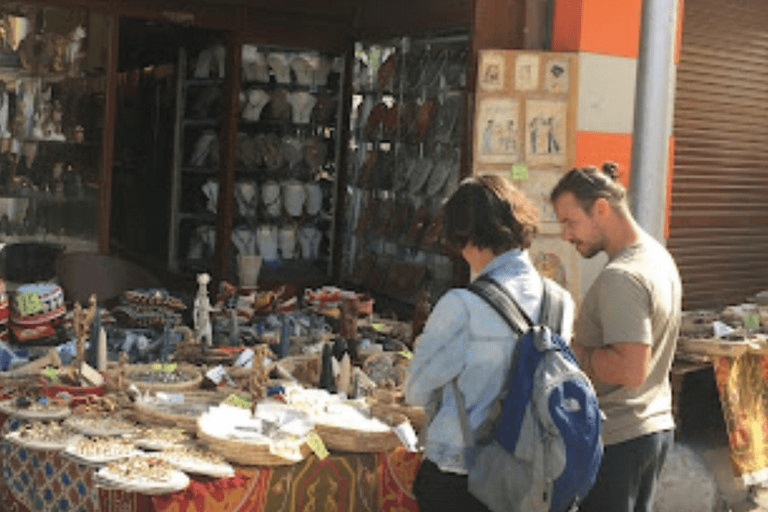
The main souk runs through the heart of the East Bank, and it still functions the way markets here always have — locals buying spices and household goods alongside stalls aimed at visitors. Scarves stack up by colour, brass lanterns hang three-deep from stall awnings, and alabaster figurines catch the light. Merchants call out in Arabic and English, usually just an invitation to look rather than a hard sell.
For the layout, the market’s three distinct sections, and how to navigate it without getting turned around, our dedicated Luxor Souk guide covers that ground in full.
Best Places to Shop in Luxor
1. Gaddis & Co.
Founded in 1907, Gaddis & Co. is one of the oldest shops in the city, and one of the few where staff can tell you the difference between a genuine antique photograph and a reprint. Worth a stop if you want something with real provenance rather than a shelf of identical trinkets.
2. Nobles Art Gallery
Set inside the historic Old Winter Palace Hotel, Nobles Art Gallery deals in statues, vintage jewelry, and Islamic bronze bowls and trays from the early 20th century — arranged in part inside the hotel’s Victorian-era room. Good for travelers after museum-quality pieces rather than market souvenirs (see the note on antiques and export rules below before you commit to anything described as ancient). Nobles Art Gallery
3. Ata Bazar
Right across from Luxor Temple, Ata Bazar is run by Osama and Hamada, who built the shop’s reputation on paying attention to what each customer actually wants rather than pushing a set script. The stock runs wide — antiques, clothing, textiles, accessories, figurines — at prices that don’t require a fight to get to fair. Its location makes it an easy stop between temple visits rather than a separate trip.
4. Shop Sandouk
“Sandouk” means treasure chest, and the shop opened in 2016 with a specific mission: fair-trade handicrafts made by artisans in Luxor and the surrounding villages, with owner Khaled selecting each piece himself. It’s less browse-and-buy, more sit-and-talk — tea is often part of the visit. If supporting the maker directly matters to you as much as the object does, this is one of the better bets in the city.
5. Caravanserai
On the West Bank, built in traditional mud-brick style, Caravanserai deals in pottery from the western oases, embroidered textiles, and handwoven scarves — regional work that doesn’t always make it into the East Bank stalls. Prices are reasonable and nobody rushes you. Caravanserai
6. Imhotep Alabaster
A West Bank workshop now run by the great-grandson of its founder, Imhotep Alabaster lets you watch artisans carve alabaster, wood, and faience into pieces ranging from close replicas of ancient designs to newer forms. If you want to see the work happen before you buy the result, this is the place — and if you want to know how to tell the real stone from a resin copy, our alabaster guide has the full test and price ranges.
7. Habiba Hand Weaving
Facing Hatshepsut’s Temple and the Valley of the Kings from the West Bank, Habiba specializes in scarves and shawls in Egyptian cotton, linen, and wool. Weavers work on-site most days of the week, so you can watch a scarf come off the loom rather than just off a shelf. The shop also carries machine-made pieces, so ask specifically for handwoven if that’s what you’re after. For more on the weaving and pottery traditions behind shops like this one, see our craft traditions guide.
8. Luxor Art Gallery
Across from the Colossi of Memnon on the West Bank, Luxor Art Gallery has shown work from more than 75 Egyptian artists since it opened in 2018 — original paintings, mixed media, and limited prints, with a regular calendar of exhibitions. It’s less a shop than a meeting point for local artists and visitors.
Shopping That Gives Back
A few Luxor shops are explicitly built around supporting local artisans directly rather than reselling through middlemen — worth knowing if that factors into where you spend. Shop Sandouk runs on a fair-trade model with a named local owner sourcing each piece. Habiba Hand Weaving and Imhotep Alabaster are both multi-generation family workshops where the person selling you the piece is often related to the person who made it. Buying from these isn’t just a nicer story — it more directly supports the craft traditions the city is known for.
Bargaining Like a Local
Haggling is expected in the souk, and it’s a social exchange more than a negotiation tactic — treat it that way and you’ll get better results and have more fun doing it.
- Start low, not insultingly low. Offering roughly half the first asking price is the standard opening move; you’ll usually land somewhere in the middle.
- Smile and take your time. A rushed or terse negotiation tends to go worse than an unhurried, friendly one — this is meant to feel like a conversation, not a standoff.
- Fixed-price shops exist too. Government-run outlets, most hotel boutiques, and some of the more established galleries (Gaddis & Co. among them) don’t expect bargaining. If prices are marked, that’s usually your signal.
- Walking away is a real move. If a price genuinely doesn’t work, thank the seller and start to leave — you’ll often get a better offer before you’re out the door. If not, that’s fine too.
- Cash gives you more room. Merchants are more flexible on price when you’re paying in Egyptian pounds than when you’re putting it on a card.
Money Matters: Cash, Cards, and Baksheesh
Cash rules the souk. Card machines exist in some of the larger shops and hotel boutiques, but market stalls overwhelmingly expect Egyptian pounds (EGP) — don’t count on tapping a card at a stall.
Get pounds from an ATM, not a street changer. ATMs are common in the East Bank near hotels and the Corniche, and their rates are standard and safer than informal exchange.
Baksheesh is part of the culture, not an insult. Small tips — for a demonstration at a workshop, help finding your way, or a bag carried to your taxi — are customary. A few EGP is generally enough; it’s a gesture, not a fee.
Rough price sense: small handicrafts and spices often run a few hundred EGP; a decent-sized handwoven scarf or a mid-size alabaster piece is more often in the low thousands of EGP before any bargaining. Treat these as a starting orientation, not a quote — prices shift with size, material, and your negotiation, and EGP prices move with inflation, so double-check current rates before you travel.
Scams and Safety: What to Actually Watch For
“Keep an eye on your belongings” is true but not that useful. Here’s what actually comes up in Luxor’s shopping areas — for broader city safety, see our Is Luxor Safe? guide.
- The “free gift.” Someone offers you something small at no cost, then walks you into a shop and the pressure to buy starts once you’re inside. You’re not obligated to enter, and you’re not obligated to buy once you do.
- Unofficial guides steering you to a shop. A friendly stranger who offers to show you “the best” papyrus or perfume shop is often working on commission, which gets built into the price you’re quoted. Shops you find yourself, or that are recommended by your hotel, are a safer bet.
- “That shop is closed today.” A common line used to redirect you to a different shop entirely. If you had a specific place in mind, it’s worth checking for yourself before you follow someone elsewhere.
None of this means Luxor is unsafe — it’s a city that depends heavily on tourism, and outright theft or aggression is rare. These are pressure tactics, not danger, and knowing the pattern is usually enough to sidestep it with a polite “no, thank you” and a smile.
A Few Words That Help
You don’t need Arabic to shop in Luxor, but a handful of words go a long way and often soften a negotiation:
- Hello: Salaam (informal) or As-salaamu alaykum (more formal)
- Thank you: Shukran
- How much?: Bikam?
- Too expensive: Ghali awi
Full Guide: Arabic Phrases for Luxor
Practical Information for Shoppers
East Bank vs. West Bank at a glance:
- East Bank — the main souk, most modern shops, Gaddis & Co., Nobles Art Gallery. Easy to combine with a Luxor Temple visit.
- West Bank — the artisan workshops: alabaster carving, hand-weaving, Caravanserai, Luxor Art Gallery. Easy to combine with a Valley of the Kings or Hatshepsut Temple visit.
Best time of year: Winter (October–April) is by far the most comfortable season for wandering the souk; summer heat is intense and shortens what you’ll want to do outdoors.
Ramadan hours shift. During Ramadan, many shops open later in the day and stay open well into the evening after iftar — daytime browsing may be quieter, and some smaller stalls close for parts of the afternoon.
Getting there: Taxis and horse-drawn calèches are the common way to reach both banks — agree on the fare before you get in. See our getting around Luxor guide for the full rundown, including the local ferry and bridge routes between banks. For a specifically horse-drawn option, see our horse-drawn carriage in Luxor guide.
Shipping fragile pieces: Several of the larger West Bank workshops, including alabaster shops, can arrange international shipping for larger or fragile items — ask before you buy if you’re not keen on carrying it home in your luggage.
How Luxor Compares
If you’re also visiting Cairo or Aswan, Luxor’s shopping has a different character — Cairo’s Khan el-Khalili is larger and more purely commercial, while Aswan leans into its own Nubian textiles and colour palette. Luxor sits in between, with West Bank workshops that put you closer to the artisan than either city typically does.
Shopping in Luxor isn’t really about the objects — it’s the tea you didn’t ask for, the story behind a family workshop’s fourth generation of carvers, the ten minutes spent negotiating over a scarf that ends in a handshake and a laugh either way. Visit the temples, but don’t skip the souk. It’s where the city talks back.