
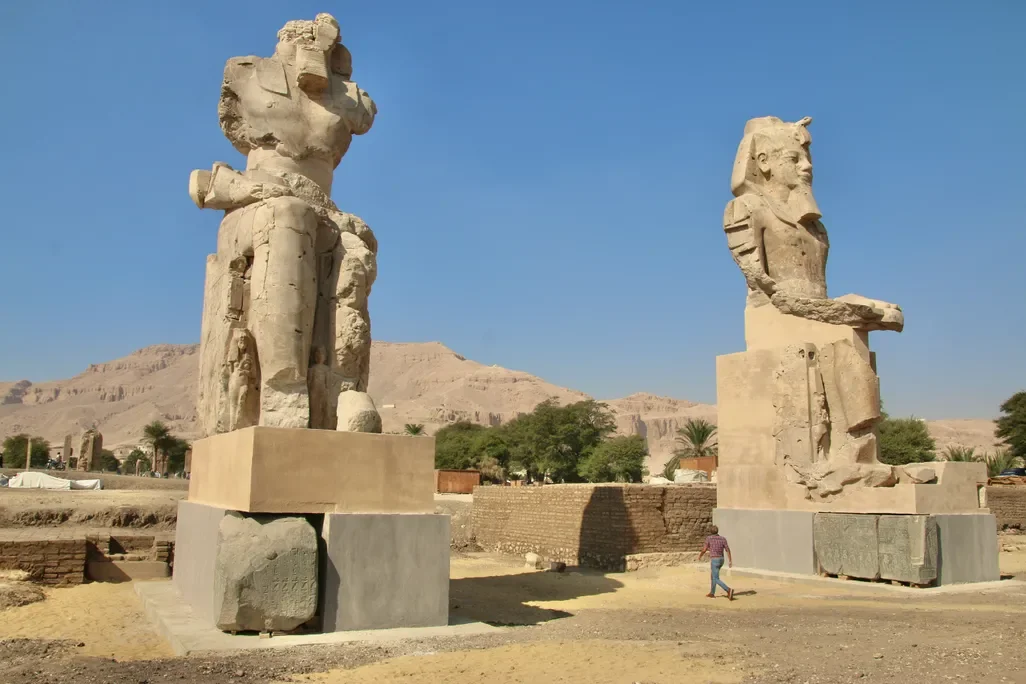
Egypt officially unveiled two restored colossal statues of King Amenhotep III at his mortuary temple in Luxor — the culmination of nearly 27 years of painstaking excavation, fragment recovery, and scientific conservation work. It is, by any measure, one of the most remarkable achievements in the history of archaeological preservation.
Who Was Amenhotep III — and Why Does He Still Matter?
To understand why this restoration is important, it helps to know about the man behind the monuments. Amenhotep III ruled ancient Egypt from around 1390 to 1353 BC during the New Kingdom, which is known as the most prosperous time in Egyptian history. His reign was marked by wealth, diplomacy, and an impressive building program that influenced areas from Nubia to the Nile Delta.
His mortuary temple, known in ancient times as the “Temple of Millions of Years,” was the largest and most decorated funerary temple in ancient Egypt. It originally measured about 450 by 700 meters. In ancient Egyptian belief, these temples were not just tombs. They were sacred spaces meant to support the king’s spirit, or ka, for eternity through rituals and a connection with Amun‑Ra.
A Temple Lost, Then Found — The Disaster That Scattered the Colossi
The temple has a remarkable story of rise and fall. Around 1200 BC, a strong earthquake toppled the statues and damaged much of the complex. What remained gradually got buried under layers of Nile silt and flooded seasonally. Later builders even quarried stone from the site. Pieces of the colossi were reused in the nearby Karnak Temple.
By the 19th century, treasure hunters and collectors had taken almost everything left above ground. The site then looked more like an empty field than the greatest mortuary temple Egypt ever built.
What the Restored Statues Actually Look Like
The two recently restored colossi are stunning in size and detail. Here’s what makes them striking:
- Height: They stand 14.5 meters and 13.6 meters tall, carved from precious Egyptian alabaster from Hatnub in Middle Egypt.
- Posture: The king sits with his hands on his thighs, looking east toward the Nile and the rising sun.
- Royal Symbols: He wears the nemes headdress, topped with the double crown, a ceremonial beard, and a pleated royal kilt with a bull’s tail — all signs of divine rule.
- Accompanying Figures: Smaller statues of his Great Royal Wife Tiye, Princess Isis, and Queen Mutemwiya stand next to him.
- Throne Decoration: The throne has the sema‑tawy motif, which symbolizes the unification of Upper and Lower Egypt.
- Traces of Color: Some parts still show faint traces of their original colors.
It’s important to note that the statues are not fully intact. One is missing an arm and a foot. The other is headless, armless, and without feet. These missing parts do not lessen their impact; instead, they symbolize survival over more than three thousand years.
27 Years in the Making: Inside the Restoration
This project achieved remarkable results. In the late 1990s, a team of Egyptian and German archaeologists, led by Egyptologist Hourig Sourouzian, aimed to save the last remains of an important temple.
The project involved several organizations, including Egypt’s Supreme Council of Antiquities, the German Archaeological Institute in Cairo, the World Monuments Fund, Johannes Gutenberg University Mainz, and the U.S. Research Center in Egypt. What they accomplished goes beyond restoring just two statues:
- They carefully assembled about 500 fragments over four months to rebuild these two colossi.
- They recovered and reinstalled over 280 statues and fragments of the goddess Sekhmet.
- They documented limestone sphinxes and returned them to their original places.
- They installed a water‑management system to protect the site from rising Nile groundwater.
- They trained Egyptian conservators and architects, helping to build local expertise in preserving heritage.
One interesting discovery was that these colossi were not carved from a single block, unlike most ancient Egyptian sculptures. Instead, they were made from separate pieces fixed to a monolithic alabaster core. This sophisticated technique required modern restorers to understand it thoroughly before they could reassemble the statues.
The two restored statues now stand at the temple’s Third Pylon, joining the colossi already restored at the first and second pylons. This process gradually brings back the impressive path that once led worshippers into Amenhotep’s sacred city.
Egypt’s Bigger Picture: Heritage, Tourism, and National Identity
The unveiling of the statues in Luxor was part of a larger plan. It happened just six weeks after the opening of the Grand Egyptian Museum near the Giza Pyramids. This museum is a key project to make Egypt a leading cultural tourism destination. Together, these events show a careful strategy: by investing in Egypt’s ancient treasures, they aim to attract visitors from around the world.
Egypt’s Minister of Tourism and Antiquities, Sherif Fathy, clearly stated at the ceremony that the restored statues show Egypt’s commitment to protecting its cultural and archaeological heritage. This message is meant to reach international visitors and investors.
Why You Should Visit Luxor’s West Bank
If you’re considering a trip to Luxor, let me encourage you to go. The West Bank is rich in ancient history, and the newly restored Amenhotep III site is another great reason to visit. While you’re there, make sure to see:
- The Colossi of Memnon — the famous twin statues that have stood for thousands of years.
- The Valley of the Kings — where you can find royal tombs, including that of Tutankhamun.
- Medinet Habu — the impressive mortuary temple of Ramesses III.
- Deir el‑Bahari — the beautiful terraced temple of Hatshepsut.
A Remarkable Restoration
In December 2025, something special happened in Luxor. A team of Egyptian and international experts spent 25 years putting together nearly 500 pieces of ancient alabaster. They worked hard to restore two statues to the place where they belong.
Some of these experts never got to see the finished work. Their colleagues honored them for their dedication.
This is more than just about archaeology; it’s a story of commitment. A monument built to last for ages was damaged, scattered, and buried. Thanks to patience and skill, it was carefully restored piece by piece. Amenhotep III built his temple to last for eternity, and after 27 years of hard work, this team made sure it would.