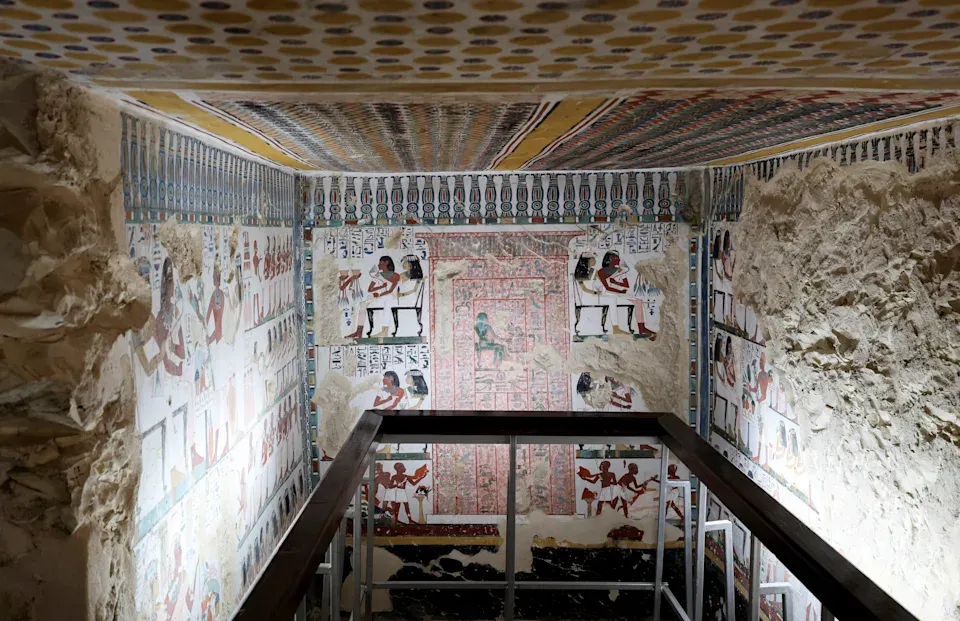
On May 14, 2026, Egypt’s Minister of Tourism and Antiquities officially opened two newly restored New Kingdom tombs to the public: TT416, belonging to Amenhotep Rebiu (also spelled Rabouya), and TT417, belonging to his son, Samut. This event marks the conclusion of an eleven‑year journey that began with a discovery in 2015 and included some of the most meticulous conservation work carried out on the Theban West Bank in recent memory.
Who Were Amenhotep Rebiu and Samut?
Amenhotep Rebiu lived during the reigns of Thutmose III (opens in new tab) and Thutmose IV (opens in new tab), approximately between 1481 and 1389 BC. This time is known for great achievements in art and power in ancient Egypt. His son, Samut, followed in his father’s footsteps, both in life and death. Their tombs are located next to each other at El‑Khokha, in the ancient burial site on Luxor’s West Bank.
What makes this father‑son duo interesting is a surprising mix. Their official titles seem quite modest by ancient Egyptian standards. Yet, both tombs have stunning wall paintings that showcase extraordinary skill and quality. According to Egypt’s Ministry of Tourism and Antiquities, this art is among the greatest in ancient Egypt. They were not pharaohs, nor high priests or viziers. They were men of good standing who somehow managed to commission work that rivals the finest royal tombs in the valley.
A Decade of Restoration: What It Actually Took
The tombs were discovered during excavations in 2015, but the discovery is only the beginning. What greeted archaeologists was centuries of accumulated rubble, damaged plaster, fragile pigments, and structural cracks that threatened the integrity of the walls themselves.
The restoration project that followed covered every dimension of conservation:
- Structural reinforcement — cracks were filled, and the architectural fabric of both tombs was stabilized.
- Surface conservation — loose and flaking paint was consolidated, colors were cleaned, reinforced, and protected.
- Debris clearance — rubble and sediment built up over centuries was carefully removed.
- Visitor infrastructure — wooden walkways, stone stairs, modern lighting, shaded rest areas, and bilingual information panels in Arabic and English were installed.
At the opening ceremony, the restorers themselves were honored with certificates of appreciation — a rare and fitting acknowledgment that the people who spend years on scaffolding with fine brushes are as much the story as the art they save.
Inside the Tombs: What You’ll See
TT416 and TT417 have a typical T‑shaped design, which is common in private tombs from the 18th Dynasty. Each tomb features a wide hall that leads to a long, straight corridor. The hall displays the life of the tomb’s owner, while the corridor focuses on death and the afterlife. This design reflects the belief that life and death are connected.
Both tombs were also used again during the Late Period (664–332 BC), when later occupants added more rooms and burial shafts. Visiting these tombs today is like exploring two different periods of Egyptian history layered together.
Tomb of Amenhotep Rebiu (TT416)
The horizontal hall shows a lively picture of daily life during the New Kingdom. You can see scenes of farming, like harvesting and storing grain, along with bread‑making, pottery, and grand banquets where guests enjoy food and music. A false door and part of an autobiographical text are also there.
In the inner corridor, the scene changes completely. It shows Amenhotep’s funeral procession and the “Opening of the Mouth” ritual. This ritual was done to help the deceased regain their senses for the afterlife. One scene that stands out to Egyptologists shows the deceased making an offering to Renenutet, the goddess of fertility and harvest, who is shown nursing a royal child. This image is quite rare and is considered a highlight of 18th Dynasty religious art.
Tomb of Samut (TT417)
Samut’s tomb was never finished, and this unfinished state adds its own mystery. We don’t know why the work stopped. Was it due to illness, lack of money, or an unexpected death? The reasons remain unclear. However, what is complete is impressive. The finished parts show lavish banquet scenes and a false door, all done with the same skill seen in his father’s nearby tomb. For researchers, unfinished tombs can provide valuable insights. The visible sketches and underpainted outlines reveal how ancient artists worked in a way that finished walls cannot.
A Visitor’s Guide to TT416 and TT417
Location: El‑Khokha Necropolis, West Bank of the Nile, Luxor, Egypt
Best time to visit: Early morning (7–9 AM) for cooler temperatures and fewer crowds. October through April for the most comfortable weather overall.
How to get there: Take the local ferry from Luxor’s East Bank to the West Bank. From the ferry landing, hire a local taxi, bicycle, or calèche to El‑Khokha.
What to expect on‑site: New wooden walkways and stone staircases for safe navigation; modern lighting throughout both tombs; bilingual (Arabic/English) information panels and a printed visitor brochure; shaded seating areas outside the tomb entrances.
Combine your visit with: The nearby Tombs of the Nobles (dozens of non‑royal tombs from across Egyptian history), Medinet Habu (opens in new tab), the Valley of the Queens (opens in new tab), and Deir el‑Bahari (opens in new tab) (Hatshepsut’s temple), visible from the ridge above El‑Khokha.
Why This Opening Matters
The opening of tombs TT416 and TT417 is important for Egypt’s tourism. It fits into a bigger plan to make Luxor and Egypt the top places for cultural and heritage tourism. In the first quarter of 2026, Egypt’s tourism grew by 15.6%, with Luxor at the center of this growth. The Governor described Luxor as a city that “still holds many of its archaeological secrets.”
These two tombs remind us that ancient Egypt’s richness wasn’t just about pharaohs and pyramids. It also came from the daily lives of the people who built that civilization. Amenhotep Rebiu and his son Samut were not kings, but they left behind walls that tell stories other treasures would envy.