
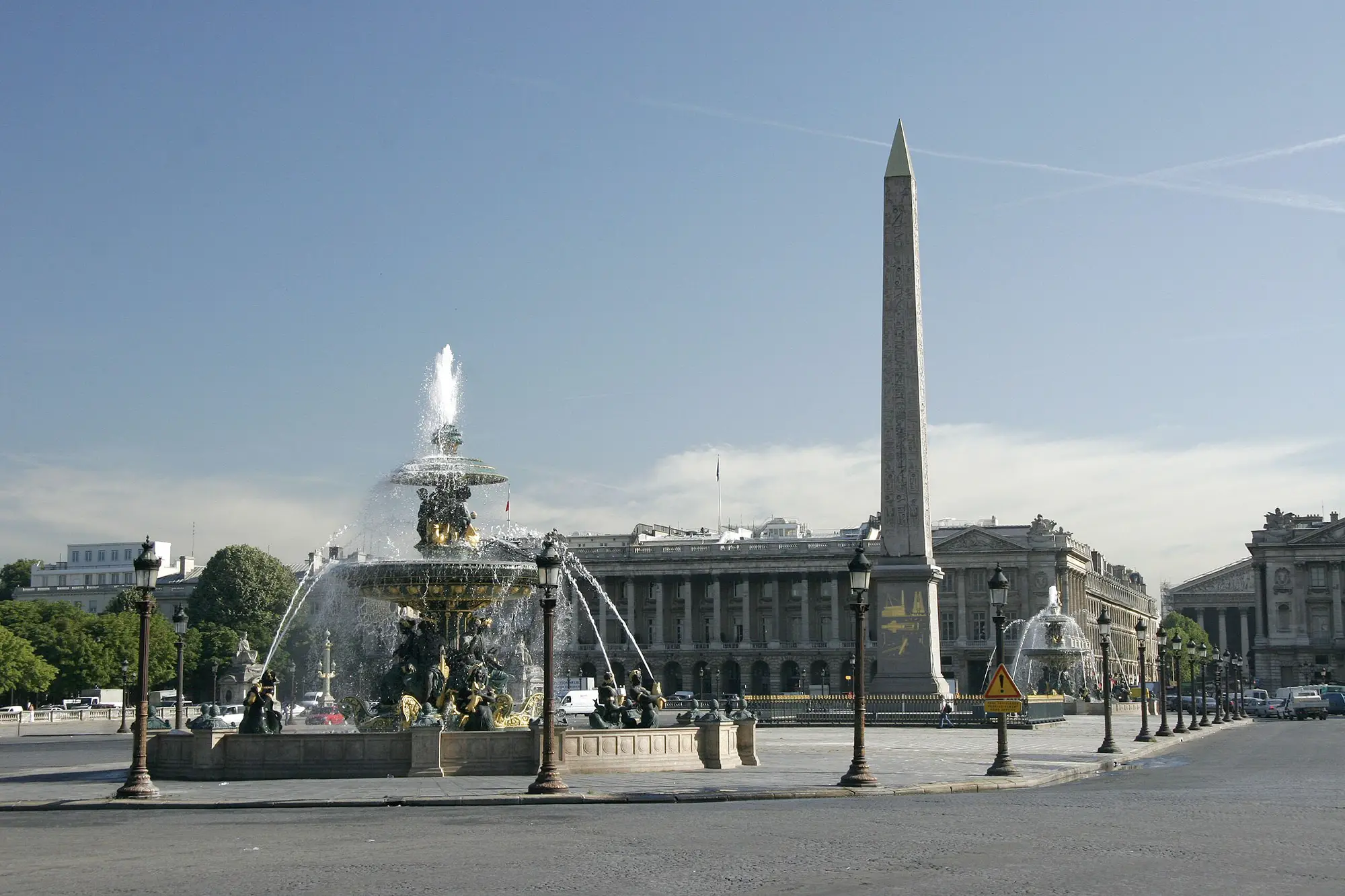
At the center of Paris’s Place de la Concorde — the same square where Louis XVI and Marie Antoinette were guillotined — stands a 3,300-year-old visitor from another world: the Luxor Obelisk. It never saw the French Revolution. It arrived four decades later, carved from a single block of Aswan granite, hauled 2,500 miles by sea, and raised in front of a crowd of roughly 200,000 Parisians in 1836. It has stood there ever since, outlasting every government that followed.
Ramses II’s Obelisk
Long before it became a Paris landmark, the obelisk was a working piece of religious architecture. Ramses II had it carved around 1250 BC as one of a matching pair guarding the entrance to Luxor Temple — a physical link, the Egyptians believed, between the earth and the sun god Amun-Ra. (The Egyptians called such monuments tekhenu, “to pierce the sky”; our full guide to Luxor’s obelisks covers what that meant and how they were built.)
- Material: A single block of red granite from the Aswan quarries, over 100 miles south of Luxor.
- Height and weight: About 23 meters (75 feet) and roughly 220–250 tons, depending on the source.
- Inscriptions: Hieroglyphs nearly 3,000 years old, celebrating Ramses II’s military campaigns and his devotion to the gods.
- Pyramidion: The tip was originally sheathed in electrum — a gold-silver alloy — to catch the first light of morning.
For centuries the two obelisks stood side by side at Luxor Temple. Then 19th-century diplomacy split the pair up: Egypt’s ruler Muhammad Ali Pasha gave both to France, but moving a quarter-million-pound monolith twice proved too costly, so only this one made the trip. In exchange, France sent Egypt a mechanical clock that reportedly stopped working within a few years. (The twin that stayed behind — and what’s carved into its base — is covered in our full guide to Luxor’s obelisks.)
The Impossible Journey of “The Louxor”
Moving a 250-ton granite pillar in the 1830s took engineering that came close to bankrupting the French navy.
In 1830, workers in Toulon built a flat-bottomed transport ship — later named Le Louxor — shallow enough to navigate the Nile. Once in Egypt, 300 workers spent months digging a canal through the sand to bring the ship within reach of the obelisk. A system of pulleys, capstans, and raw manpower then lowered the obelisk onto its side, a process that took weeks. The ship then sat in the Nile for months, waiting for the annual flood to rise high enough to float it back out to the Mediterranean.
The obelisk finally reached Paris in December 1833 — then sat on the docks for three years while the city argued over where to put it. On October 25, 1836, in front of a crowd of roughly 200,000, engineer Apollinaire Lebas raised it into position using a system of capstans and pulleys, reportedly stationing himself directly beneath the shaft during the lift — unwilling to survive his own calculations if something went wrong. The obelisk went up in about three hours without incident. King Louis-Philippe watched the entire operation from the balcony of the Hôtel de la Marine, on the edge of the square.
The “Obscene” Baboons
Look closely at the obelisk’s pedestal today and you’ll find gilded diagrams explaining how it was moved — but not the original Egyptian base.
Like its twin still standing at Luxor Temple, this obelisk’s pedestal was originally carved with a relief of four baboons standing on their hind legs, arms raised in worship of the sun. That original base stayed behind in Egypt: French authorities in the 1830s judged the baboons’ explicit anatomy unsuitable for a public square and sent the relief to the Louvre instead, where — after a stint away from public view — it’s now displayed, in part at the Louvre-Lens satellite museum.
Modern Additions
The gold cap. The original pyramidion vanished in antiquity, possibly stolen. In 1998, the French government added the current gold-leafed cap to restore the obelisk’s intended sun-catching silhouette.
The world’s largest sundial — maybe. On clear days, the obelisk’s shadow is said to sweep across Roman numerals set into the pavement of Place de la Concorde. It’s a claim repeated often about the square, though it’s difficult to verify against any formal record — treat it as local lore worth checking out in person rather than settled fact.
The Twin Left Behind
The obelisk’s match still stands at Luxor Temple, leaving the entrance visibly lopsided — one obelisk, one empty pedestal. France held a technical claim to it for 145 years until President François Mitterrand renounced it in 1981. (For what’s carved into that remaining obelisk’s base, see Obelisks of Luxor: A Complete Guide.)
Planning Your Visit
Paris: Place de la Concorde is a public square — free, unticketed, and open around the clock. The nearest Métro stop is Concorde (lines 1, 8, and 12). Go toward sunset: the light flatters the stone, and from the edge of the Tuileries Garden, the obelisk lines up neatly with the Arc de Triomphe down the Champs-Élysées.
Luxor: The remaining obelisk is best seen at night, when Luxor Temple stays open late and floodlighting throws deep shadow across the hieroglyphs. Walk the Avenue of Sphinxes behind it — the ancient processional route runs all the way to Karnak.