
Luxor Temple has been in continuous use as a sacred site for over 3,400 years. That continuity is not accidental — the site’s power as a place of authority and community outlasted the specific religious frameworks that built it. By the time the last pharaohs ruled, the temple had already been a sacred space for a thousand years. It survived them by adapting: becoming a Roman imperial sanctuary, then a Coptic Christian church, then accumulating the Abu Haggag Mosque within its walls — which remains in active use today. No other site in Luxor demonstrates Egypt’s layered religious history as directly as this single building.
Roman Reuse: The Temple of Augustus
When Egypt passed under Roman control following the deaths of Antony and Cleopatra in 30 BCE, the Romans faced a practical question about Luxor Temple: what to do with a functioning sacred complex that the local population continued to regard as holy.
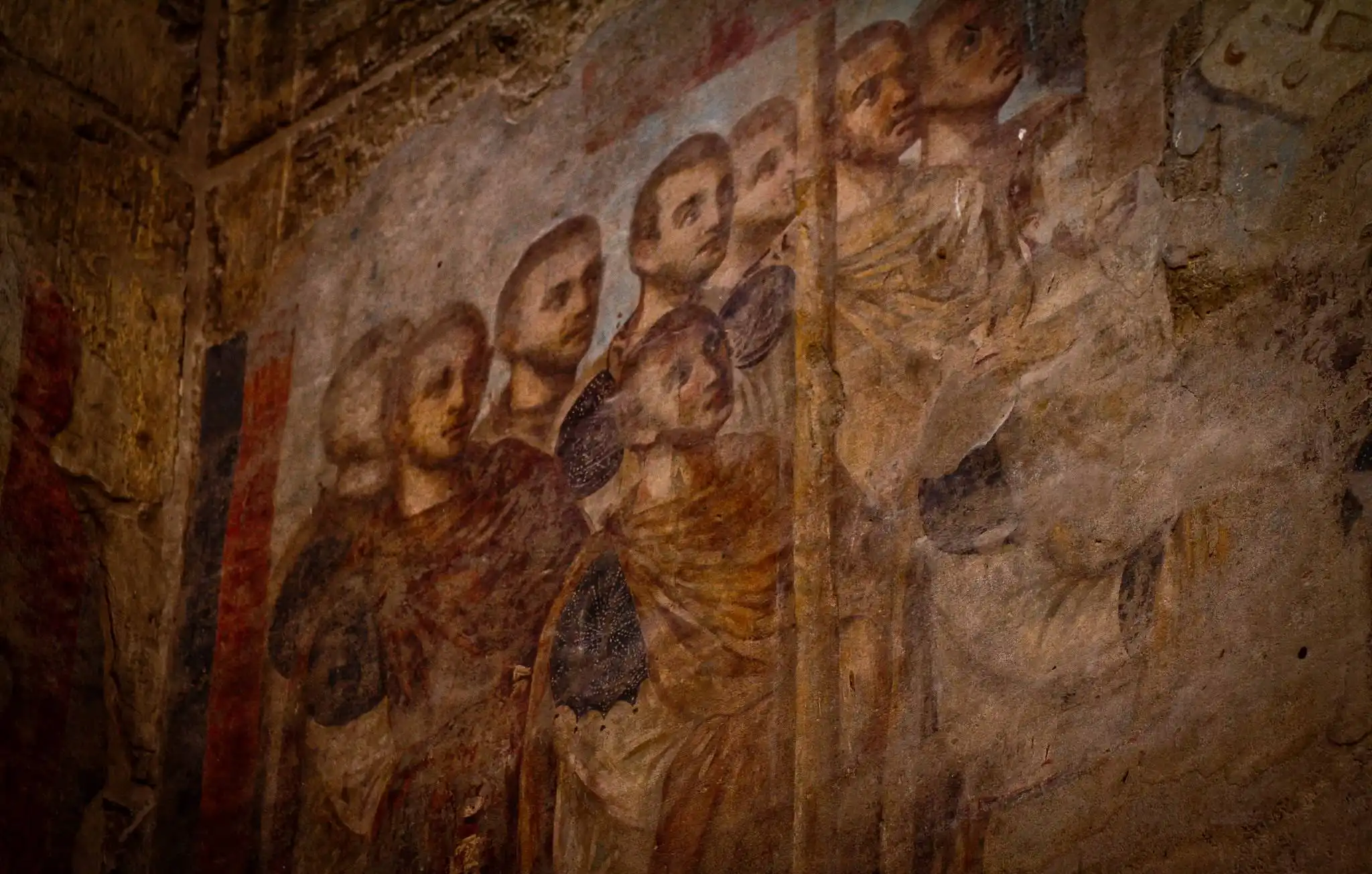
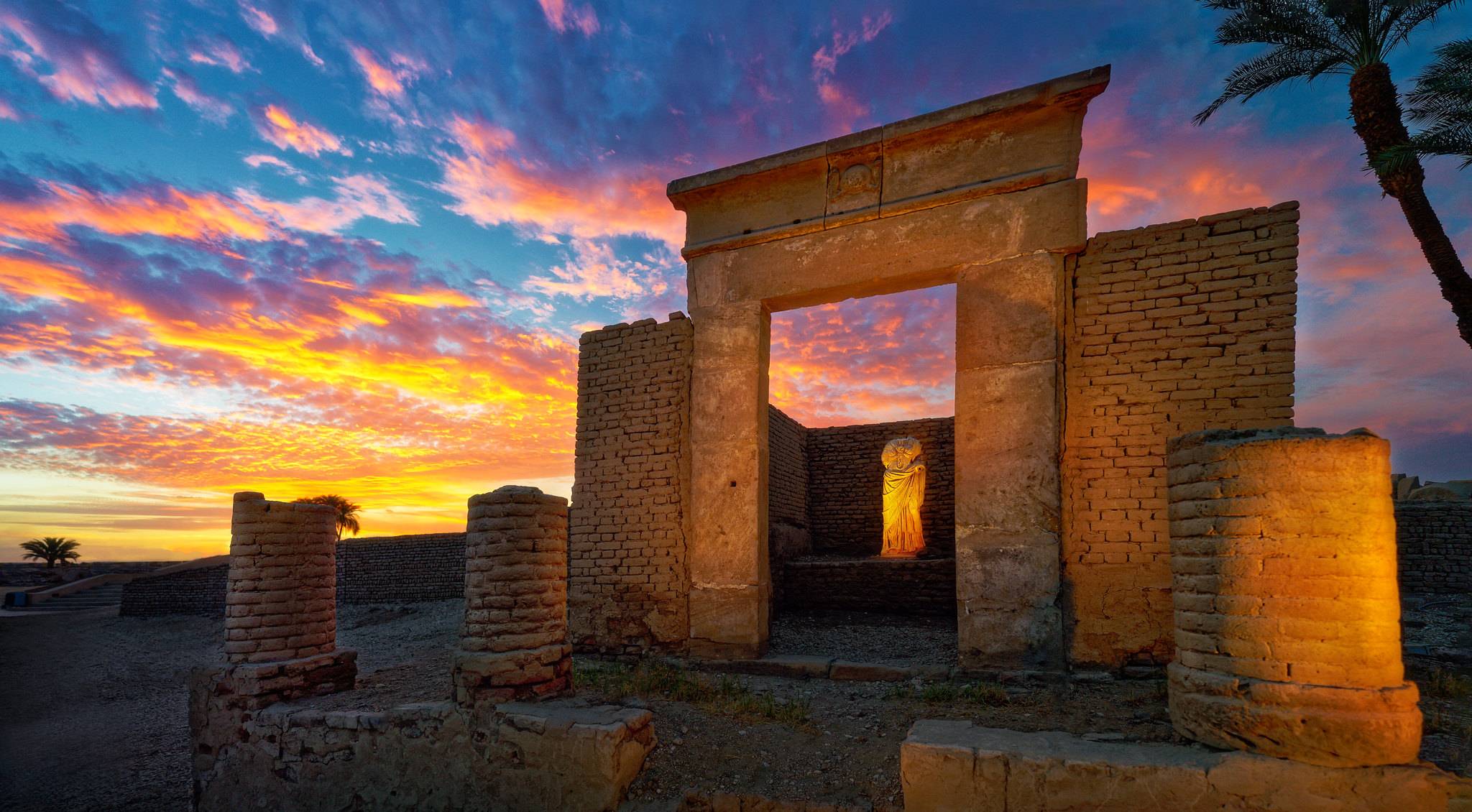
Their answer was characteristically pragmatic. The Romans converted a lateral chamber in the temple’s innermost section into a sanctuary for the imperial cult — the worship of the Roman emperor as a divine figure. The chamber was replastered and painted with frescoes in a style that combined Roman artistic conventions with Egyptian religious imagery: Roman figures rendered in frontal poses, a deliberate departure from the profile convention of Egyptian relief carving. These Roman-era paintings are still visible today in the sanctuary, beneath and alongside the original pharaonic reliefs.
This wasn’t desecration — it was incorporation. By placing the imperial cult inside an existing Egyptian sacred space, Rome connected the emperor’s divine authority to the temple’s existing prestige. The theological logic was the same as the pharaohs’ had been: authority flows from divine sanction, and a sacred building confers that sanction on whoever controls it. The building’s ceremonial function — confirming the right of the ruler to rule — continued essentially unchanged. Only the ruler had changed.
The Romans also used the temple’s courtyards for civic and military purposes, and the surrounding area became integrated into the Roman administrative infrastructure of Thebes. The temple’s physical relationship to the town changed during this period: Luxor gradually built up around and above the ancient structure, eventually burying much of it under centuries of accumulated habitation.
Christian Transformation: The Coptic Church
By the 4th century CE, Egypt had converted to Christianity, and Luxor Temple underwent its most dramatic transformation of the post-pharaonic period. A Coptic Christian church was established within the temple precinct — in the court of Ramesses II, the large forecourt that today visitors cross on the way toward the inner temple.
The columns and structural elements of the ancient temple were incorporated into the church’s architecture; Christian murals were painted over pharaonic reliefs. This practice — painting over rather than destroying — was typical of how early Egyptian Christians adapted existing sacred spaces. The images beneath were covered rather than removed, which is why the underlying pharaonic reliefs have survived in many cases. In some parts of Luxor Temple, the faint outlines of Coptic-era paintings remain visible alongside the pharaonic reliefs beneath them.
The church served the Christian community of Thebes — by this period renamed Luxor, from the Arabic “El-Uqsur” meaning “the palaces” — as the city’s population reorganized around the new faith. It was a significant community space for several centuries before declining in use as the Islamic period took hold.
Islamic Reuse: The Abu Haggag Mosque
The most visible layer of Luxor Temple’s post-pharaonic history is the Abu Haggag Mosque, which occupies the northeastern corner of the court of Ramesses II and remains in active use as a place of worship today. It was built in the 13th century CE during the Ayyubid period, on top of the accumulated debris and construction of previous centuries — which is why it sits approximately 9 metres above the level of the ancient temple floor. The height differential that gives it its popular nickname “the Hanging Mosque” is a measure of how much history has accumulated at this site since the pharaonic period.

The mosque is named for Sheikh Yusuf Abu al-Haggag, a Sufi saint who settled in Luxor in the 12th century and is considered the town’s spiritual patron. His tomb is beneath the mosque’s dome. The mosque functions as an ordinary neighborhood mosque throughout the year, with daily prayers continuing alongside tourist visits to the temple around it.
Each year, the Moulid of Abu Haggag — the festival celebrating the saint’s birthday — is observed with a procession through the streets that includes decorated boats carried on wheeled platforms. The parallel to the ancient Opet Festival, in which sacred barques of Amun, Mut, and Khonsu were carried in procession along this same route from Karnak to Luxor Temple, is noted by scholars and is part of local tradition’s own understanding of the festival’s ancestry.

For the full story of the mosque, its history, and practical visiting information, see our Abu Haggag Mosque guide.
Luxor Temple as a Palimpsest
The specific theological systems that each period brought to Luxor Temple were different — polytheistic Egyptian religion, Roman imperial cult, Coptic Christianity, Sunni and Sufi Islam — but the underlying pattern was consistent. Each group recognized the site as sacred, adapted it to their own framework of meaning, and used it to connect authority or community to a holy place. The building was never abandoned because the human impulse that built it — to establish a powerful, permanent sacred space — proved more durable than any of the specific doctrines that occupied it.
This is what makes Luxor Temple unusual even among Egypt’s ancient sites. The Valley of the Kings was sealed and forgotten; Karnak was eventually overwhelmed by the surrounding city; the pyramids became quarries. Luxor Temple was continuously inhabited and continuously reinterpreted, which is why it carries so many visible layers of history in such a compact space.
For visitors today, the result is a site where you can stand in a pharaonic court, look up at a medieval mosque, and know that the mosque’s congregation uses the same door their parents used, their grandparents used, and — in the unbroken logic of sacred place — the priests of Amun used over three thousand years before them.