
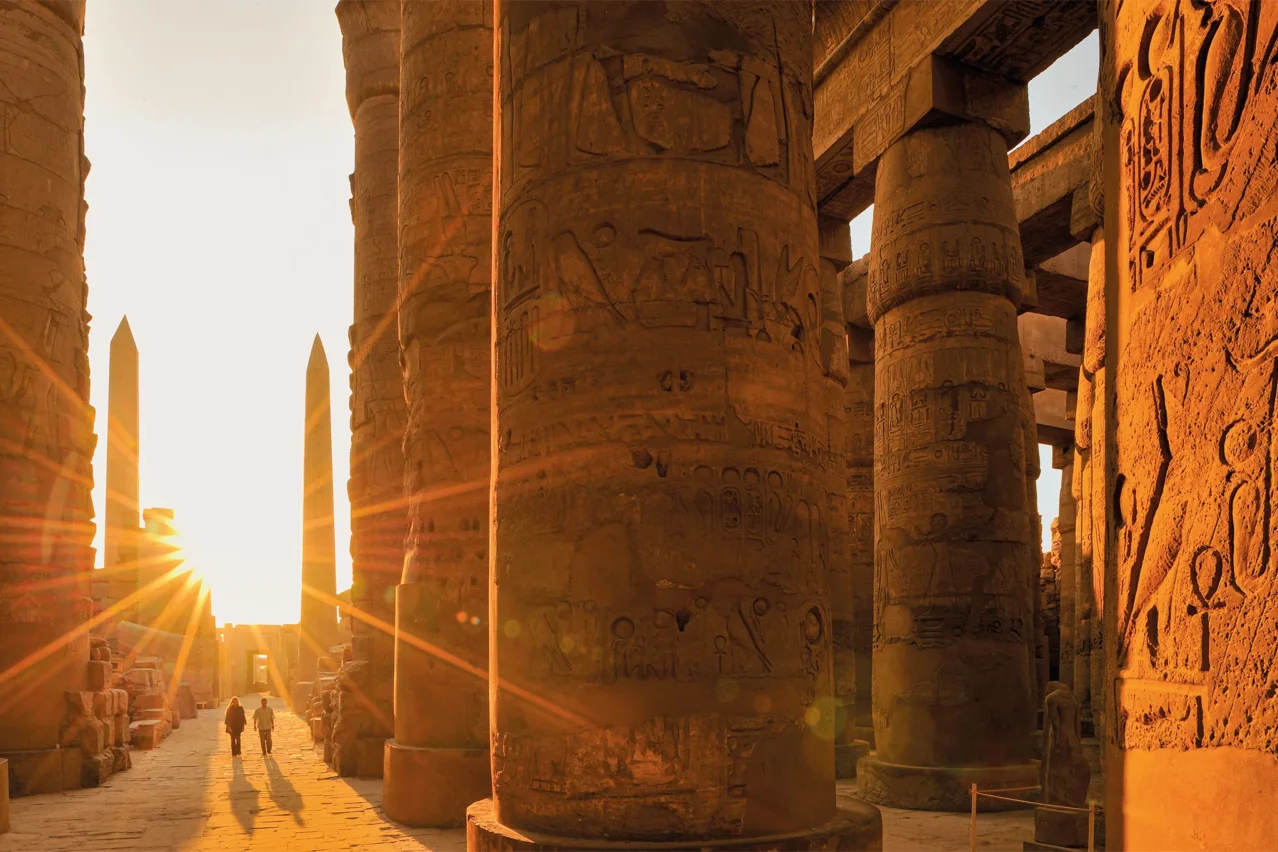
Ancient Thebes once bristled with obelisks — soaring shafts of red granite the Egyptians called tekhenu, “to pierce the sky.” Today, only three still stand in Luxor. The rest were pulled down, cracked, or shipped off across two thousand years of conquest: by Roman emperors who wanted a piece of Egypt for their own capital, and by a 19th-century French king who wanted one for his. This guide covers what’s still standing in Luxor, what has fallen, how the Egyptians managed to build these things at all, and where the missing obelisks ended up — as far away as Paris, Rome, and a university museum in northern England.
The Last Obelisk at Luxor Temple
At the First Pylon of Luxor Temple, two colossal seated statues of Ramesses II flank the entrance — but only one obelisk stands beside them. To the right is an empty pedestal.
Ramesses II raised a matching pair of red granite obelisks here around 1250 BC, and they stood together for more than 3,000 years. Then, in the 1830s, Egypt’s ruler Muhammad Ali Pasha gifted the pair to France. Moving a 250-ton monolith proved too difficult to do twice: only the western obelisk made the journey, arriving in Paris in 1833 and finally raised in the Place de la Concorde in 1836. (That obelisk’s full story — the ship built for the Nile, the engineer who stood beneath it during the final lift, the pedestal carving France found too scandalous to display — gets its own deep dive: The Luxor Obelisk in Paris.) In exchange, France gave Egypt a mechanical clock, still housed at the Cairo Citadel, which reportedly stopped working within its first few years and has rarely run since.
The obelisk that stayed is worth studying up close. At its base are four baboons carved in high relief, arms raised in worship of the rising sun. Ramesses II’s names and titles are cut unusually deep into the granite — deep enough to hold real shadow, so the hieroglyphs stay legible even under the flat light of midday.
The Two Survivors at Karnak
A short walk down the Avenue of Sphinxes leads to Karnak, the largest religious complex ever built. It once held dozens of monuments; today only two obelisks remain standing in their original positions.
The Obelisk of Thutmose I
Beyond the Fourth Pylon stands the obelisk of Thutmose I — at 71 feet, the smaller of Karnak’s two standing obelisks, but the oldest still upright here, cut from a single block of Aswan granite around 1493–1482 BC.
Hatshepsut’s Obelisk: Egypt’s Tallest Standing Obelisk
Deeper into the temple stands the obelisk of Hatshepsut, one of the few women who ruled as pharaoh in her own right. She commissioned two obelisks to mark her sixteenth year on the throne. At roughly 97 feet and 320 tons, this is the tallest obelisk still standing anywhere in Egypt.
The Fallen Giants
Luxor’s standing obelisks are only half the story. The fallen ones let you get close enough to see the carving at eye level — something you can’t do with anything still upright.
Hatshepsut’s Broken Twin
Near the Sacred Lake at Karnak lies the upper section of Hatshepsut’s second obelisk, toppled and broken in antiquity. Because it’s lying on its side, you can walk right up to the pyramidion — the pointed tip that was once sheathed in electrum, a gold-silver alloy, so it would catch the sun. At ground level, the precision of the carving is obvious: this was cut without a single piece of steel.
Fragments in the Open-Air Museum
Scattered across Karnak are broken pieces from smaller obelisks raised by other pharaohs, including Thutmose III and Seti II — a reminder of how crowded these courtyards once were.
How the Egyptians Built Them
Every obelisk in Luxor began as raw granite in the quarries of Aswan, more than 100 miles south.
Pounding, not cutting. Egyptian workers didn’t saw the granite. They pounded it into shape with hand-sized balls of dolerite, a stone harder than granite itself — a process that could take months for a single obelisk.
Floating them down the Nile. Once freed from the quarry, an obelisk was loaded onto a barge and moved during the Nile’s annual flood, when the water ran high enough to carry the weight. Some records suggest the largest obelisks needed two barges lashed together.
Raising them on sand. To stand the finished obelisk upright, engineers likely built a ramp packed with sand, slid the obelisk down it base-first onto its pedestal, then dug the sand out from underneath — letting the stone settle into place under its own weight.
Where the Missing Obelisks Ended Up
Not every Luxor obelisk stayed in Egypt. Four now stand in three other countries. For more on how Theban objects left Egypt, see our guide to Luxor’s artifacts in museums outside Egypt.
Paris: The Obelisk in Place de la Concorde
Ramesses II’s other Luxor Temple obelisk has stood at the center of Paris since 1836. At 23 meters and roughly 220–250 tons (sources vary), it’s the most famous Egyptian obelisk outside Egypt — and its journey, its scandal-plagued pedestal carvings, and the deal that eventually settled the fate of its twin are covered in full in The Luxor Obelisk in Paris.
Rome: The Lateran Obelisk
At over 32 meters, the obelisk in Piazza di San Giovanni in Laterano is the tallest ancient Egyptian obelisk anywhere in the world. It was commissioned at Karnak by Thutmose III and completed by his grandson Thutmose IV. Roman Emperor Constantius II moved it to Rome in 357 AD; it later fell and broke into three pieces before Pope Sixtus V had it re-erected in 1588.
Istanbul: The Obelisk of Theodosius
Originally raised south of Karnak’s Seventh Pylon by Thutmose III, this obelisk now stands in Istanbul’s former Hippodrome, present-day Sultanahmet Square. Emperor Theodosius I brought it to Constantinople in 390 AD; the bottom third was lost or damaged in transit, which is why it looks disproportionately short on its oversized marble base. The carvings, remarkably, are still sharp despite thirty centuries and the salt air off the nearby Sea of Marmara.
Durham: The Smallest of the “Big” Obelisks
The Oriental Museum at Durham University in England holds a much smaller obelisk commissioned by Amenhotep II. It reached Britain in the 1830s through the collecting efforts of the Duke of Northumberland and later passed to the university — one of the few Luxor obelisks with no connection to Thutmose III, Hatshepsut, or Ramesses II.