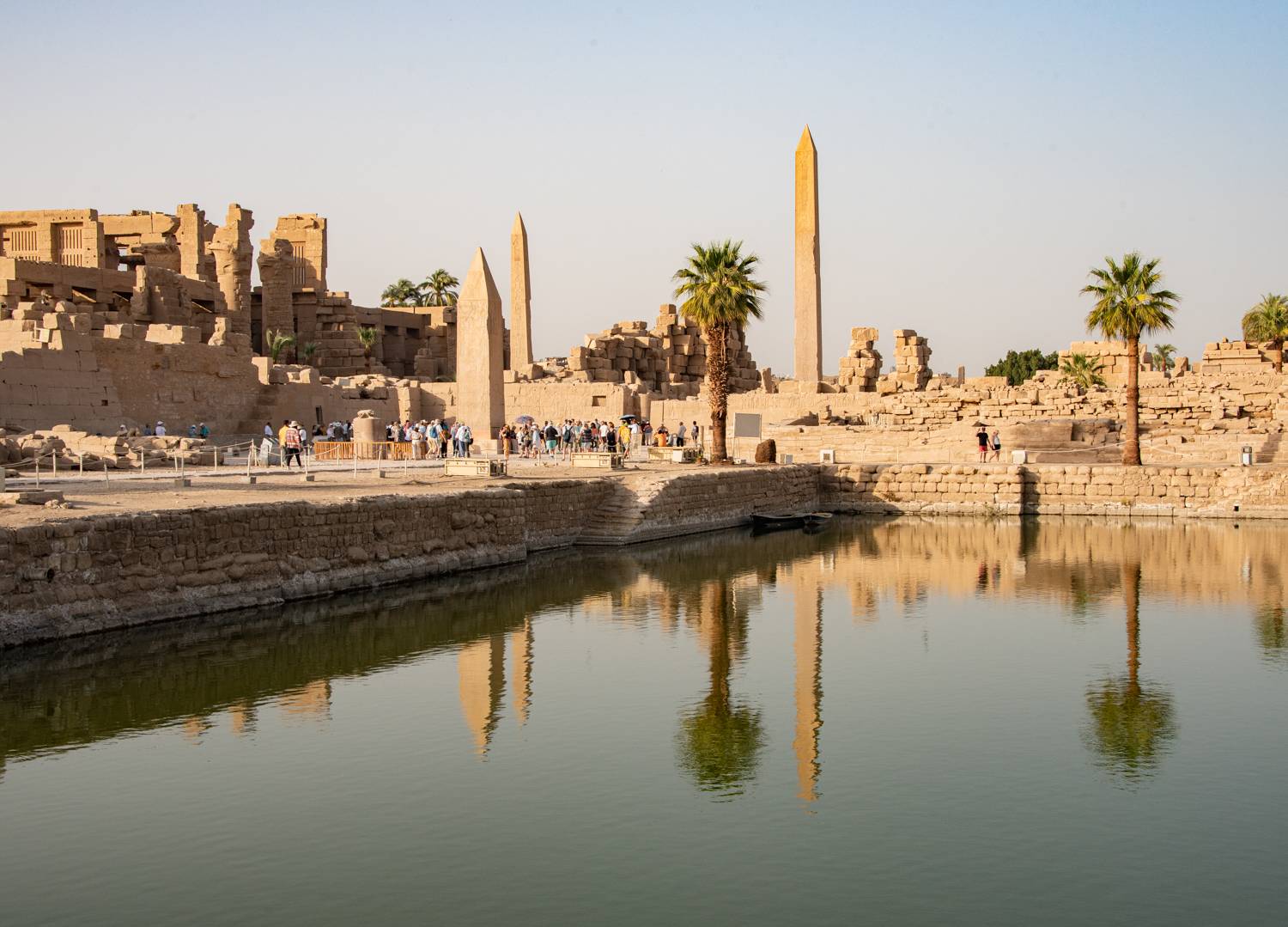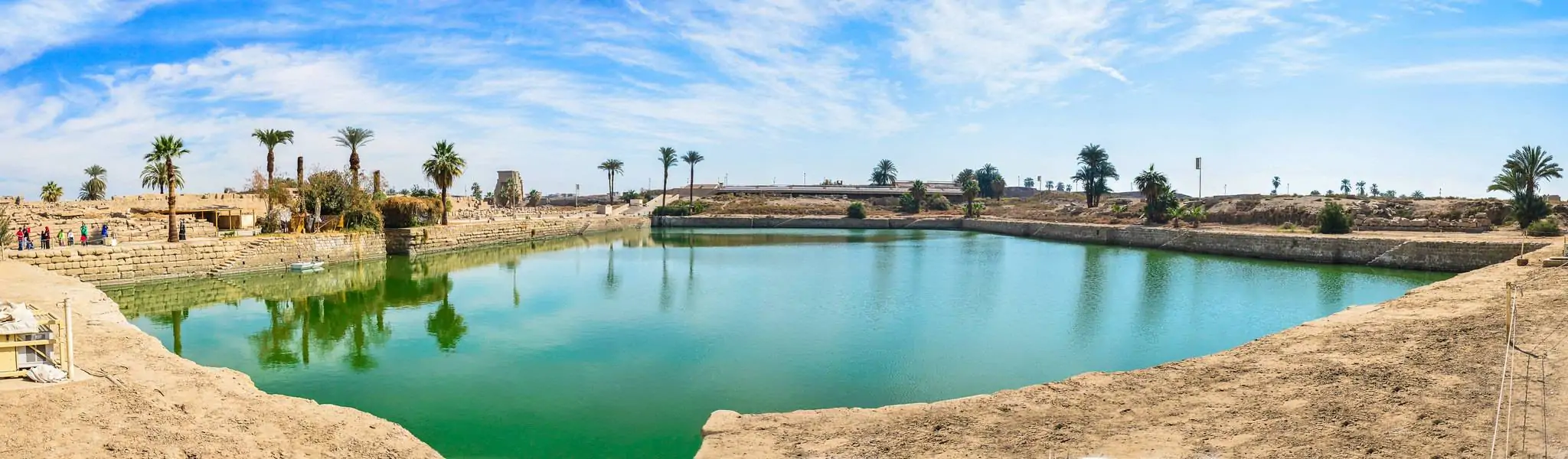

Walk past the Great Hypostyle Hall, through Karnak‘s inner precincts, and the noise of tour groups fades. The Sacred Lake opens up ahead — 120 meters long, 77 meters wide, its surface reflecting the obelisks and palm trees around it in near-silence. After the overwhelming scale of the Hypostyle Hall, the lake has a different quality entirely: still, open, and easier to sit with.
It’s the largest ceremonial lake ever built at an Egyptian temple, and it’s been full for over 3,000 years.
Origins and Engineering
The Sacred Lake was constructed by Pharaoh Thutmose III in the 15th century BCE, during the New Kingdom’s peak. It measures approximately 120 meters long, 77 meters wide, and 4 meters deep — dimensions that required significant earthwork and a permanent hydraulic solution.
That solution is still functioning: the lake is fed by underground channels connected to the Nile’s water table, which keep it full year-round regardless of the river’s seasonal fluctuations. The engineering was not incidental — a lake that dried up would have been ritually useless, and the design ensured it never did.
Religious Purpose and Symbolism
In Egyptian cosmology, the lake represented Nun — the primordial waters that existed before creation, from which the sun first rose. For the priests of Amun at Karnak, it connected their daily rituals to the very beginning of existence.
Its practical functions followed from that symbolic role:
Purification: priests bathed in the lake before entering the temple — multiple times daily — to ensure ritual cleanliness before approaching the god. The lake was less a convenience than a theological requirement.
Sacred birds: geese and other birds associated with Amun were kept at the lake’s edge. They appear in temple accounts as creatures requiring food, housing, and care — a small domestic fact alongside the cosmic symbolism.
Festival use: during major ceremonies, sacred barques carrying the statues of Amun, Mut, and Khonsu were floated on the lake. The Opet Festival, which celebrated the pharaoh’s divine renewal, used the lake as a staging area for these processions.
Ceremonial stage: priests and musicians gathered along the shore during festivals, and the community’s experience of the gods passing on the water was one of the more public aspects of otherwise restricted temple ritual.
The Granite Scarab of Amenhotep III
Near the lake’s northern edge stands a large granite scarab beetle on a pedestal — placed here by Amenhotep III (not Thutmose III) as a dedication to Khepri, the scarab-headed god of the rising sun. The scarab represents regeneration and the daily renewal of the sun — thematically connected to the lake’s symbolism of primordial waters and rebirth.
The tradition of walking around it seven times while making a wish is modern — not ancient — but it’s real enough that you’ll almost certainly find people doing it during your visit. The image of tourists carefully circling a 3,400-year-old statue on a stone path is one of Karnak’s stranger and more endearing sights.
The Edifice of Taharqa
On the lake’s northern edge stands the Edifice of Taharqa — a kiosk-style structure built by the Kushite pharaoh of the 25th Dynasty (7th century BCE). Taharqa ruled Egypt during the Late Period, when Nubian kings controlled the Nile Valley, and his additions to Karnak were deliberate statements of piety and legitimacy. The Edifice represents one of the later layers of construction at the lake, added nearly 800 years after Thutmose III first created it.
Visiting the Sacred Lake Today
The lake is included in the standard Karnak Temple entry (EGP 600 for foreign adults) — no additional ticket required.
Best timing: early morning or late afternoon. The reflections of the obelisks and columns on the water’s surface are most striking when the light is low — either the golden light just after opening or the warm tones before closing. The Sound and Light Show at Karnak culminates beside the lake in the evening, and the illuminated ruins reflected on the water in darkness are genuinely striking.
Getting there within Karnak: follow the main processional axis past the Hypostyle Hall and turn south through the inner precincts — the lake becomes visible once you’ve passed the main sanctuary area. Signs within the site help orientate the route.
Photography: the lake’s reflective surface paired with the vertical lines of obelisks and pylons makes it one of the best photography spots in Karnak. Wide-angle shots from the northern or southern shores capture the lake’s full length with the architectural backdrop.
Rest: after the Hypostyle Hall — which is genuinely overwhelming on a crowded morning — the lake provides a useful place to stop, sit on the low walls along the shore, and process what you’ve seen before continuing through the site.