
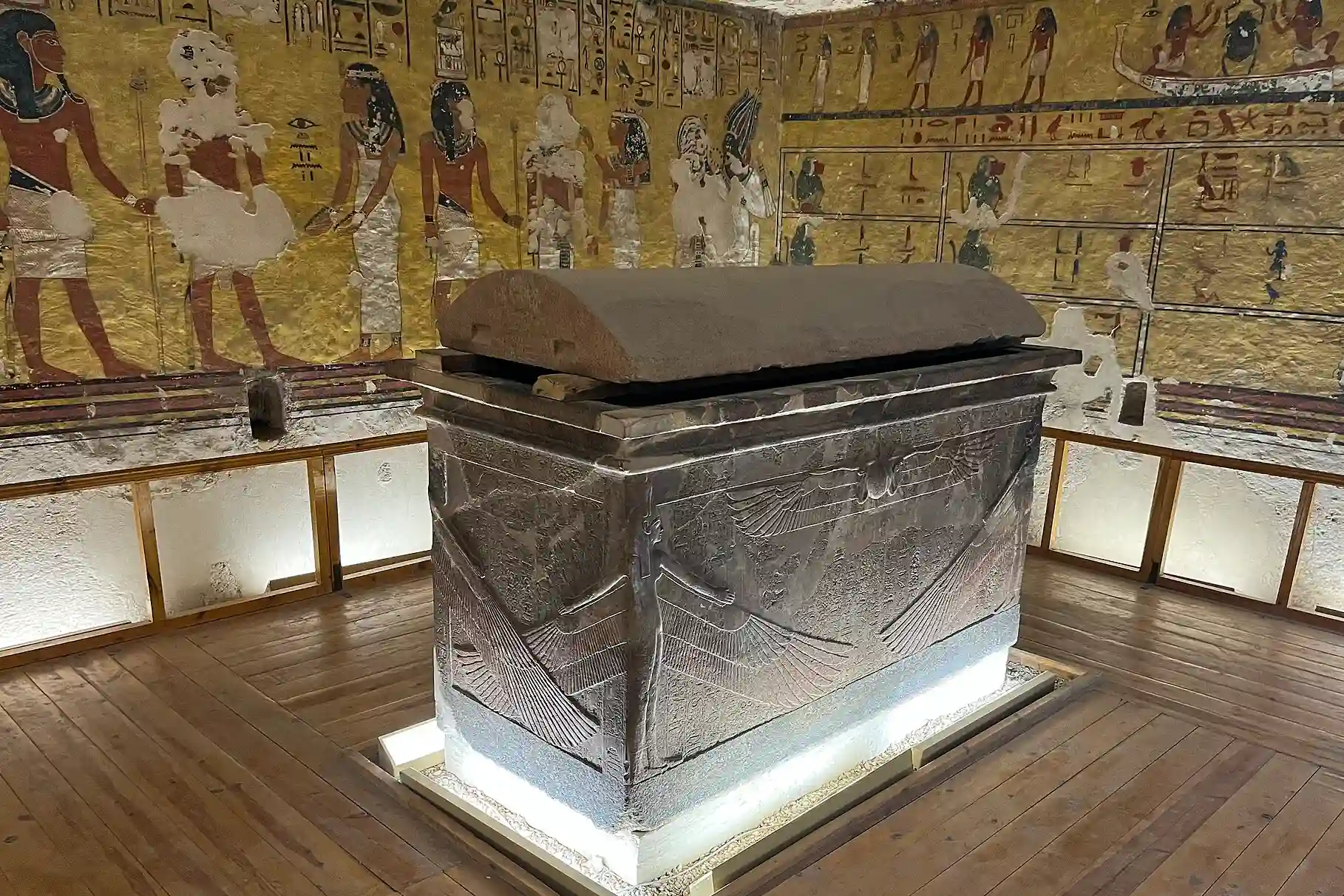
While most visitors to the Valley of the Kings head straight for Tutankhamun, a quieter mystery sits a short detour away in the Western Valley. WV23 is the tomb of Pharaoh Ay — a ruler whose name was chiseled off his own tomb walls, whose mummy has never been found and may never be, and who may be buried in a tomb that wasn’t originally his at all.
Who Was Pharaoh Ay?
Ay rose from a high-ranking court official under Akhenaten to vizier under Tutankhamun, then seized the throne himself when the young king died. His reign lasted only about four years — the last of the Eighteenth Dynasty — and he was already elderly when it began, inheriting a country still unsettled by the religious upheaval of the Amarna Period. His wife, Tey, held the title “Nurse of the Great Royal Wife,” meaning she had cared for Nefertiti herself. Some scholars go further and propose that Ay was Queen Tiye’s brother, which would place him at the center of two consecutive royal families rather than one. His own title, “Divine Father” (it-netjer), reflects his close hand in raising the boy who would become king.
Where the Tomb Sits, and Why the Layout Is Unusual
WV23 lies in the Western Valley — Wadi el-Gharbi, “the western valley” — a quieter branch of the Valley of the Kings a short drive from the main ticket gate. It’s one of only two completed royal tombs in this branch, the other being the tomb of Amenhotep III (WV22). The burial chamber’s painted baboon frieze is why the area is sometimes casually nicknamed the “Valley of the Monkeys” in travel writing, though that name more precisely belongs to a separate, adjacent wadi — worth knowing if you see the term used inconsistently elsewhere.
Its architecture breaks from the norm for its period. Rather than the bent-axis corridors typical of earlier Eighteenth Dynasty tombs, WV23 descends in a straight line through a well chamber directly into the burial chamber — a layout that closely echoes Akhenaten’s tomb at Amarna. The whole structure runs about 100 meters, but only the burial chamber was ever decorated, which makes the artwork inside feel concentrated rather than diluted across dozens of painted corridors. For general Western Valley access and hours, see our Valley of the Kings guide.
Was WV23 Actually Built for Tutankhamun?
This is the tomb’s central mystery, and it’s older than you might think — the idea was first proposed by the Egyptologist Reginald Engelbach, and later taken up by Nicholas Reeves and Richard Wilkinson. The circumstantial case is real: WV23 has no canopic chest or shrine, no faience shabtis, and none of the gilded shrine panels that normally surrounded a royal sarcophagus — all things you’d expect in a properly finished king’s burial. The theory holds that when Tutankhamun died young and unprepared, his own smaller tomb (KV62) was hastily finished for him, while the larger WV23 — originally being cut for him — was reassigned to Ay.
It’s a compelling theory, not a settled fact. When Otto Schaden’s University of Minnesota team fully excavated WV23 in the early 1970s, part of their brief was to search specifically for foundation deposits that would help confirm which king the tomb was begun for — and despite an extensive search, they found none. The stylistic similarities to Tutankhamun’s tomb go beyond general resemblance: several scenes are shared almost beat for beat, and the decoration is close enough in color and content that some Egyptologists believe the same team of artists worked on both tombs. That, plus the missing burial equipment, remains the strongest evidence either way — but it is evidence, not proof, and the theory should be presented to readers as the leading interpretation rather than an established fact.
The Wall Paintings Inside
For a tomb this damaged, the burial chamber is remarkably rich. The east wall shows a scene rare in royal tombs: Ay hunting birds in the marshes with Tey at his side, using a boomerang — an intimate, almost private image, closer to the kind of scene found in noble tombs than in a pharaoh’s. The southwest wall depicts the nine gods of the Ennead alongside Ra-Horakhty; the northwest wall shows Ay and his ka receiving offerings from Nut and being embraced by Osiris.
Above the doorway to the small canopic chamber, the Four Sons of Horus appear in what several Egyptologists cite as their earliest known appearance in a royal tomb — a notable milestone in the development of Egyptian funerary art, if a claim still worth verifying against a specific site report rather than treating as beyond question.
Discovery, Desecration, and a Missing Mummy
Giovanni Battista Belzoni found the tomb by chance in 1816, after visiting WV22 nearby: probing an unusual pile of stones with his cane, he felt a void beneath and returned the next day with workmen. Karl Richard Lepsius documented it decades later and noted that Ay’s name had already been deliberately erased from the walls.
The destruction wasn’t random. Ay’s cartouches and images — and Tey’s — were systematically chiseled out, the sarcophagus was smashed, and every valuable was stripped from the burial. Horemheb, Ay’s successor and the man most determined to erase the Amarna period from Egyptian memory, is the leading suspect. Ay’s mummy has never been located: some Egyptologists think it may have been moved into Horemheb’s own tomb (KV57), while Otto Schaden proposed that an unidentified “yellow skeleton” found in nearby WV25 could be Ay’s remains. Neither theory is confirmed — which means the story that opened this page has, so far, no ending.
Visiting WV23
Unlike its neighbor WV22, this tomb is straightforwardly open to visitors. It requires a separate ticket beyond the standard Valley of the Kings entrance fee — recent, well-corroborated listings put it at around EGP 200 for foreign adults, roughly $4, with standard hours in line with the rest of the valley (approximately 6:00 am to 5:00 pm, with some seasonal variation). Prices and hours last checked [insert date] — always confirm at the ticket office, as fees are set by Egypt’s Ministry of Tourism and Antiquities and can change without notice.