
One of the two obelisks Ramesses II raised at the entrance to Luxor Temple now stands in the middle of the Place de la Concorde in Paris. You can see it for free, in a public square, before you buy a single museum ticket. Its twin is still in Luxor.
The obelisk is the best-known piece of a much larger story. Luxor and ancient Thebes gave museums abroad some of their finest Egyptian objects, from a colossal granite head in London to a 17-foot Tutankhamun in Chicago. This guide tracks those Theban objects: what they are, how they left Egypt, and where to see them.
Why so many Luxor artifacts are in museums abroad
Most of these pieces left Egypt in the 19th and early 20th centuries. Napoleon’s campaign in Egypt from 1798 to 1801 set off a wave of European interest, and scholars, artists and collectors followed. Excavations led by Europeans were then governed by partage, a system that divided finds between Egypt and the excavating country, which is how museums in London, Turin and New York built large collections. Other pieces left as diplomatic gifts. In 1829, Muhammad Ali, Egypt’s Ottoman viceroy, offered France the Luxor obelisk.
Egypt has pressed for the return of some high-profile objects, while museums generally point to the legal terms under which their pieces were acquired. Most Theban objects remain abroad. The Grand Egyptian Museum near Giza, which fully opened in November 2025, reportedly displays the complete Tutankhamun collection, but it cannot show what already lives elsewhere.
Luxor objects abroad at a glance
| City | Museum | Highlight from Luxor or Thebes |
|---|---|---|
| Paris | Place de la Concorde | The Luxor Obelisk of Ramesses II (free, outdoors) |
| London | British Museum | Amenhotep III granite head; Nebamun tomb-chapel paintings |
| New York | Metropolitan Museum of Art | Meketre’s tomb models; Hatshepsut statues |
| Turin | Museo Egizio | The intact tomb goods of Kha and Merit |
| Chicago | ISAC Museum | Colossal Tutankhamun statue from Medinet Habu |
Prices, opening days and what is on view change. Confirm them on each museum’s own site before you go.
Paris: the obelisk you can see for free
The Luxor Obelisk was carved in the reign of Ramesses II, around 1250 BC, and stood on the western side of the gateway to Luxor Temple. It is about 23 metres high, covered in hieroglyphs praising Ramesses, and reached Paris in December 1833. It was raised in the Place de la Concorde on 25 October 1836.
Its twin still stands at the temple in Luxor. Standing beside the one in Paris, then in front of the one in Luxor, is one of the clearest illustrations of how these objects moved. The full story is in The Luxor Obelisk in Paris, and our Luxor Temple guide covers the site itself.
The obelisk is in the square, not inside the Louvre. The Louvre’s Egyptian department is worth a visit in its own right; search its online collection database for what is currently on display.
London: a colossal head and Nebamun’s garden
Amenhotep III’s granite head (Egyptian Sculpture Gallery, ground floor). This colossal head was found in the Temple of Mut, just south-east of Karnak. See our page on Amenhotep III and the Temple of Mut.
The tomb-chapel paintings of Nebamun (upper floor). Eleven fragments of painted plaster, dated to about 1350 BC, show a scribe and grain accountant of Amun hunting in the marshes, watching banquets and counting cattle. The British Museum acquired them in the early 1820s from the collection of Henry Salt, the British consul-general. The tomb-chapel’s own location is now lost.
Plan about an hour for these two highlights and the surrounding galleries. The Rosetta Stone draws the crowds, but the Theban material rewards a slower look.
New York: Meketre’s models and Hatshepsut’s statues
The Met’s excavations at Thebes produced two exceptional finds. In 1920, the team led by Herbert Winlock found the tomb of Meketre, a Middle Kingdom official, high on the cliff near Deir el-Bahari. It held wooden models showing his boats, workshops, stables and cattle count.
Hundreds of fragments of smashed Hatshepsut statues, found in a quarry near her mortuary temple, were reassembled by museum conservators and are now shared between the Met and the Egyptian Museum in Cairo.
Together they cover two very different Thebes: an official’s daily life, and a queen who ruled as king. The Met’s wider Egyptian wing also includes the Temple of Dendur, a Roman-era temple rebuilt indoors. Dendur is not from Luxor, but it shows what a Nile Valley temple looks like.
Turin: the tomb that survived intact
The Museo Egizio, founded in 1824, describes itself as the oldest museum dedicated to Egyptian civilization. Its Luxor headline is the burial of Kha and his wife Merit, found intact in 1906 by Ernesto Schiaparelli at Deir el-Medina, the village of the royal tomb-builders on the West Bank. Kha was an architect who directed the work on royal tombs. The museum describes the assemblage as the most complete private grave-goods collection outside Egypt.
Turin is also known for its papyri, including the Turin Royal Canon, an important list of ancient Egyptian kings. If you are travelling in northern Italy and care about Thebes, it repays a dedicated trip. See Deir el-Medina for the village itself.
Chicago: Tutankhamun, twice rewritten
The Institute for the Study of Ancient Cultures Museum, formerly the Oriental Institute Museum, was renamed in 2023. (The Oriental Institute itself was founded by the Egyptologist James Henry Breasted in 1919.) The museum holds a 17-foot red quartzite statue of Tutankhamun, excavated at Medinet Habu on Luxor’s West Bank in 1930. It is one of a pair; the other is in Cairo. It is the real statue, not a cast, and it stands at the entrance to the museum’s Egyptian gallery.
The statue’s story is better than its size. After Tutankhamun died, Ay and then Horemheb recut the inscriptions to claim it, leaving the boy-king’s face untouched. Egyptologists can still identify the original owner from the surviving traces. See Medinet Habu and our page on Tutankhamun.
Berlin, London and beyond
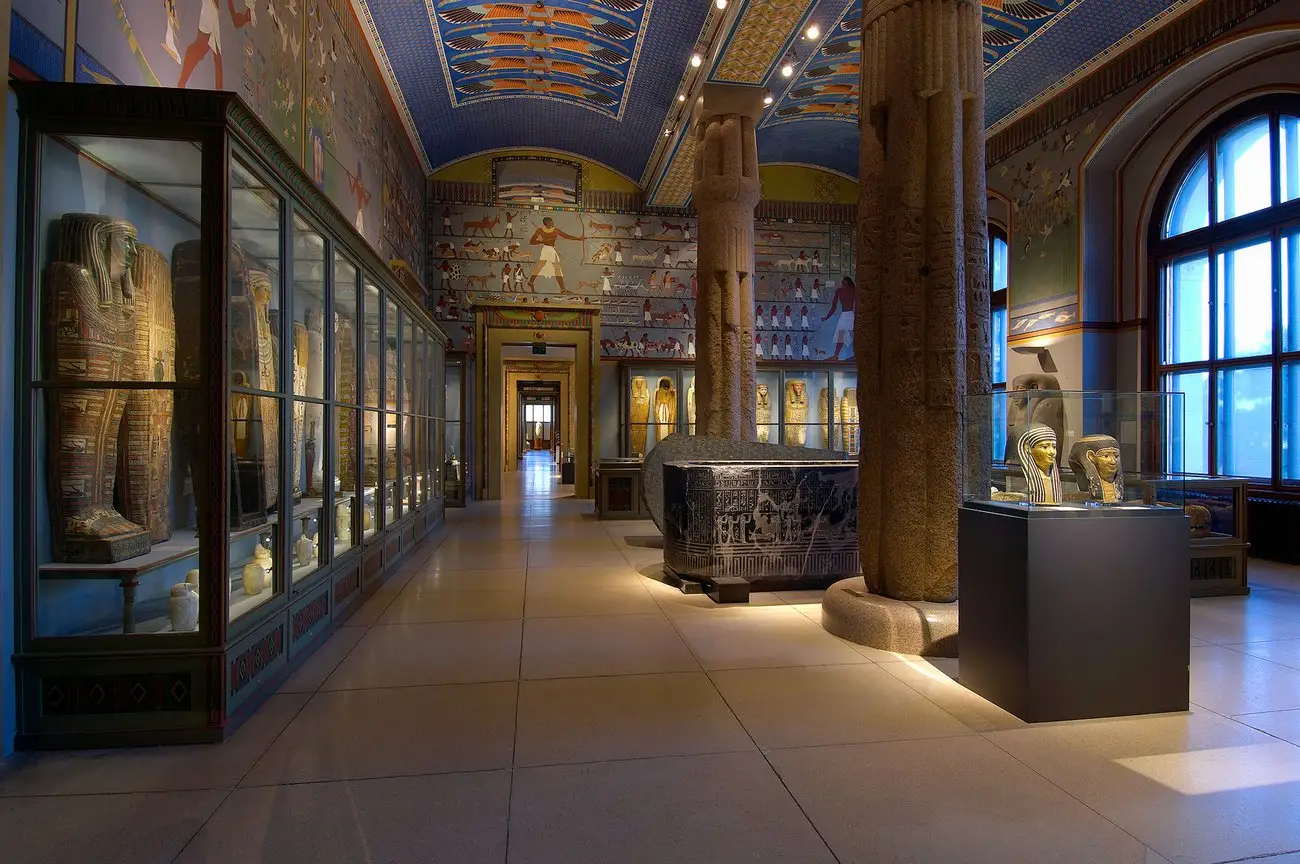
Neues Museum, Berlin. The bust of Nefertiti is not a Theban object (it comes from Amarna), but it is the most famous Egyptian face in any museum and part of the Akhenaten story that runs through Karnak. Egypt has argued that it left the country improperly in 1913, and Germany has declined to return it.
Petrie Museum, London. Part of University College London, with about 80,000 objects and a much quieter atmosphere than the big museums. It is named after Flinders Petrie, who helped establish careful stratigraphic excavation.
Other collections worth adding. The Rijksmuseum van Oudheden in Leiden has a reconstructed Temple of Taffeh. The Brooklyn Museum and the Michael C. Carlos Museum in Atlanta both hold significant Egyptian collections.
The return debate
Egypt has publicly requested the return of some high-profile objects, including the Nefertiti bust and the Rosetta Stone, and in recent years some looted pieces have been repatriated, such as a gilded coffin from the Metropolitan Museum of Art. Museums holding older acquisitions generally point to the legal terms under which they were obtained, and to the role of partage. The picture changes as new cases arise, so check current news before you travel.
Back in Luxor: see what stayed
The Luxor obelisk’s twin is still at Luxor Temple, and the Luxor Museum displays Theban finds that remained in Egypt. Seeing both before or after the museums above gives the objects their local context.