
Luxor’s temples and tombs come with entrance fees that add up fast, but a surprising amount of ancient Thebes can be enjoyed without a ticket. From 3,400-year-old statues that stand beside the road to a river crossing that costs a few pounds, here are seven ways to see Luxor without paying admission.
What “free” means here: no admission ticket. Three of these stops are on the West Bank, so you will still pay for the ferry and some onward transport to reach them, and the ferry itself costs a few pounds. We flag the real cost of each stop, and the last section covers what isn’t free.
Free in Luxor at a Glance
| Stop | Cost | Time | Best time | Bank |
|---|---|---|---|---|
| Corniche at sunset | Free | 30–45 min | About 30 min before sunset | East |
| Luxor souk | Free to browse | 30–60 min | Evening, once the heat breaks | East |
| Temples from the street | Free | Flexible | Late afternoon or evening | East |
| Public ferry | About 5–10 EGP | Short crossing | Any time | Crossing |
| Colossi of Memnon | Free (transport extra) | 10–15 min | Early morning | West |
| West Bank farm lanes | Free | Flexible | Early morning or late afternoon | West |
| New Qurna village | Free (transport extra) | About 1 hour | Morning | West |
1. Walk the Corniche at Sunset
The Corniche el-Nile is Luxor’s riverside walkway on the East Bank, with the West Bank hills and the Theban Necropolis across the water. Start near the Winter Palace Hotel about 30 minutes before sunset and follow the river at your own pace; Luxor Temple, floodlit after dark, is close by.
The crowd: local families gather here in the evening, with kids playing, vendors selling roasted corn and friends sharing tea.
The view: traditional feluccas drift past as the sky turns orange and purple behind the West Bank hills.
Cost: free (vendor snacks are extra) · Time: 30–45 minutes · Best time: the hour before sunset
Planning an evening out? See our guide to Luxor at night.
2. Get Lost in the Luxor Souk
Just behind Luxor Temple, the old market rewards a wander even if you buy nothing. The lanes near the entrance are lined with alabaster carvings and souvenirs; go further in and it turns into a local market of spices, hand-woven scarves and produce.
Shopkeepers will invite you for tea more than once. That is hospitality, not a sales contract. If you would rather just look, a polite “la shokran” (no, thank you) with a hand over your heart is understood and appreciated.
Cost: free to browse · Time: 30–60 minutes · Best time: early evening, when it is busiest and most fun
Thinking of buying? Our Luxor souk guide covers what to buy and how to haggle.
3. See the Temples from the Street
You don’t need a ticket to sense the scale of Pharaonic architecture. A good deal of it can be seen from public streets.
- Luxor Temple: from the public plaza in front of the entrance you can see the great entrance pylon and the temple’s remaining obelisk. Look for the Abu Haggag Mosque perched above the ancient stonework; it is an active place of worship, so treat it with respect. Details are in our Luxor Temple guide and Abu Haggag Mosque guide.
- Avenue of Sphinxes: this 2.7 km processional road links Luxor and Karnak temples. Parts of it can be seen, and walked, from public streets without a temple ticket. See the Avenue of Sphinxes guide.
- Karnak: from outside you get the scale of the enclosure walls and outer pylons, though not the Great Hypostyle Hall, which needs a ticket. See Karnak Temple.
Cost: free · Time: flexible; it pairs naturally with the Corniche walk · Best time: late afternoon or evening
4. Cross the Nile on the Public Ferry
Skip the private motorboats and take the public ferry, the same one locals use every day. It is the cheapest way across to the West Bank, and the crossing itself gives you views back over the East Bank and across to the Theban hills.
Cost: roughly 5–10 EGP per person; bring small notes and confirm the fare before boarding, as it shifts · Time: a short crossing · Best time: any time
Good to know: the ferry involves steps and can be difficult for travelers with limited mobility. Private motorboats cost more; see Getting Around Luxor for current fares and options.
5. Marvel at the Colossi of Memnon
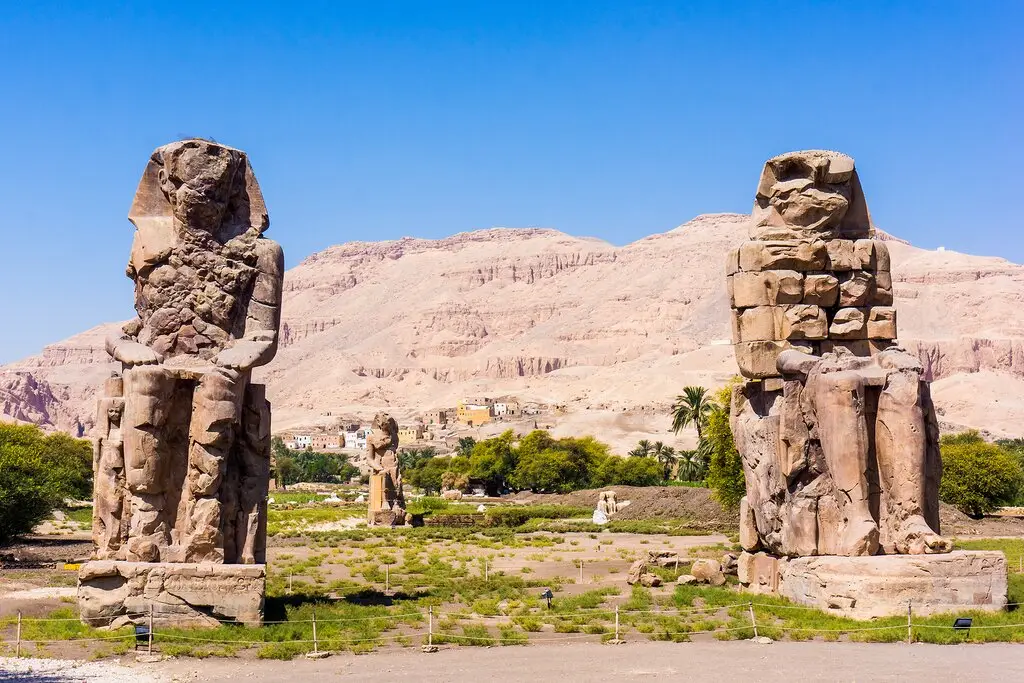
Two seated statues of Amenhotep III, each about 18 meters (60 feet) high, have stood on the West Bank plain since around 1350 BCE. They once guarded the entrance to the largest mortuary temple in Thebes. Little of the temple survives, but the statues remain, and in Roman times the northern colossus was famous for a dawn “singing” sound.
They stand right beside the road, with no ticket, no enclosure and no closing time. Many tour groups stop briefly mid-morning; go early for softer light and fewer people.
Cost: free to see (you’ll pay for transport to reach them) · Time: 10–15 minutes · Best time: early morning
The history and the legend are in our Colossi of Memnon visitor guide.
6. Walk the West Bank’s Farm Lanes
Away from the monuments, the West Bank is a working landscape: sugarcane and clover fields, irrigation canals, date palms and village houses between the river and the pale desert cliffs. Walk short stretches of village edges and canal-side paths, or rent a bike (not free, but cheap), for a slower, quieter side of Egypt than the East Bank’s tourist strip.
In many Upper Egyptian villages, house fronts are painted with murals marking a family member’s pilgrimage to Mecca, so you may come across some.
Etiquette: these are homes and livelihoods, not attractions. Ask before photographing people, dress modestly, don’t wander into fields or courtyards uninvited, and be wary of improvised “village tours”. Our Luxor countryside guide explains how to do it respectfully.
Cost: free · Time: flexible · Best time: early morning or late afternoon; avoid the midday heat
7. Visit New Qurna, Hassan Fathy’s Mudbrick Village
New Qurna (also spelled New Gourna) is a village of domes and vaults built between 1946 and 1952 by the architect Hassan Fathy to rehouse the residents of the old hillside village of Qurna. Its restored mosque, market (khan) and open-air theater, which reopened in 2021, are the main draws.
It is a living village rather than a ticketed site, so there is no entry fee. Some buildings are only accessible in the morning, so go early.
Cost: free (transport extra) · Time: about an hour · Best time: morning
What Isn’t Free (and How to Keep Costs Down)
- Getting around the West Bank: the ferry is cheap, but hiring a driver for a full day is the biggest cost. Shared minibuses and the public ferry are the budget route. Current options are in Getting Around Luxor.
- Tea and tips: accepting tea doesn’t oblige you to buy, but a small tip is customary for services. See our Luxor travel cost guide.
- Ticketed sites: Karnak, Luxor Temple and the tombs all need tickets. Prices and pass options are in our entrance fees guide.
Putting It Together: Two Free Half-Days
- East Bank evening: temples from the street in the late afternoon, the Corniche at golden hour, then the souk once the lanterns are on.
- West Bank morning: cross on the public ferry, then start early at the Colossi, continue to New Qurna, and finish in the farm lanes before the heat builds. You’ll need onward transport for this one.
Final Thoughts
None of these stops needs an admission ticket, and together they fill a relaxed day or two. Luxor’s monuments are worth their ticket prices, but some of the city’s best moments cost little or nothing. For the full picture, from Karnak’s Hypostyle Hall to the Valley of the Kings, see our complete guide to things to do in Luxor.