
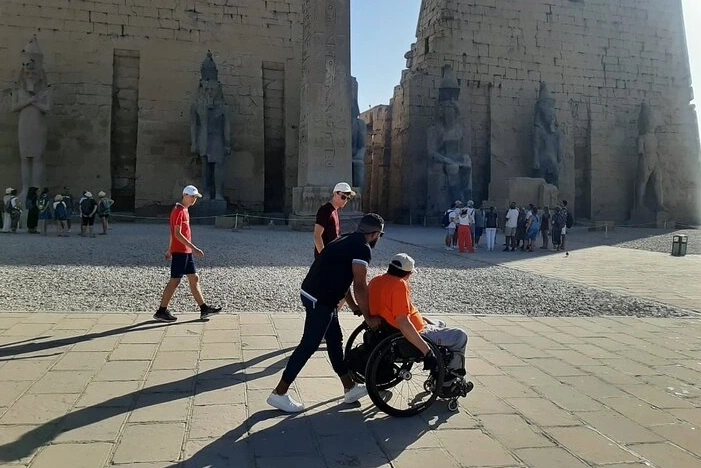
Yes, Luxor has accessibility challenges. It was not built with modern access needs in mind. Some tombs are not accessible, and some paths may need more help than you expect. Features marked as accessible may not meet your expectations. This is all true.
However, the Hypostyle Hall at Karnak Temple is one of the most remarkable spaces created by humans, and it is accessible. The Colossi of Memnon will make you feel small, and they are fully accessible. Standing by the Nile as the sun sets behind the West Bank cliffs is not a mobility challenge. It is simply one of the most extraordinary sights you will ever see.
Understanding Luxor’s Layout: East Bank vs. West Bank
The most important thing for wheelchair users to know before visiting Luxor is that the city is divided into two distinct sides of the Nile, and these areas are not equally accessible.
The East Bank is where modern Luxor is located. It has better roads, more amenities, and is home to Karnak Temple, Luxor Temple, the main museums, and most hotels. For wheelchair users, the East Bank is easier to navigate and is the best place to stay during your trip.
The West Bank has famous sites like the Valley of the Kings, Hatshepsut’s Temple, and the Colossi of Memnon. However, this area is more challenging to visit because of the difficult terrain. To get between the two banks, you need to take a ferry on the Nile. Assistance is available at the ferry points, but it’s a good idea to inform your tour operator about your needs ahead of time. On the West Bank, having a private, adapted vehicle is essential, not a luxury. For more on the differences, see our East Bank vs. West Bank comparison guide.
Karnak Temple — Wheelchair Accessible
Karnak Temple is surprisingly accessible for wheelchair users, with an air-conditioned visitor center, ramps, and paved paths throughout key areas like the Hypostyle Hall and Sacred Lake. While some ramps can be steep, most areas are reachable with assistance. A visitor noted its unexpected accessibility compared to other historical sites. Arriving early (6 AM) helps avoid crowds and heat.
Luxor Temple — Flat and Manageable
Located in the city center, Luxor Temple features mostly flat, paved ground, making it wheelchair-friendly. Some uneven stones may require help. Open late into the evening, it offers a cooler, less crowded experience with stunning evening lighting.
Valley of the Kings — Challenging Yet Accessible
While the Valley of the Kings poses challenges due to rough terrain and steep tomb stairs, it’s not entirely off-limits. Visitors can take an electric vehicle from the center to the valley entrance, enjoy open-air viewpoints, and access Tutankhamun’s tomb, which is fairly flat. A local guide can help identify accessible tombs.
Temple of Hatshepsut — Limited Access
The Temple of Hatshepsut features easy paths to lower levels but has stairs at the upper levels, limiting access for some. Views from below are still impressive, and an electric tram offers convenient transport from the parking lot.
Colossi of Memnon — Easy Visit
The two large statues of Amenhotep III are located on flat ground, making them easily accessible for wheelchair users. They are a quick, rewarding stop and popular for photos.
Luxor Museum and Mummification Museum — Highly Accessible
Luxor’s museums are modern and designed for accessibility, with ramps and elevators. The Luxor Museum and Mummification Museum are ideal for visiting in the midday heat, housing impressive artifacts comparable to those in Cairo.
For the West Bank, hire a private Egyptologist with an adapted vehicle. They know which tombs have the easiest access and can arrange wheelchair-friendly transport. The Luxor Pass can save money if you’re visiting multiple sites.
Getting Around Luxor: Accessible Transport Options
Public buses and regular local taxis are not wheelchair accessible, so the transport you arrange in advance will greatly impact your experience. Here’s what works best:
- Private adapted vehicle: This is the best option. Ask your operator specifically for vehicles with ramps or hydraulic lifts—don’t just assume a standard minivan is suitable. Make sure the vehicle has air conditioning.
- On-site electric trams: Available at the Valley of the Kings and Hatshepsut’s Temple for a small extra fee. These trams are very helpful on the West Bank.
- Nile ferry crossing: This is necessary to reach the West Bank. Assistance is available, but let your operator know your needs well in advance.
- East Bank Corniche: This riverside promenade is mostly flat and great for a nice, accessible walk, especially at dusk when it becomes lively.
What to avoid: Public buses, crowded local minibuses, and standard taxis—none of these can safely or comfortably accommodate wheelchair users.
Wheelchair Accessible Hotels in Luxor
Choosing the right hotel can greatly affect your trip. Here are some of the best hotels for wheelchair users on the East Bank:
- Hilton Luxor Resort & Spa: This hotel is by the riverside and has accessible rooms, pool facilities, and reliable amenities.
- Sofitel Winter Palace Luxor: This historic hotel offers accessible features and beautiful grounds. Be sure to call ahead to check specific room features.
- Steigenberger Nile Palace: This hotel has good accessibility options and is close to major East Bank sites.
No matter which hotel you choose, always call them directly to ask about:
- Roll‑in showers (not just bathtubs with grab rails)
- Grab bars in the bathroom
- Elevator access to all floors
- Width of door frames and bathroom entries
- Distance from accessible parking to the reception entrance
For a complete list of accommodations, check our Where to Stay in Luxor and Best Hotels in Luxor guides.
Accessible Nile Cruises: A Comfort-Forward Way to See More
For wheelchair users who want to visit several temple sites without the hassle of packing and unpacking every day, a Nile cruise between Luxor and Aswan is a great option. You only unpack once, and each morning, new sites are right outside your window.
The best accessible cruise ships offer:
- Elevators connecting all passenger decks
- Adapted cabins with roll‑in showers and grab bars
- Wide gangways for easy boarding and disembarking
- Flat, manageable deck surfaces for both manual and power chairs
However, not all cruise ships are the same. Gangway widths, step heights, and deck transitions vary a lot between ships, and marketing photos may not show these details accurately. Before you book, ask your operator these specific questions:
- What is the exact width of the gangway at boarding?
- Are there steps between any decks that the elevator does not reach?
- Has a wheelchair user completed this cruise on this particular ship?
It is essential to work with a specialist accessible travel operator who has personally inspected the ship and knows if disabled travelers can board it.
Honest Challenges to Expect — And How to Plan Around Them
A travel guide for Luxor should be honest about what to expect. Here are some important points to consider:
- Expect uneven surfaces everywhere. Ancient stone paths, sandy trails between sites, and unexpected steps are common in Luxor’s outdoor areas.
- Accessible features might not always work well. A ramp on a map could be blocked, under repair, or harder to use than it seems.
- Heat can be a major challenge. In hot months, it can be unsafe to spend too much time outside. Treat this seriously, just like you would any physical challenge.
- Crowds can create problems. Busy times at major sites can block paths and make it hard for helpers. Starting your day early can really help.
- Stay flexible. Prepare for limited access, celebrate where you can go, and work with a guide who can adapt when plans change. Travelers who enjoy Luxor the most are those who stay open-minded and ready for adjustments.
Practical Tips for Wheelchair Users Visiting Luxor
Before You Go:
- Book a tour operator that specializes in accessible travel. Companies offer tours designed for accessibility and have staff who understand what you need.
- Ask for a personal assistant along with your guide. Your Egyptologist can focus on the history, while the assistant takes care of daily logistics.
- Talk about your wheelchair type with your tour operator. Manual chairs are lighter and easier to push on sandy ground; power chairs provide more independence but may struggle on rough terrain. Weigh the options together.
- Call each hotel directly to check their accessibility features before you book your stay.
On the Ground:
- Visit between October and April. The temperatures are cooler, making your experience more comfortable.
- Start your day by 6 or 7 AM. This choice can greatly improve your experience as a wheelchair user in Luxor.
- Bring more water than you expect to need. Then bring even more.
- Put on sunscreen before leaving the hotel, not when you arrive at the site.
- Plan for shaded rest stops during your day. This is about logistics, not just comfort.
- Download a translation app before you arrive. While many people speak English in tourist areas, having Arabic can help with small interactions.