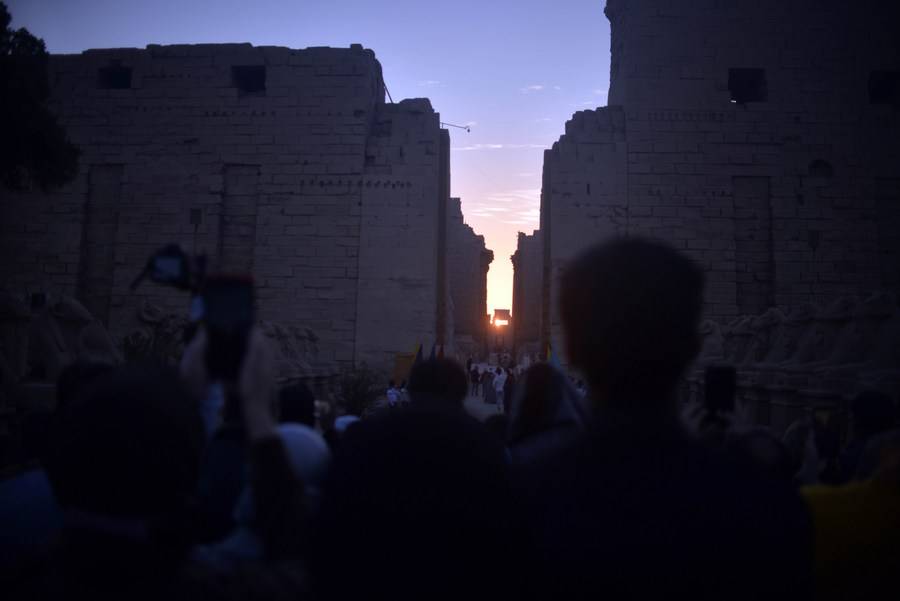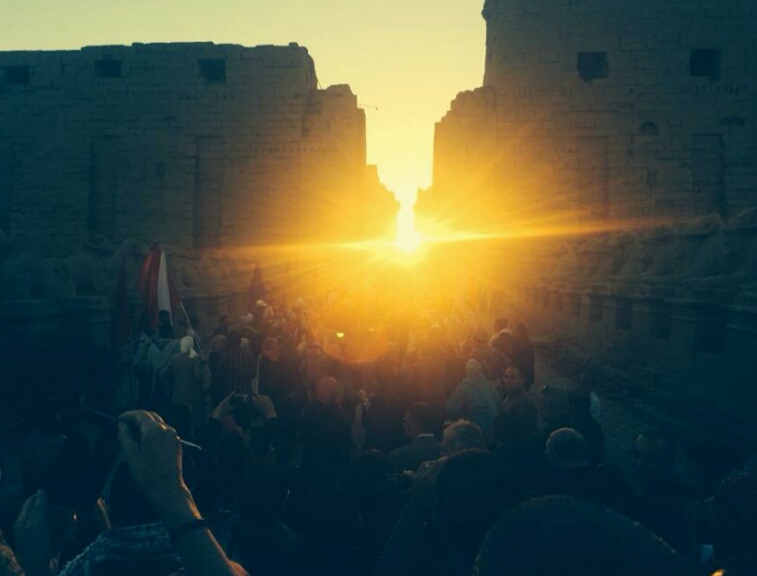
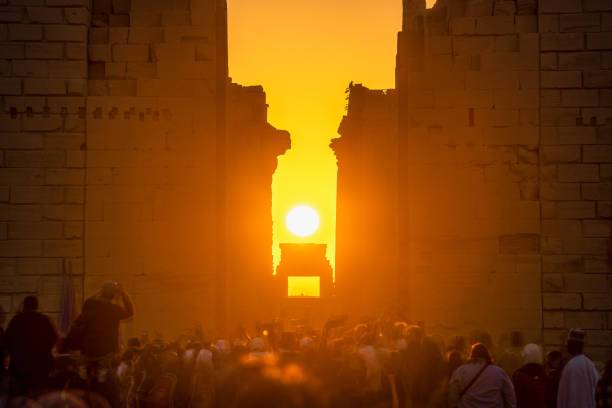
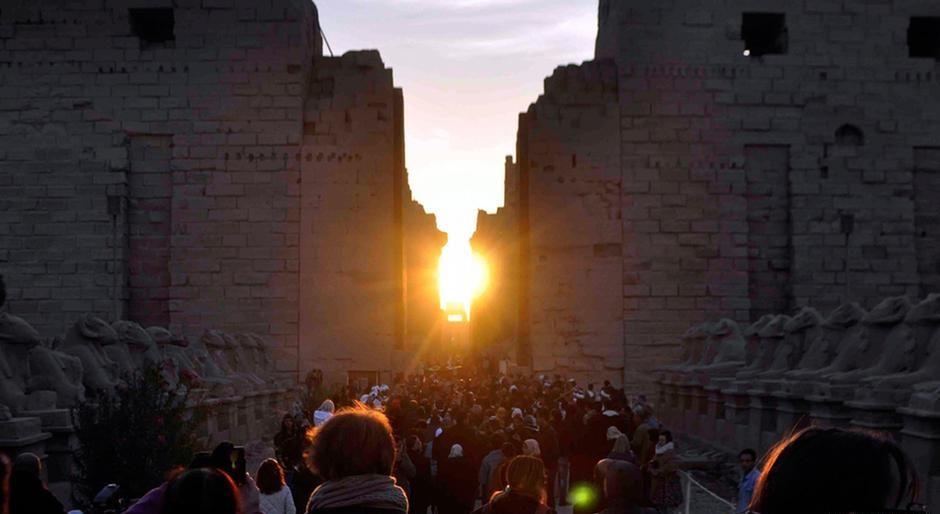
Every December 21, for a few minutes just after sunrise, a beam of light enters Karnak Temple‘s eastern gate and travels the full length of the temple’s main axis to illuminate the sanctuary of Amun-Ra at the far end. This alignment has been happening, by design, for nearly 4,000 years.
It is not an accident or an approximation. Karnak’s architects oriented the temple’s axis with deliberate precision so that the winter solstice sunrise — the moment the sun begins its return northward after the year’s shortest day — would produce exactly this effect. Standing inside the temple as it happens, watching cold stone turn gold as the light travels past the hypostyle hall columns, is one of the more genuinely moving things available to a visitor in Luxor.
What Happens and Why
The winter solstice is the day the sun rises furthest to the southeast, having reached the southernmost point of its annual arc. At Karnak, the temple’s main axis runs approximately east-west, aligned specifically toward this sunrise point. When conditions are clear, the sun’s first rays enter through the main gate and penetrate along the axis to reach the innermost sanctuary — the Holy of Holies — in a shaft of light that lasts only a few minutes before the sun rises high enough to lose the alignment.
The alignment happens around sunrise on December 21 — the exact time varies slightly by year and weather conditions. Visitors who want to see the light inside the sanctuary need to be positioned inside the temple before the sun clears the horizon, which means arriving at the temple by around 5:30 AM. The alignment window is narrow.
Ancient Egyptian architects used instruments called the merkhet (a sighting tool, similar in function to an astrolabe) and tracked the rising of the star Sirius — whose annual reappearance coincided with the Nile’s flood season — to establish astronomical alignments. The solstice alignment at Karnak was not Egypt’s only intentional solar orientation: the Temple of Hatshepsut at Deir el-Bahari has its own solar alignment, and the temples at Abu Simbel are famously illuminated on the equinoxes.
Historical and Religious Significance
Karnak was dedicated to Amun-Ra — a compound deity combining Amun, the hidden god of Thebes, with Ra, the sun god. The winter solstice held specific theological significance: it marked the moment the sun began to grow stronger after its annual decline, which in Egyptian religious terms was understood as the rebirth of Ra. An architecture that captured and demonstrated this rebirth in the god’s own sanctuary was a statement about the divine order made in stone.
The priests of Amun at Karnak functioned simultaneously as astronomers, tracking celestial events to time temple rituals and agricultural calendars. The solstice alignment was one of the more dramatic expressions of this knowledge, but it existed within a broader tradition of astronomical precision that shaped festival timing across Egypt. For more on ancient Egyptian astronomy, see our Ancient Egyptian Astronomy guide.
Karnak was built and expanded over nearly 2,000 years — from Senusret I (c. 1971 BCE) through the Ptolemaic period — with major contributions from Thutmose III, Hatshepsut, Seti I, and Ramesses II, among others. The main axis, and its solstice alignment, appears to have been established early and maintained through subsequent building campaigns.
Planning Your Visit for December 21
Arrive by 5:00–5:15 AM. The alignment lasts only a few minutes, crowds gather quickly for this event, and positioning inside the temple before sunrise is necessary to see the light travel down the axis. The ticket office should be confirmed to be open at this hour before you arrive — check with your hotel the evening before. For current opening hours, see our Luxor ticket offices guide.
December temperatures: mornings in Luxor in late December are genuinely cool — typically 8–12°C before sunrise, warming through the morning. Dress in proper layers; the chill at 5:30 AM standing in an open stone complex is real, not just relative. For more seasonal guidance, see our Luxor weather guide.
Camera settings: the pre-dawn and sunrise conditions inside the temple require a camera capable of shooting in low light without flash. A tripod is helpful but may be restricted depending on how many visitors are present — confirm at entry.
A guided visit adds significant value here. The astronomical context, the specific positioning within the temple, and the interpretation of what you’re seeing are all much richer with a knowledgeable guide who knows Karnak well. Most Luxor tour operators can arrange a solstice-specific guided visit; book well in advance for December dates.
Standard Karnak entrance fees apply (EGP 600 for foreign adults). No additional ticket is required for the solstice event itself. For a cost-saving option if visiting multiple sites, consider the Luxor Pass.

The Experience
What makes the December 21 visit different from a standard Karnak morning is less about the spectacle than about what it makes legible. Karnak is large enough to feel abstract — a vast accumulation of structures added over 2,000 years, oriented in ways that aren’t always immediately clear. The solstice alignment makes the temple’s primary intention suddenly obvious: this building was designed to demonstrate the sun’s relationship with the god, physically and annually, for as long as the temple stood.
When the light enters and travels the axis, you’re watching the original purpose of the building perform itself in real time. That is worth a 5:00 AM alarm.