
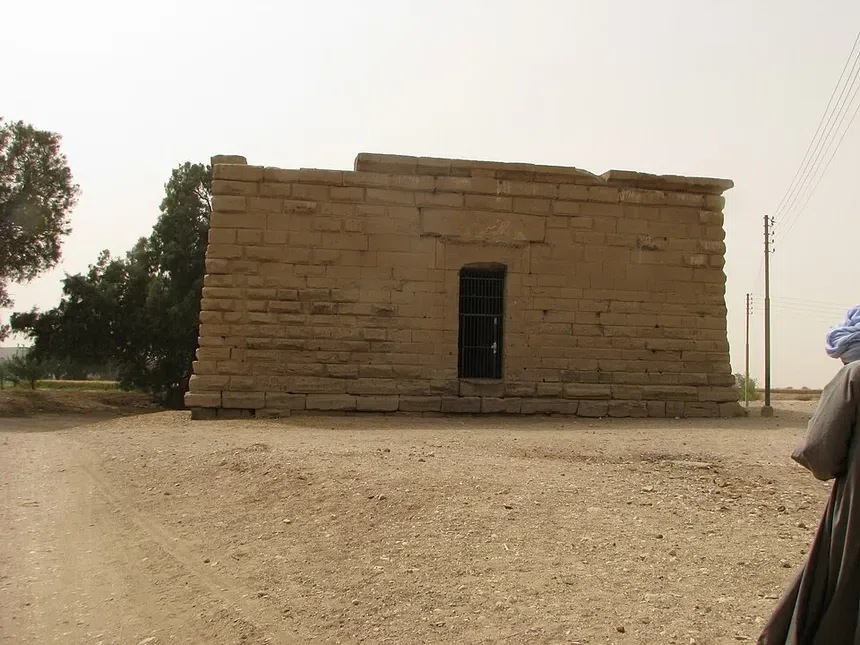
Karnak pulls in crowds by the busload. Luxor Temple lights up at night for a reason. But a few kilometers south, past Medinet Habu and the ruins of Malkata, sits a temple almost nobody visits: Deir El-Shelwit. It’s small, sun-bleached, and skipped entirely by most tour itineraries — yet it holds a distinction none of Luxor’s bigger sites can claim. It’s the only major Greco-Roman religious building in the Theban region not dedicated to Amun, Mut, and Khonsu. Instead, this quiet ruin belongs to Isis. If you’d rather stand alone in a 2,000-year-old sanctuary than shuffle through a crowd, it deserves a spot on your West Bank itinerary.
What Is Deir El-Shelwit?
Deir El-Shelwit is a Greco-Roman period temple dedicated to the goddess Isis, standing on Luxor’s West Bank roughly a kilometer from the royal palace remains at Malkata and about four kilometers south of Medinet Habu. Its name comes from the Arabic word for “monastery” — a nod to its later life as a Coptic Christian site, a naming pattern shared by several Theban temples that were repurposed by early Christians long after their original gods had gone quiet.
History
The exact starting point of construction is still debated. Inscriptions on the temple’s propylon (a freestanding entrance gateway) date the building’s completion to the early 1st century CE, but one theory suggests that work on the main temple itself may have begun under Nectanebo II before being completed in the Greco-Roman era. What’s certain is that no earlier structure is known to have stood on this site — Deir El-Shelwit was built for Isis from the ground up, not layered over an older cult center.
Over the following decades, several Roman rulers left their mark on the walls and pylon. Their cartouches still appear on the stonework today:
- Julius Caesar
- Galba
- Otho
- Vespasian
- Hadrian
- Antoninus Pius
That span of emperors — from Caesar to Antoninus Pius covers roughly 200 years — tells its own story: a temple actively maintained and added to across multiple imperial reigns. Its afterlife is just as revealing. By the Coptic era the temple had been abandoned as a place of worship, and its well was eventually used as a rubbish pit. When a team from Japan’s Waseda University excavated it between 1971 and 1979, they found thirty-two layers of compacted debris inside — evidence of how long the site sat forgotten before anyone looked closely at it again.
Why Isis, Not the Theban Triad?
This is the detail that makes Deir El-Shelwit genuinely unusual. Nearly every other religious structure built in the Theban area during the Greco-Roman period honored Amun and his family. Deir El-Shelwit didn’t — reflecting the way Isis worship had spread and gained prominence across Egypt and the wider Mediterranean world during this period, eventually rivaling the older Theban cults in popular devotion.
Isis isn’t the only deity depicted inside. Reliefs throughout the temple also show Anubis (wearing the double crown of Upper and Lower Egypt), Montu (falcon-headed, with a double-plumed crown), Osiris and Horus (including a youthful Horus in a child’s sidelock), Nephthys, Maat, and Sekhmet.
For visitors without an Egyptology background, identifying which goddess is which can be genuinely tricky — most wear similar cow-horn and sun-disk headdresses. The key to spotting Isis specifically is her throne-shaped hieroglyph crown (a flat-topped seat worn on her head) and, in scenes showing her with Osiris, her characteristic protective wing posture with arms stretched wide. Where that distinctive throne crown appears, you’re looking at Isis. The puzzle of working it out slowly is part of what makes a slow walk through the temple worthwhile.
Architecture
Compared to Karnak’s scale, Deir El-Shelwit is almost domestic in size. The temple precinct covers roughly 78 by 58 meters; the sanctuary itself is a modest 13 by 16 meters. What it lacks in footprint, it makes up for in layered detail:
The propylon: a heavily decorated freestanding gateway standing about 60 meters east of the main temple — it’s often the first thing visitors see approaching the site, and the most extensively studied structure here thanks to Christiane Zivie’s 1992 publication of its inscriptions.
The naos (inner sanctuary): the heart of the temple, wrapped by a corridor sometimes called the “Corridor of Mysteries.”
Side chapels and a wabet: a dedicated purification room opening off the corridor, where ritual cleansing of cult objects took place.
A rooftop staircase: accessible from the corridor, used for solar rituals — one of the features that link Deir El-Shelwit to the broader Ptolemaic-Roman tradition of rooftop ritual spaces (the zodiac ceiling at Dendera’s roof chapel is the most famous example of the same tradition).
Recycled New Kingdom blocks: older stones are built into the outer walls, many believed to have come from nearby Medinet Habu. For visitors who like their history layered, this is a pleasing detail — a Greco-Roman temple to Isis, built in part from the bones of a temple dedicated to Ramesses III.
Archaeological History
Deir El-Shelwit’s modern story is one of slow rediscovery. Karl Richard Lepsius examined the site in the mid-19th century without leaving a detailed record. The Waseda University team’s excavation (1971–1979) cleared centuries of debris and opened the well. Christiane Zivie’s 1992 publication of the propylon inscriptions provided the first rigorous historical framework for the site.
Since 2012, the American Research Center in Egypt (ARCE) has partnered with Egypt’s Supreme Council of Antiquities on conservation work — stabilizing walls, treating stonework, and making the site safer for the limited number of visitors who find their way here.
Visiting Deir El-Shelwit
Getting there: Cross to the West Bank by ferry or bridge, then continue by taxi south through the village area near Medinet Habu toward Malkata. The access road leading to the temple is unpaved and rough in sections — a standard taxi can manage it, though the driver may prefer to park at the edge and let you walk the last stretch (a few hundred meters). Allow extra time if combining with Medinet Habu and Malkata on the same day.
Tickets: entry is arranged through the main West Bank ticket office rather than on-site. Buy your ticket before heading out to the southern West Bank.
| Tickets (foreign adult) | EGP 100 |
|---|---|
| Tickets (foreign student) | EGP 50 |
| Hours | Generally 6:00 AM – 5:00 PM; confirm locally |
| Time needed | 30–45 minutes |
| Facilities | Minimal — bring water |
| Other visitors | Very few; quiet is the norm |
Best combined itinerary: Medinet Habu (EGP 220, 45–60 minutes) + Colossi of Memnon (free, 10 minutes roadside) + Deir El-Shelwit (EGP 100, 30–45 minutes) forms a coherent southern West Bank half-day. Add Malkata Palace ruins if you want a full day in this quieter part of the necropolis.
Photography: unrestricted outdoors; confirm inside the sanctuary on arrival.
Why It’s Worth the Detour
Deir El-Shelwit belongs to a different register from Luxor’s headline sites — not overwhelming, not dazzling, but quietly legible in a way that the bigger temples, crowded and clamoring for attention, sometimes aren’t. The span of Roman emperors on its walls is a compressed history of Egypt under Roman rule. The recycled blocks from Medinet Habu are a reminder that ancient builders worked with what was around them. The thirty-two layers of debris in the well are proof of just how completely a civilization can disappear, and how long it can take someone to come looking.
For travelers who’ve seen the major sites and want to understand Luxor a little more fully, this is one of the places where that happens.