
By the time Ameneminet was performing rituals in Thebes, Montuhotep II had already been dead for roughly 900 years — and was still being worshipped as a god. That gap is the whole point of TT277: it’s a tomb about religious continuity, showing a Ramesside-era priest honoring a king from an entirely different age of Egyptian history.
Ameneminet held the title “divine father of Ptah-Sokaris” and served in the mortuary cult of Amenhotep III during the Ramesside Period (roughly Dynasty 19–20, c. 1295–1170 BCE) — generations after Amenhotep III’s own reign had ended. His small, incompletely finished but well-preserved tomb sits in Qurnet Murai, part of the Theban Necropolis on Luxor’s West Bank, and its decoration brings together royal cult ritual, priestly procession, and detailed royal costume in a way few other private tombs attempt.
Honoring Montuhotep II and Ahmose-Nefertari
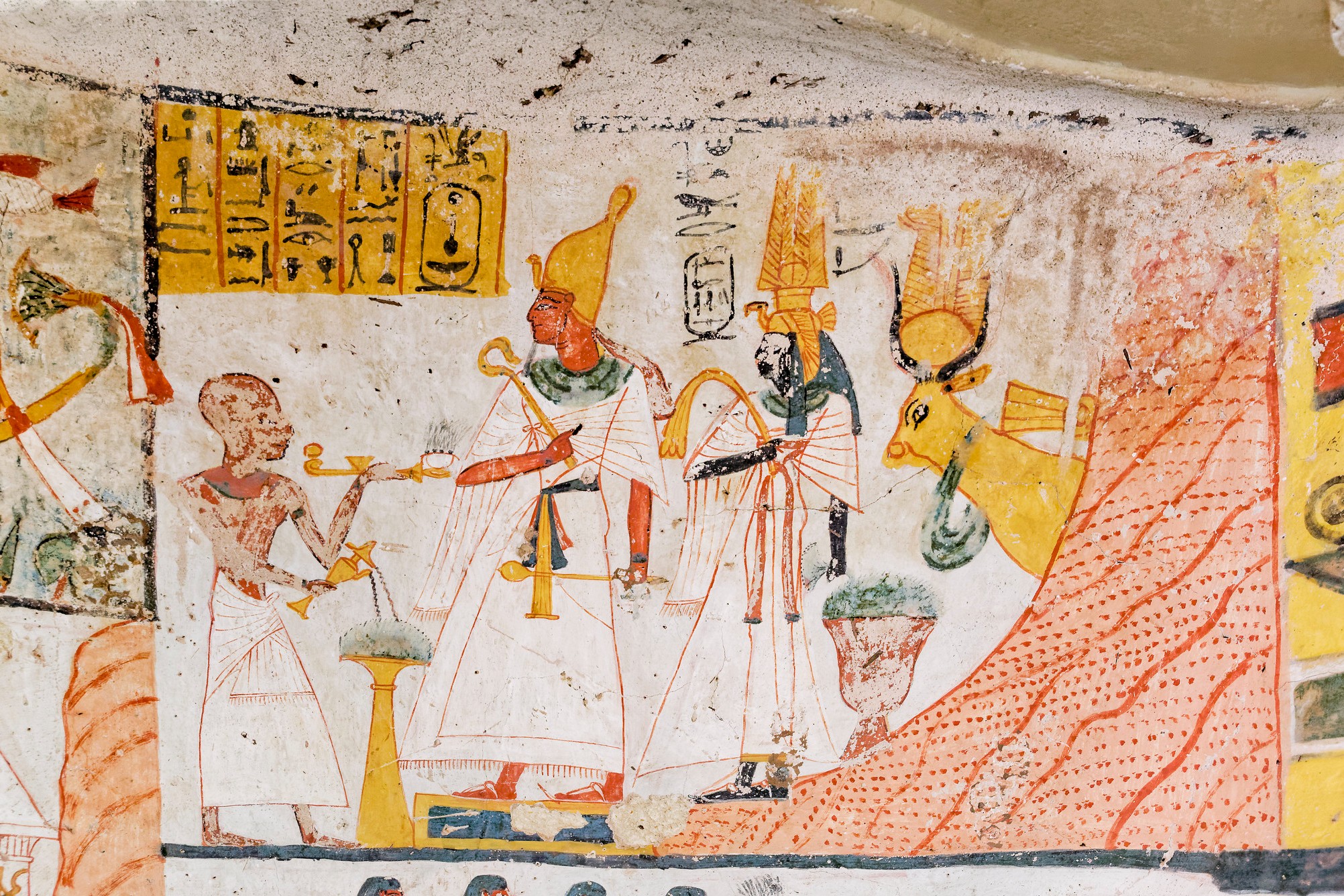
One of TT277’s most striking scenes shows Ameneminet pouring a libation and offering incense before statues of Montuhotep II — founder of the Middle Kingdom — and Queen Ahmose-Nefertari, both shown posthumously rather than as living figures, indicated by the pedestal beneath Montuhotep’s feet and Ahmose-Nefertari’s conventionally dark skin tone. Montuhotep wears the white royal robe and Upper Egyptian crown with the heqa sceptre and hedj mace of kingship; behind the pair, the sacred cow of Hathor emerges from the Theban mountain.
Ahmose-Nefertari — wife of Ahmose I and mother of Amenhotep I — was venerated at Thebes for centuries after her death, and a nearly identical scene appears in the nearby tomb of Inerkhau (TT359), suggesting this was an established ritual tradition rather than something Ameneminet invented for his own tomb.
The Royal Procession
Priests pull the royal statues forward on sledges in two distinct groups — some wigged, some shaven-headed — dressed formally for what was clearly a major ceremonial occasion. Ameneminet himself appears behind them, carrying a large feather fan in his role as a fan-bearer connected to Amenhotep III’s temple, a position that would have put him close to genuinely important royal and religious ceremonies during his lifetime.


Amenhotep III and Queen Tiy
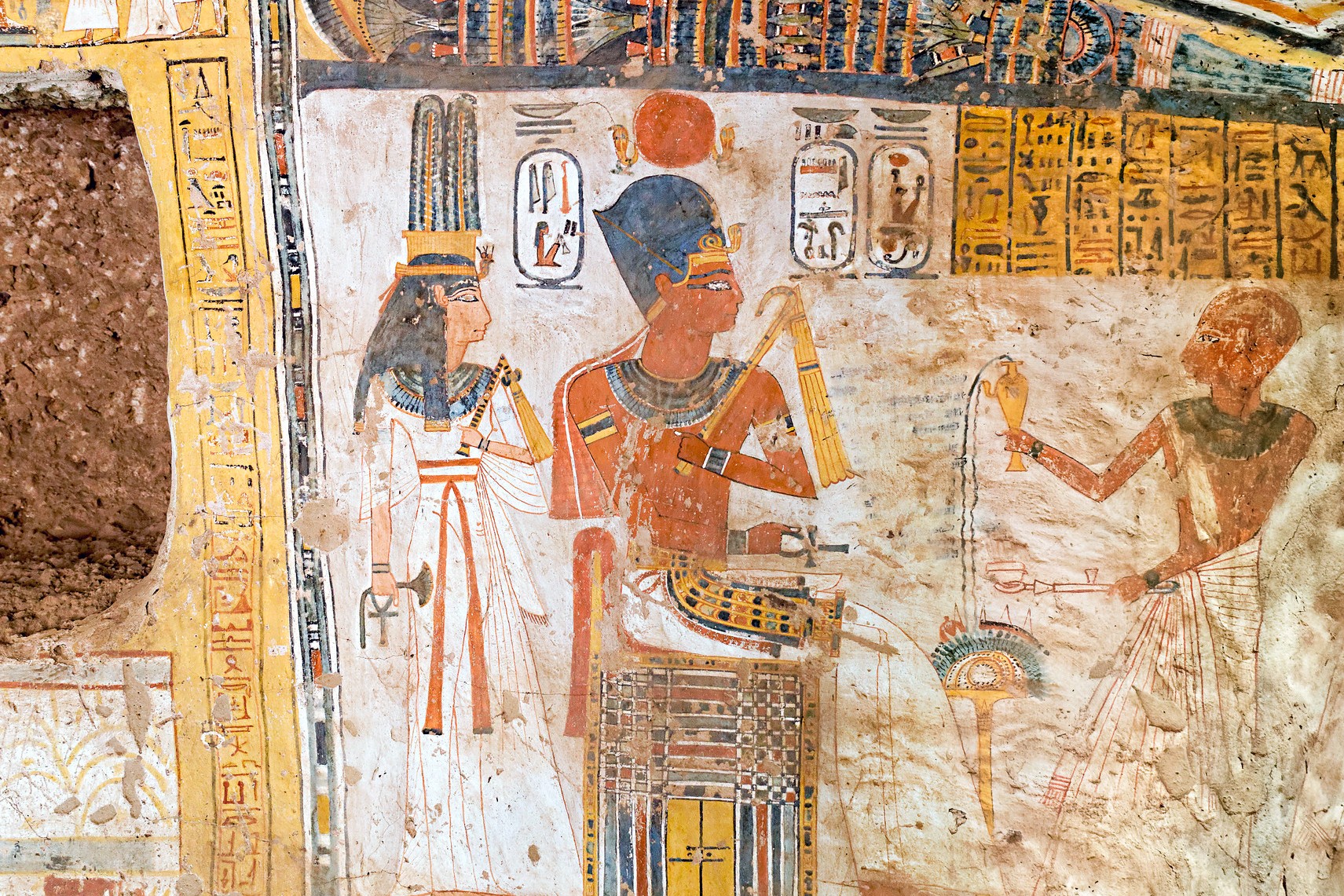
A separate scene shows Amenhotep III enthroned in the blue khepresh crown, holding the crook, flail, and ankh, with Queen Tiy standing behind him in an elaborate feathered headdress, carrying a flail, ankh, and lotus flower. Ameneminet stands on a raised platform before them, pouring water and holding a censer over a small offering stand — the classic Egyptian purification ritual of water and incense preparing a sacred setting for offerings.

The Royal Statues in Detail
The decoration also captures the statues themselves in unusual detail: Amenhotep III’s statue, identified by his throne name Nebmaatre, wears a voluminous white garment and the blue crown, with papyrus plants rising symbolically on either side of his head. The queen’s statue is equally elaborate — a fringed garment, an open lotus flower, a protective vulture overhead, and an unusual composition involving uraei and what has been interpreted as a water scorpion, likely carrying its own symbolic weight rather than serving as pure decoration. Named priests and fan-bearers — Usermontu, Piay, Ptahmes, and Userhat — appear behind the royal figures, underscoring how many distinct religious offices were involved in a ceremony like this.


What the Inscriptions Ask For
TT277’s doorpost inscriptions are unusually direct about what Ameneminet wanted from the afterlife: one offering formula asks Osiris, lord of Abydos, for pure offerings, libations, wine, and milk; another addresses Amun, Re-Horakhty, and Atum for protection and free passage in and out of the underworld. Together, they capture one of the central anxieties of Egyptian funerary religion — that the dead needed not just sustenance, but continued freedom of movement between worlds. For the wider context, see Funerals in Ancient Egypt.
Visiting the Tomb of Ameneminet
- Location: Qurnet Murai, a smaller and less-visited section of the Theban Necropolis than Sheikh Abd el-Qurna.
- Ticket: TT277 is typically sold on a joint Qurnet Murai ticket with neighboring tombs in the area. For current grouping and pricing, see Luxor Entrance Fees.
- Time needed: 20–25 minutes, given the density of distinct scenes.
- Accessibility: Rock-cut hillside tomb; not wheelchair accessible.
- Best time: Early morning, for light and lower heat. See the best times to visit Luxor.
TT277 isn’t the biggest or most famous tomb on the West Bank, but it’s one of the clearest windows into how far back Egyptian royal ancestor worship reached — a Ramesside priest, still performing rites for a king nine centuries gone.