Painting Gallery · Orientalist Egypt

Orientalist Paintings of Egypt: Staged Scenes and Imagined Antiquity

Eleven 19th-century paintings of Egypt and how to read them: what is shown, what is staged and what was imagined.

Many 19th-century European painters sold Egypt to Western audiences, and many of their scenes were composed in studios from sketches, props and imagination. These eleven works include reconstructions of ancient Egypt and staged scenes of the artists’ own day: a market, a harem outing, a prisoner and a desert storm. Read them as pictures made for buyers in Europe, not as photographs. Each entry says what is shown and what may be staged or stereotyped. For paintings of the real market and mosque at Luxor, see Paintings of Luxor Temple and the Nile.

What “Orientalist” Means

“Orientalist” is the label art historians give to Western paintings of North Africa and the Middle East, most of them made in the 19th century. The term took its critical sense from Edward Said’s book Orientalism (1978), and Linda Nochlin’s essay “The Imaginary Orient” (1983) is a standard starting point for applying that argument to paintings like these: the Egypt they show was shaped as much by European tastes and expectations as by what the painters saw. Two habits recur in this gallery. Some artists reconstructed ancient Egypt from books and museum objects; others painted the Egypt of their own day, with props and poses arranged in the studio.

Imagined Ancient Egypt

Seven scenes of the pharaonic world as painters imagined it, built from books and museum collections rather than from direct observation of ancient life.

Egyptian Chess Players
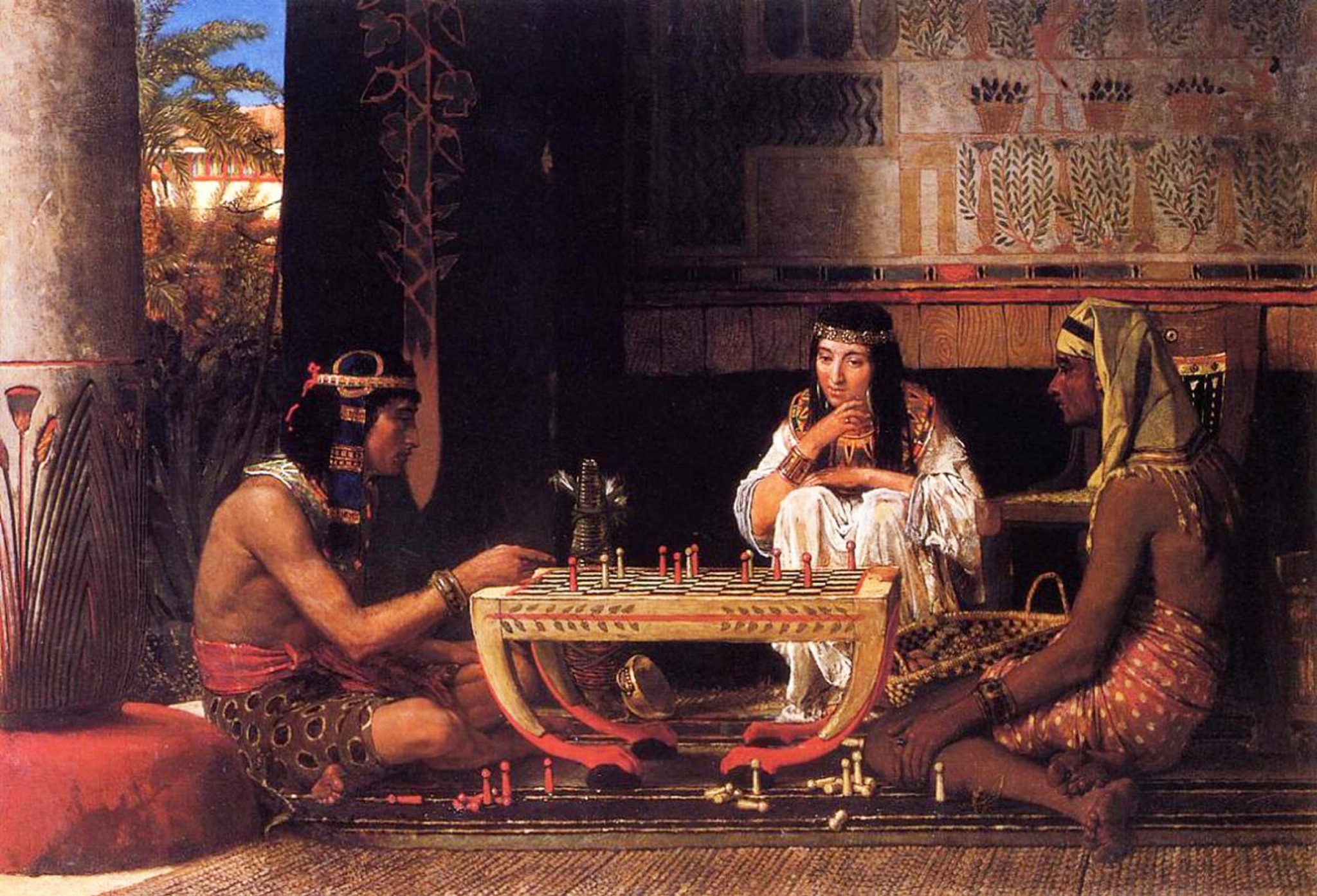
Painting of Egyptian Chess Players, Sir Lawrence Alma-Tadema, 1865
Sir Lawrence Alma-Tadema, 1865 · medium: Oil on wood panel (approx. 40 × 56 cm; published dimensions vary slightly) · collection or source: Private collection · artwork: public domain

Often titled Egyptian Chess Players, this 1865 panel shows three figures gathered around a board game in an imagined ancient Egyptian interior. Alma-Tadema was developing the close rendering of costume, objects and domestic settings that would later mark many of his scenes of antiquity. The quiet, balanced composition makes the encounter feel self-contained. The support is wood, not canvas, and the identity of the game is less certain than the conventional title suggests. Nothing here records how Egyptians played: it is a reconstruction made in Europe.

An Egyptian in a Doorway

Painting of An Egyptian in a Doorway, Sir Lawrence Alma-Tadema, 1865
Sir Lawrence Alma-Tadema, 1865 · medium: Oil on wood (55.9 × 39.4 cm) · collection or source: The Metropolitan Museum of Art, New York (acc. 2017.202.1) · artwork: public domain

Painted in 1865, this small panel shows a young man in a white robe and red sash leaning in a doorway beside a painted column. Alma-Tadema treats it as an intimate moment rather than a dramatic historical episode, using archaeological detail and a carefully staged setting to make the imagined ancient world feel immediate. The picture was made for the dealer Ernest Gambart, which shows how closely such work was tied to the art market.

The Mandolin Player

Painting of The Mandolin Player, Edwin Long, 1886
Edwin Long, 1886 · medium: Oil on panel (27 × 20 in) · collection or source: The Maas Gallery · artwork: public domain

Signed and dated 1886, Edwin Long’s The Mandolin Player belongs with his late-Victorian single-figure works, in which staged costumes, props and polished surfaces evoke an idealised ancient or Eastern setting rather than documenting historic life. Long’s journey through Egypt and Syria in the mid-1870s helped shape his later subjects, alongside his study of objects in the British Museum. The panel is often paired with An Egyptian Girl with a Sistrum.

An Egyptian Girl with a Sistrum

Painting of An Egyptian Girl with a Sistrum, Edwin Long, 1886
Edwin Long, 1886 · medium: Oil on panel (27 × 20 in) · collection or source: Maas Gallery · artwork: public domain

Signed and dated 1886, this panel shows a young woman holding a sistrum, a ritual rattle associated especially with the cults of Hathor and Isis. Long regularly built single-figure compositions on Egyptian themes, combining museum-inspired details with the staged beauty and costume favoured by Victorian academic painting. These are nineteenth-century reconstructions of antiquity, not records of pharaonic dress or ritual. Its companion is The Mandolin Player.

A Votary of Isis

Painting of A Votary of Isis, Edwin Long, 1883
Edwin Long, 1883 · medium: Oil on canvas (66 × 51 cm; 26 × 20 in) · collection or source: Private collection; sale record: Sotheby’s, Victorian & Edwardian (2007) · artwork: public domain

Signed with Long’s monogram and dated 1883, A Votary of Isis shows a woman in elaborate Egyptianising dress against a wall of hieroglyphic decoration and a lotus border. Her headdress, jewellery and translucent robe are painted with the finish associated with Long’s Victorian reconstructions of ancient life. The figure is thought to relate to the central head in his larger painting Love’s Labour’s Lost (1885), now at the Dahesh Museum of Art. Isis was a major Egyptian goddess associated with kingship, protection and motherhood.

An Ancient Custom

Painting of An Ancient Custom, Edwin Long, 1876
Edwin Long, 1876 · medium: Oil on canvas (100 × 138 cm; 39½ × 54 in) · collection or source: Private collection · artwork: public domain

Long signed and dated this canvas in 1876. The title points to a custom imagined in an ancient setting, part of his wider interest in reconstructing past societies through costume, architecture and carefully arranged figures. He had travelled in Egypt and Syria in the mid-1870s, but many details in his paintings were assembled from published sources and museum objects rather than recorded from a single observed scene. Auction records also list a separate, smaller version dated 1877.

The Gods and Their Makers

Painting of The Gods and Their Makers, Edwin Long, 1878
Edwin Long, 1878 · medium: Oil on canvas (142 × 224 cm; 55¾ × 88 in.) · collection or source: Towneley Hall Art Gallery and Museums, Burnley · artwork: public domain

In this large 1878 canvas Long imagines a workshop where craftsmen make and arrange images of Egyptian deities. Workers, finished figures, sketches and a cat with kittens turn the making of sacred objects into a detailed scene of everyday activity. Its archaeological look is a Victorian reconstruction, shaped by the period’s growing interest in ancient Egypt and the museum collections available to artists. It is one of Long’s ambitious multi-figure history paintings.

Staged Scenes of 19th-Century Egypt

Four scenes set in the Egypt of the artists’ own day: an antiques seller, a harem outing, a prisoner and a desert wind. They look observed, but each was composed for buyers in Europe.

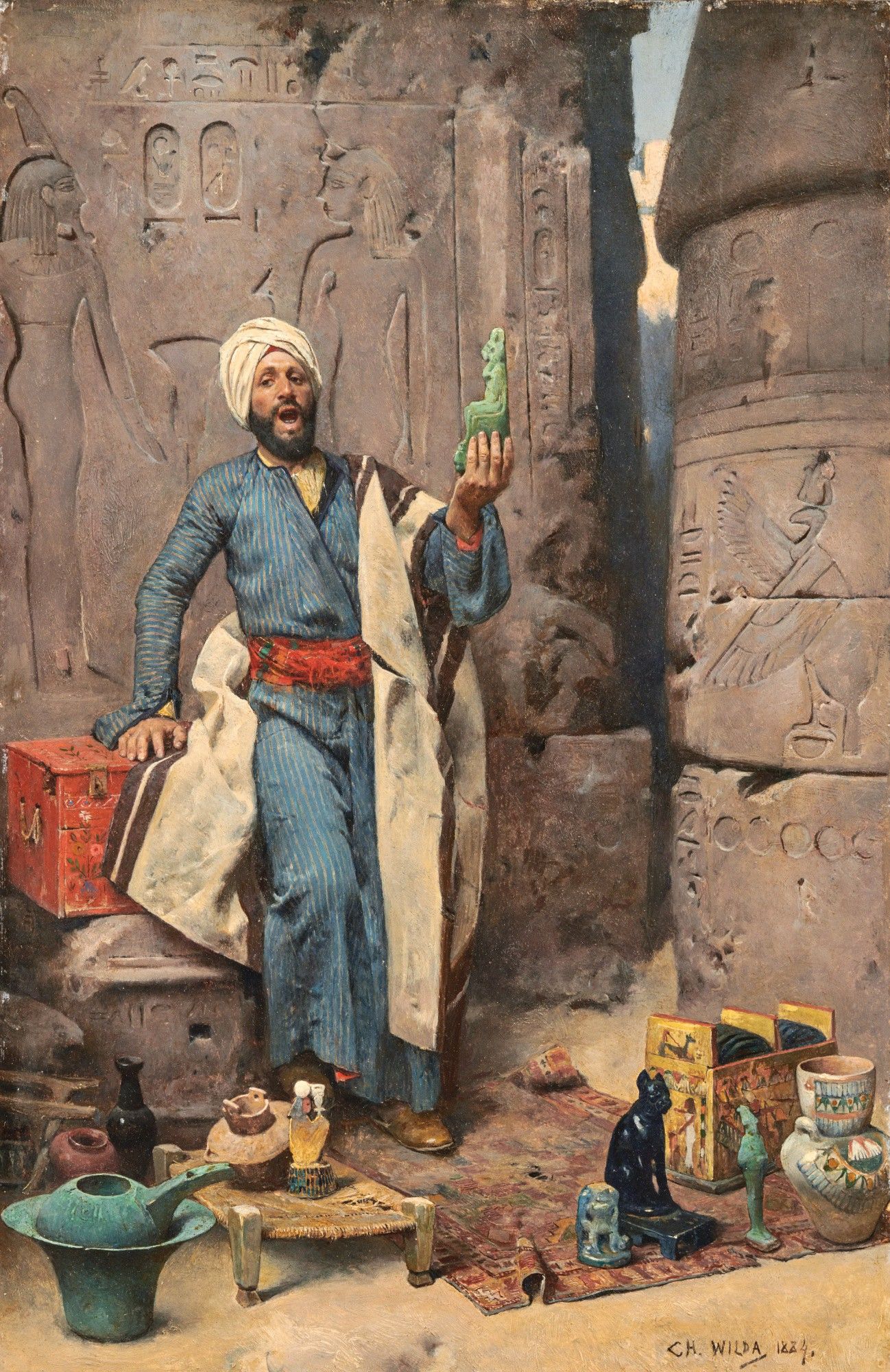
The Egyptian Antiques Seller

Painting of The Egyptian Antiques Seller, Charles Wilda, 1884
Charles Wilda, 1884 · medium: Oil on panel (46 × 29 cm) · collection or source: Sotheby’s, Important Works from the Najd Collection, London, 22 October 2019 (lot 4) · artwork: public domain

Charles Wilda’s 1884 painting shows a vendor displaying ancient Egyptian objects in a temple-like setting. Statuettes, vessels and funerary objects are arranged before columns decorated with hieroglyphic motifs, joining a bustling market subject to the nineteenth-century European appetite for pharaonic antiquities. Wilda travelled to Egypt and became known for carefully detailed scenes of local life, but the temple-like backdrop suggests staging more than a record of a real shop.

Excursion of the Harem

Painting of Excursion of the Harem, Jean-Léon Gérôme, 1869
Jean-Léon Gérôme, 1869 · medium: Oil on canvas (78.7 × 134.6 cm) · collection or source: Chrysler Museum of Art, Norfolk, Virginia (obj. 71.511) · artwork: public domain

Jean-Léon Gérôme’s 1869 painting follows a pleasure boat carrying a ruler’s harem along the Nile, with a caravan and birds on the distant shore. The scene is carefully staged: reflective water, crisp architectural and costume details and measured movement give the composition the look of observation. Gérôme had travelled in Egypt in 1856, but his Orientalist works often combined travel studies with studio construction and European assumptions about life in the region.

The Prisoner

Painting of The Prisoner, Jean-Léon Gérôme, 1861
Jean-Léon Gérôme, 1861 · medium: Oil on canvas (45 × 78 cm) · collection or source: Musée d’arts de Nantes, France · artwork: public domain

In The Prisoner, Gérôme shows a captive travelling by boat on the Nile, with attendants and a musician nearby. The carefully observed river setting gives the scene an air of specificity, but its story of captivity follows the conventions of nineteenth-century Orientalist painting rather than a documented event. Gérôme travelled in Egypt in 1856 and later built several Egyptian compositions from sketches and studies; the Ashmolean’s View of the Nile at Luxor was used in this background.

The Simoom

Painting of The Simoom, Ludwig Hans Fischer, 1878
Ludwig Hans Fischer, 1878 · medium: Oil on canvas (175.9 × 116.8 cm) · collection or source: Private collection · artwork: public domain

The simoom is a hot, dry, dust-laden desert wind. Ludwig Hans Fischer’s large painting of 1878 belongs to the nineteenth-century European market for dramatic scenes set in North Africa and the Middle East. Its subject and atmosphere invite a reading of the desert as powerful and potentially hostile, a common theme in Orientalist art.

From the Studio to Luxor

Gérôme, who appears here twice, also painted at Luxor and the Colossi: he reused a small study of the Nile at Luxor as the background of The Prisoner and returned to the Colossi of Memnon repeatedly. Other 19th-century artists in our galleries for Luxor Temple, Karnak, the Theban west bank and the Colossi of Memnon worked the same way, building finished pictures in Europe from earlier sketches. Read those pictures with the same question: what was observed on site, and what was arranged later?

Image credits and sources

“Artwork: public domain” describes the painting, print or drawing itself, not any photograph of it. The images here are reproductions from museum, auction and archive sources, and reuse terms for those photographs can differ. Medium, size and date for each work are given in its caption. Found a mistake? See our corrections policy and sources.

  • Egyptian Chess Players — Sir Lawrence Alma-Tadema, 1865. Source: Private collection.
  • An Egyptian in a Doorway — Sir Lawrence Alma-Tadema, 1865. Source: The Metropolitan Museum of Art, New York (acc. 2017.202.1).
  • The Mandolin Player — Edwin Long, 1886. Source: The Maas Gallery.
  • An Egyptian Girl with a Sistrum — Edwin Long, 1886. Source: Maas Gallery.
  • A Votary of Isis — Edwin Long, 1883. Source: Private collection; sale record: Sotheby’s, Victorian & Edwardian (2007).
  • An Ancient Custom — Edwin Long, 1876. Source: Private collection.
  • The Gods and Their Makers — Edwin Long, 1878. Source: Towneley Hall Art Gallery and Museums, Burnley.
  • The Egyptian Antiques Seller — Charles Wilda, 1884. Source: Sotheby’s, Important Works from the Najd Collection, London, 22 October 2019 (lot 4).
  • Excursion of the Harem — Jean-Léon Gérôme, 1869. Source: Chrysler Museum of Art, Norfolk, Virginia (obj. 71.511).
  • The Prisoner — Jean-Léon Gérôme, 1861. Source: Musée d’arts de Nantes, France.
  • The Simoom — Ludwig Hans Fischer, 1878. Source: Private collection.