Painting Gallery · Luxor Temple and the Nile

Paintings of Luxor Temple and the Nile

Twelve paintings and prints of Luxor Temple, from its great gateway to the market, mosque and river around it.

Luxor Temple now stands in the middle of the modern city. In the 19th century it was partly buried and built over, with houses, a market and a mosque among its columns. These twelve works follow it from the gateway and the obelisks, through the school, market and mosque that grew up among the ruins, to views of the Nile and the town. Entries note what has changed since, where the picture shows it. Many were finished away from the site, so see how to read Orientalist paintings of Egypt; for the ancient reliefs inside the temple, see our Luxor Temple guide.

Gateway and Front

Four works showing the temple’s great entrance: the pylon, the colossal statues and the obelisk that once stood in a pair.

The Gate to the Temple of Luxor

Painting of The Gate to the Temple of Luxor, Antoine-Xavier-Gabriel de Gazeau, comte de La Bouëre, 1836
Antoine-Xavier-Gabriel de Gazeau, comte de La Bouëre (1801–1881), 1836 · medium: Oil on paper, laid down on canvas (27 × 18.8 cm; 10 5/8 × 7 3/8 in.) · collection or source: The Metropolitan Museum of Art, New York (The Whitney Collection; acc. 2003.42.37) · artwork: public domain

La Bouëre painted this small study at Luxor in October 1836, showing the temple gateway and the obelisk that still stood beside it. The other obelisk had been given to France in 1830, taken down in 1831 and brought to Paris in 1833; it was erected in the Place de la Concorde on 25 October 1836, around the time of this sketch (the obelisk in Paris). Only one now stands at Luxor. La Bouëre regularly exhibited landscapes at the Paris Salons and travelled widely.
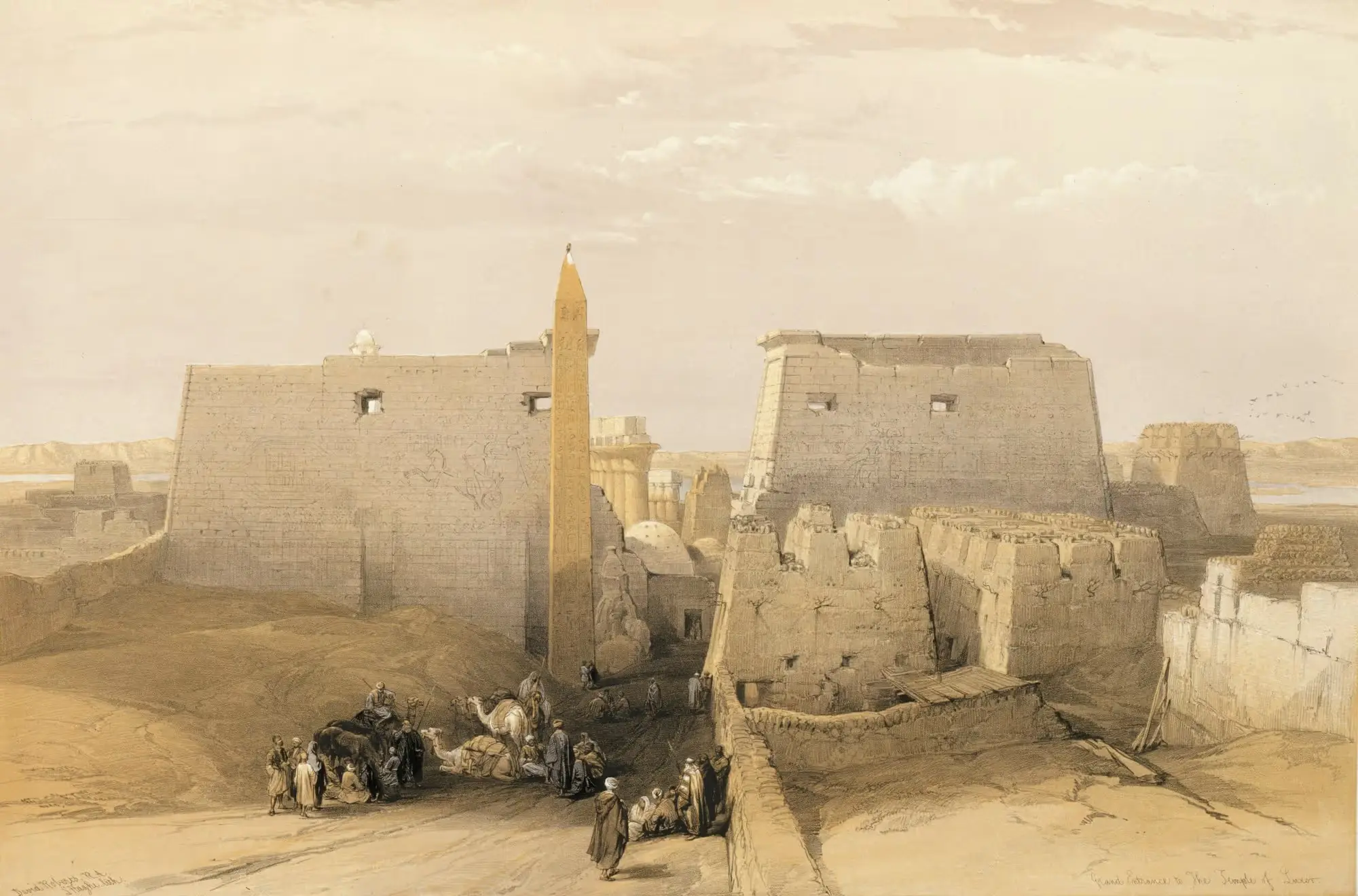
Grand Entrance to the Temple at Luxor

Lithograph of Grand Entrance to the Temple at Luxor, David Roberts, 1848
David Roberts (lithographed by Louis Haghe), plate published 1 August 1848; Roberts’s field drawing dates to 1838–39 · medium: Tinted lithograph, two tints (328 × 487 mm) · collection or source: Royal Academy of Arts (RA object no. 05/627) · artwork: public domain

David Roberts travelled through Egypt in 1838–39 and drew Luxor Temple’s great entrance, including the pylon, the surviving obelisk and the colossal seated statues of Ramesses II. This tinted lithograph, printed by Louis Haghe for the series Egypt and Nubia and published on 1 August 1848, comes about ten years after the field drawing. Such lithographs carried these views to readers who could not travel, though each passed through a lithographer’s hands before it reached them.

Facade of the Luxor Temple

Watercolour of Facade of the Luxor Temple, attributed to François-Charles Cécile, c. 1800
Attributed to François-Charles Cécile, c. 1800 (uncertain) · medium: Watercolour · collection or source: Current location unknown · artwork: public domain

This watercolour shows the entrance of Luxor Temple with an obelisk. An obelisk standing in its original position places the scene before the western one was taken to Paris in the early 1830s. The attribution to François-Charles Cécile and the approximate date of 1800 are both uncertain. The façade is the first pylon, built by Ramesses II.

Obélisques de Luxor à Thèbes (Obelisk of Luxor in Thebes)

Engraving of Obélisques de Luxor à Thèbes (Obelisk of Luxor in Thebes), Louis Nicolas Philippe Auguste de Forbin, 1819
Louis Nicolas Philippe Auguste de Forbin, 1819 · medium: Engraving (70.9 × 53.4 cm) · collection or source: The Gennadius Library – The American School of Classical Studies at Athens · artwork: public domain

This engraving by Auguste de Forbin, published in 1819, shows the obelisks that originally stood at the temple’s entrance. Both were still in Egypt when it appeared; the western one went to Paris in the 1830s. Forbin, director of the Louvre, travelled in Egypt and the Levant in 1817–18, and his illustrated account helped circulate images of the monuments to European readers.

Life Among the Ruins

Four works showing the school, market and mosque that grew up inside the temple before it was cleared. The Abu Haggag mosque (also spelled Abu el-Haggag or Abu al-Haggag) still stands above the temple’s court of Ramesses II; see our Abu Haggag Mosque guide.

School in the Temple of Luxor

Watercolour of School in the Temple of Luxor, Carl Friedrich Heinrich Werner, c. 1865
Carl Friedrich Heinrich Werner, c. 1865 · medium: Pencil, watercolour and gouache on paper (approx. 15 × 25 cm) · collection or source: Private collection · artwork: public domain

Carl Werner’s small watercolour is titled School in the Temple of Luxor and shows a group of people gathered inside a monumental architectural space. It dates from about 1865, when local people still used the temple for daily life, as the market and mosque views in this section also show; the site was cleared later. Werner was known for detailed watercolours of architecture and daily life in Egypt.

Luxor, Market Scene in front of a Mosque

Watercolour of Luxor, Market Scene in front of a Mosque, Carl Werner, 1865
Carl Werner, 1865 · medium: Watercolour on cardboard (41 × 57 cm) · collection or source: Private collection · artwork: public domain

This view shows a market outside a mosque in Luxor, traditionally associated with the Abu Haggag mosque inside the ancient precinct of Luxor Temple. Werner, a German architectural watercolourist, travelled in Egypt and recorded monuments, towns and everyday scenes with close attention to structure and light. The market and mosque show how people lived and traded among the ruins before the temple was cleared.

View of the Abu Al-Haggag Mosque At Luxor

Painting of View of the Abu Al-Haggag Mosque At Luxor, Carl Wuttke, 1906
Carl Wuttke, 1906 · medium: Oil on board (53.5 × 39 cm; 21.1 × 15.4 in.) · collection or source: Current location unknown · artwork: public domain

The title identifies this work as a view of the Abu Haggag Mosque, a working mosque inside the historic precinct of Luxor Temple, built above the temple’s court of Ramesses II. Its location shows how later religious use became part of the ancient site’s continuing history. The mosque is still in use today.

Market at the Mosque of Abu el-Haggag

Painting of Market at the Mosque of Abu el-Haggag, Louis Comfort Tiffany, 1911
Louis Comfort Tiffany, 1911 · medium: Watercolour, gouache, pastel and charcoal on paper laid down on board (101.9 × 76.8 cm) · collection or source: Private collection (sold at Bonhams, New York, 20 May 2021, lot 14) · artwork: public domain

Louis Comfort Tiffany made this mixed-media work in 1911, showing a market beside the Abu Haggag mosque at Luxor Temple. Best known for glass and interior design, Tiffany also made watercolours and works on paper on his travels. His 1908 return to Egypt gave him sketches and impressions that informed later work; this finished picture is dated three years after that voyage.

Town and River

Four views of the Nile and the town, from Gérôme’s first journey to Egypt in 1856–57 to a painting of 1923.

View of the Nile at Luxor

Painting of View of the Nile at Luxor, Jean-Léon Gérôme, 1857
Jean-Léon Gérôme, 1857 · medium: Oil on canvas laid on board (16.5 × 28.7 cm) · collection or source: Ashmolean Museum of Art and Archaeology, Oxford (WA2001.45) · artwork: public domain

Jean-Léon Gérôme painted this small view during his first visit to Egypt in 1856–57. The river landscape is unusually free of the figures that fill many of his Egyptian scenes, so the water, shoreline and distant buildings carry the composition. He later reused the study as the background for The Prisoner (1861), now in Nantes, a useful example of how a travel sketch could become part of a larger studio painting.

View of Luxor 1865

Watercolour of View of Luxor 1865, Carl Werner, 1865
Carl Werner, 1865 · medium: Watercolour on cardboard (approx. 15 × 25 cm) · collection or source: Private collection · artwork: public domain

Dated 1865 and attributed to Carl Werner, this small watercolour shows a view of Luxor. Werner’s Egyptian subjects often combine architectural precision with atmospheric washes of colour. The title suggests a cityscape or riverfront view rather than a close study of a single monument.

Sunrise at the Temples of Luxor

Painting of Sunrise at the Temples of Luxor, Carl Wuttke, 1906
Carl Wuttke, 1906 (uncertain) · medium: Oil on artist’s board (approx. 25.6 × 38.3 cm) · collection or source: Current location unknown · artwork: public domain

Attributed to Carl Wuttke and dated 1906, this painting builds its composition around the warm early light on Luxor’s ancient monuments. Wuttke was a German painter of architectural and travel views. Dawn and dusk were favourite times for painters of Luxor, when the sandstone takes on a golden glow.

Luxor, 1923

Painting of Luxor, 1923, Konstantinos Maleas, 1923
Konstantinos Maleas, 1923 · medium: Oil on cardboard (48.5 × 54.5 cm) · collection or source: Private collection · artwork: public domain

Konstantinos Maleas, a Greek painter active in the early twentieth century, titled this work Luxor, 1923. It was painted the year after the discovery of Tutankhamun’s tomb, when Luxor drew visitors from around the world, and it belongs to the period when modern European and Mediterranean artists continued to use Egyptian landscapes as subjects.

Image credits and sources

“Artwork: public domain” describes the painting, print or drawing itself, not any photograph of it. The images here are reproductions from museum, auction and archive sources, and reuse terms for those photographs can differ. Medium, size and date for each work are given in its caption. Found a mistake? See our corrections policy and sources.

  • The Gate to the Temple of Luxor — Antoine-Xavier-Gabriel de Gazeau, comte de La Bouëre (1801–1881), 1836. Source: The Metropolitan Museum of Art, New York (The Whitney Collection; acc. 2003.42.37).
  • Grand Entrance to the Temple at Luxor — David Roberts (lithographed by Louis Haghe), plate published 1 August 1848; Roberts’s field drawing dates to 1838–39. Source: Royal Academy of Arts (RA object no. 05/627).
  • Facade of the Luxor Temple — Attributed to François-Charles Cécile, c. 1800 (uncertain). Source: Current location unknown.
  • Obélisques de Luxor à Thèbes (Obelisk of Luxor in Thebes) — Louis Nicolas Philippe Auguste de Forbin, 1819. Source: The Gennadius Library – The American School of Classical Studies at Athens.
  • School in the Temple of Luxor — Carl Friedrich Heinrich Werner, c. 1865. Source: Private collection.
  • Luxor, Market Scene in front of a Mosque — Carl Werner, 1865. Source: Private collection.
  • View of the Abu Al-Haggag Mosque At Luxor — Carl Wuttke, 1906. Source: Current location unknown.
  • Market at the Mosque of Abu el-Haggag — Louis Comfort Tiffany, 1911. Source: Private collection (sold at Bonhams, New York, 20 May 2021, lot 14).
  • View of the Nile at Luxor — Jean-Léon Gérôme, 1857. Source: Ashmolean Museum of Art and Archaeology, Oxford (WA2001.45).
  • View of Luxor 1865 — Carl Werner, 1865. Source: Private collection.
  • Sunrise at the Temples of Luxor — Carl Wuttke, 1906 (uncertain). Source: Current location unknown.
  • Luxor, 1923 — Konstantinos Maleas, 1923. Source: Private collection.