Paintings of the Theban West Bank: 19th-Century Views of Tombs and Temples
Seven paintings of the Theban west bank, from the open plain to the royal tombs, two royal tours and the great temples.
The west bank of Thebes was the burial ground of Egypt’s pharaohs, and 19th-century artists painted its valleys, tombs and temples as they found them. These seven works move from the open plain to the Valley of the Kings, two royal tours and the mortuary temples of the Ramesseum and Medinet Habu. This gallery is about those 19th-century pictures; for the ancient paintings inside the tombs, see our Valley of the Kings and Tombs of the Nobles guides. Many views were finished away from the site, so see how to read Orientalist paintings of Egypt. Where a picture can be matched to a place you can still visit, the entry links to the guide.
Plain and Valley
Two views of the land itself: the wide plain where the pharaohs’ temples stood, and the dry valley of the Asasif.
The Plain of Thebes
Ernst Karl Eugen Koerner, 1882 · medium: Oil on canvas (85 × 126 cm) · collection or source: Private collection (sold at Sotheby’s, London, 2012; previously Galerie Ettel) · artwork: public domain
Signed and dated 1882, The Plain of Thebes is a broad view of the landscape around ancient Thebes, now Luxor. Koerner’s Egyptian views drew on his travels in the region and on his ability to turn architectural studies into carefully composed studio paintings. The two Colossi of Memnon, which stand on this same plain, have a gallery of their own.
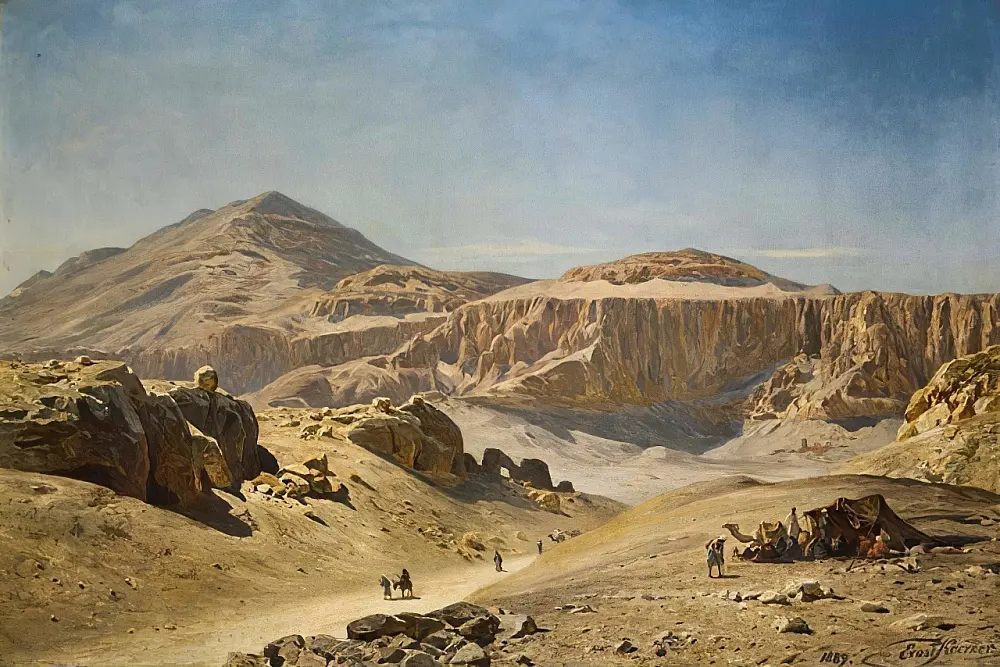
The Asasif Valley At Thebes
Ernst Karl Eugen Koerner, 1889 or 1923 (uncertain) · medium: Oil on canvas (67 × 100 cm) · collection or source: Current location unknown · artwork: public domain
Ernst Koerner was a German landscape painter who travelled in Egypt in 1873–74 and returned to Egyptian subjects throughout his career. This canvas shows the Asasif Valley on Thebes’s west bank, the necropolis area below the cliffs near Deir el-Bahari, where high officials of the Late Period built large tombs. The date is uncertain: 1889 is often given, but a signature dated 1923 has also been mentioned. For the temple at Deir el-Bahari, see our Temple of Hatshepsut guide; for other private tombs on the west bank, see Tombs of the Nobles.
Tombs and Royal Visitors
Three watercolours from two royal tours: the Prince of Wales at an excavation at Thebes in 1862, and the Prince and Princess of Wales at the Valley of the Kings in February 1869.
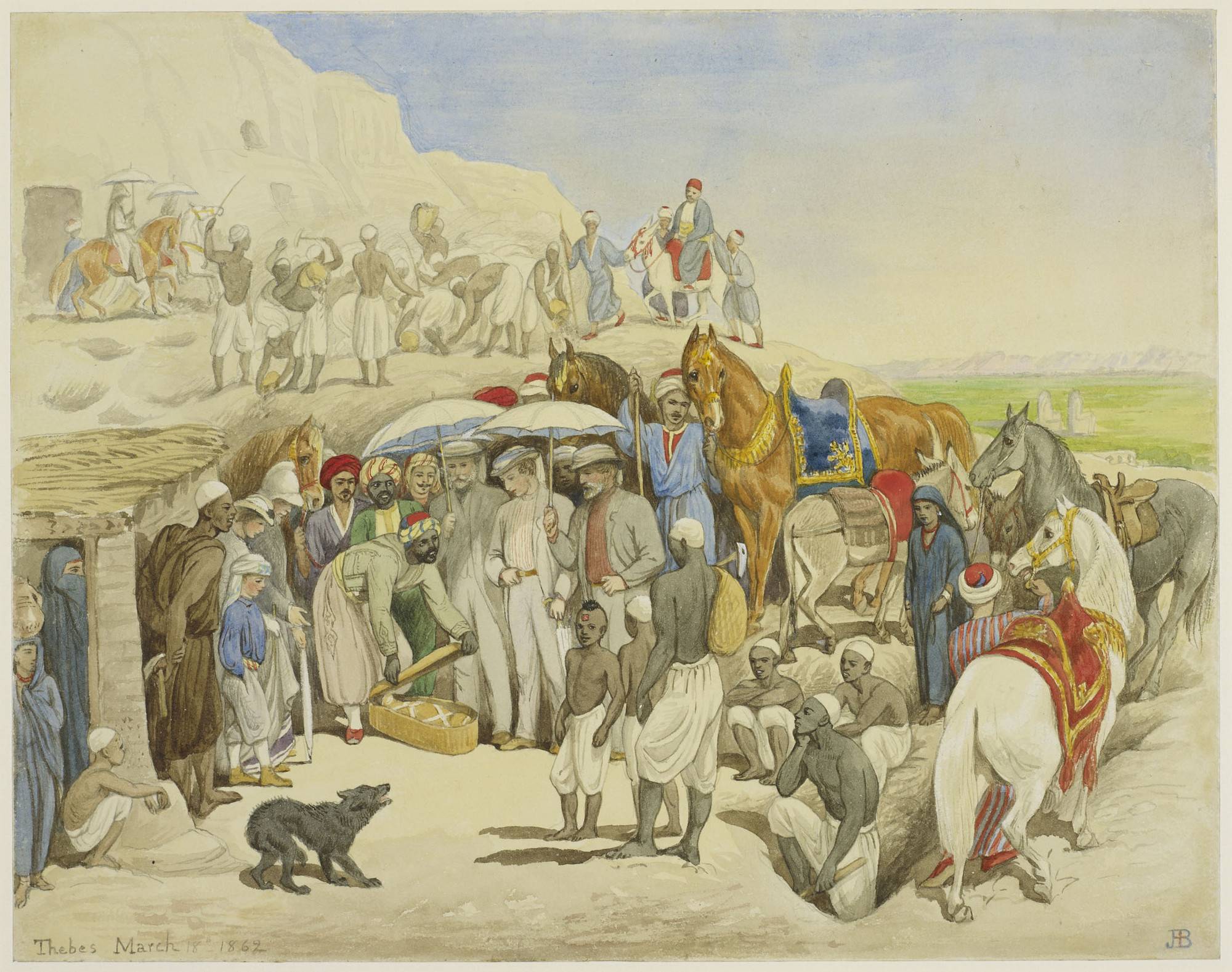
The Prince of Wales at Thebes
Jemima Blackburn, 18 March 1862 · medium: Watercolour (22.7 × 28.8 cm) · collection or source: Royal Collection Trust (RCIN 920994); presented by the artist to the Prince of Wales, Christmas 1862 · artwork: public domain
Jemima Blackburn’s watercolour records an episode during the Prince of Wales’s visit to Thebes on 18 March 1862. The royal party observes an excavation in which a small sarcophagus was opened, part of the prince’s wider tour through Egypt and the eastern Mediterranean. Blackburn was an accomplished Scottish watercolourist, and she presented this picture to the prince at Christmas 1862.
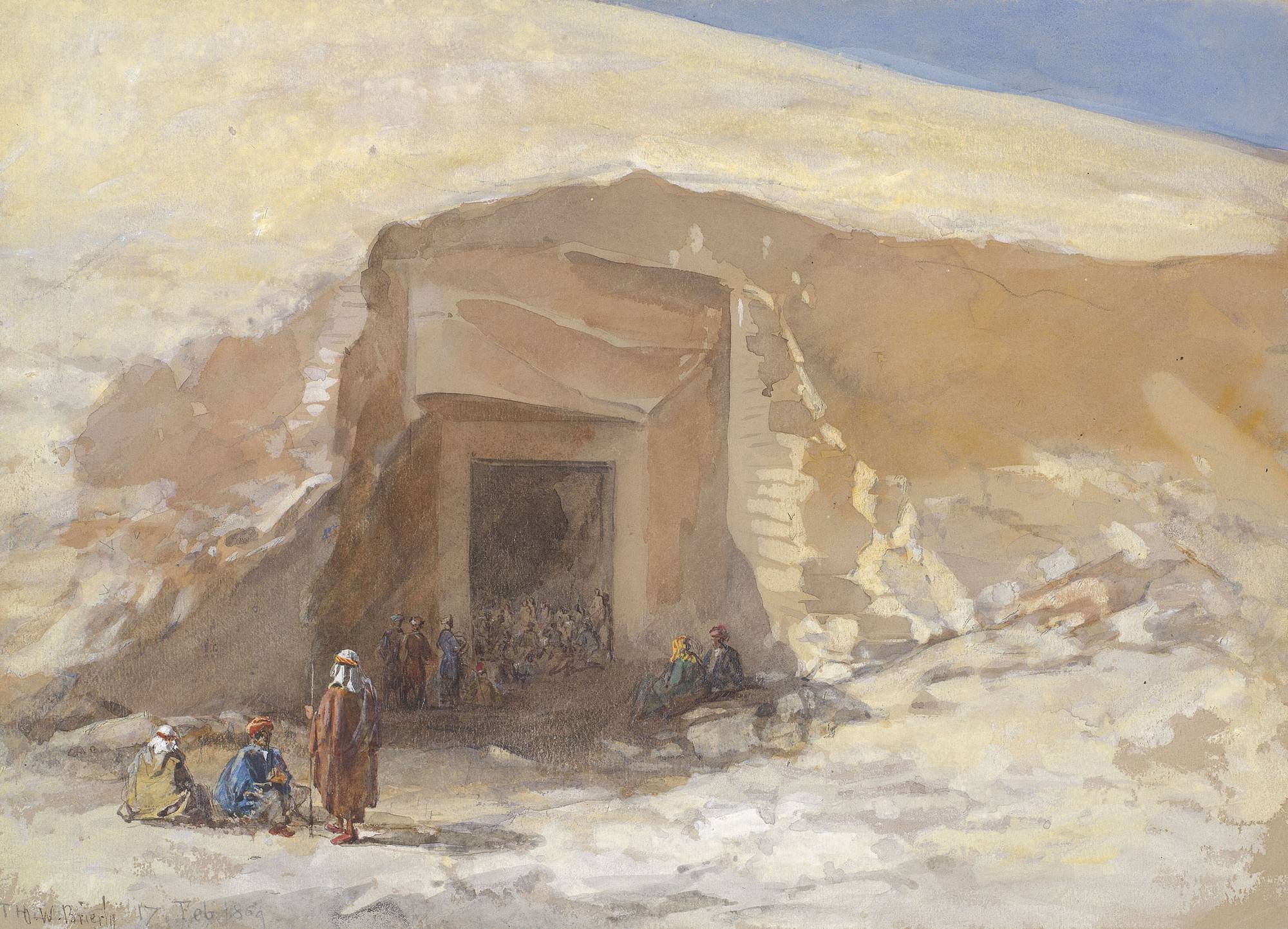
Thebes, Tombs of the Kings: entrance to Belzoni’s Tomb
Sir Oswald Walters Brierly, 17 February 1869 · medium: Watercolour (25.8 × 35.7 cm) · collection or source: Royal Collection Trust (RCIN 921099) · artwork: public domain
Sir Oswald Walters Brierly made this watercolour on 17 February 1869 during the Prince and Princess of Wales’s visit to the Theban tombs. It shows the entrance to Belzoni’s Tomb, discovered by Giovanni Battista Belzoni in 1817 and identified as the tomb of Seti I (KV17). The sheet documents how a royal party encountered the Valley of the Kings in the nineteenth century.
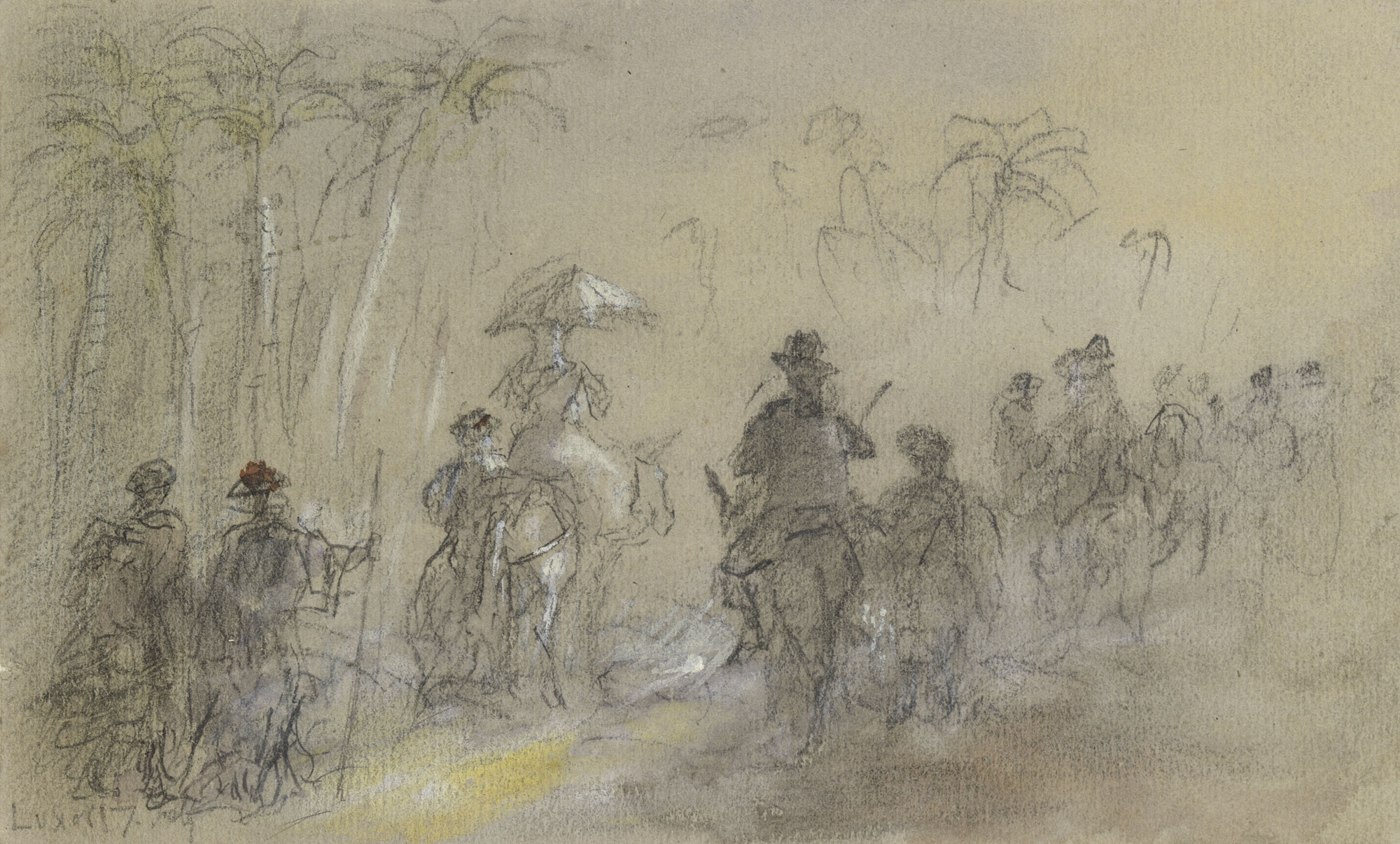
Return from Luxor
Sir Oswald Walters Brierly, 17 February 1869 · medium: Pencil and watercolour (9.8 × 16.7 cm) · collection or source: Royal Collection Trust (RCIN 920354) · artwork: public domain
Dated 17 February 1869, the same day as the Belzoni’s Tomb watercolour above, this drawing by Brierly shows a large group travelling on donkeys after visiting the royal tombs at Thebes. Brierly accompanied the Prince and Princess of Wales on their Egyptian tour and made a number of visual records of the journey. The Royal Collection lists the sheet as Return from Luxor; it combines the immediacy of a travel sketch with the documentary interest of a royal itinerary.
The Great Temples
Two paintings of the mortuary temples of the west bank: the Ramesseum at sunset and a corridor at Medinet Habu.
The Ramesseum at Thebes, Sunset
William James Müller, 1840 · medium: Oil on canvas (74.2 × 135.8 cm) · collection or source: Bristol Museum & Art Gallery · artwork: public domain
William James Müller visited Egypt in 1838–39 and painted this broad view of the Ramesseum, the mortuary temple of Ramesses II on the west bank of the Nile. The title emphasises the warm, low light of sunset, while broken masonry and colossal sculpture convey the site’s scale and age.
Corridor to the Great Court at Medinet Abou
John Walrond, 1877 · medium: Watercolour and graphite on paper (55.6 × 38.6 cm; mat 71.1 × 55.9 cm) · collection or source: Current location unknown · artwork: public domain
This watercolour-and-graphite study is titled Corridor to the Great Court at Medinet Abou, the name historically used for Medinet Habu, the mortuary temple of Ramesses III on Luxor’s west bank (see our Medinet Habu guide). It records a passage within the temple complex, where deep shadow and strong perspective emphasise the architecture. The sheet is attributed to John Walrond and dated 1877.
“Artwork: public domain” describes the painting, print or drawing itself, not any photograph of it. The images here are reproductions from museum, auction and archive sources, and reuse terms for those photographs can differ. Medium, size and date for each work are given in its caption. Found a mistake? See our corrections policy and sources.
The Plain of Thebes — Ernst Karl Eugen Koerner, 1882. Source: Private collection (sold at Sotheby’s, London, 2012; previously Galerie Ettel).
The Asasif Valley At Thebes — Ernst Karl Eugen Koerner, 1889 or 1923 (uncertain). Source: Current location unknown.
The Prince of Wales at Thebes — Jemima Blackburn, 18 March 1862. Source: Royal Collection Trust (RCIN 920994); presented by the artist to the Prince of Wales, Christmas 1862.
Thebes, Tombs of the Kings: entrance to Belzoni’s Tomb — Sir Oswald Walters Brierly, 17 February 1869. Source: Royal Collection Trust (RCIN 921099).
Return from Luxor — Sir Oswald Walters Brierly, 17 February 1869. Source: Royal Collection Trust (RCIN 920354).
The Ramesseum at Thebes, Sunset — William James Müller, 1840. Source: Bristol Museum & Art Gallery.
Corridor to the Great Court at Medinet Abou — John Walrond, 1877. Source: Current location unknown.