Paintings of Karnak Temple: Gateways, Columns and Ruins
Ten paintings of Karnak, from gateways and sphinxes to forests of columns and ruins still partly buried.
In the 19th century Karnak was a regular stop for Nile travellers. These ten works show the temple as artists met it: huge gateways, ram-headed sphinxes, the Great Hypostyle Hall and ruins that were still partly buried. Many were finished away from the site, so see how to read Orientalist paintings of Egypt. Set beside the site today, they show how much has since been cleared and restored.
Gateways and Approaches
Three paintings of the ways into Karnak and the first wide views of the precinct.
The South Gate, Karnak
Paul Rudolf Linke, 1889 (uncertain) · medium: Oil on canvas (45 × 32 cm; 17.7 × 12.6 in) · collection or source: Private collection · artwork: public domain
The South Gate, Karnak is attributed to Paul Rudolf Linke, and its date of 1889 is uncertain. The title places the scene at a southern entrance of the Karnak precinct, a complex whose gates, pylons and courts were built and altered over many centuries.
An Entranceway at Karnak
Attributed to Carl Friedrich Heinrich Werner (formerly attributed to David Roberts), 1864 (as inscribed) · medium: Watercolor, brush and brown ink, over black chalk with scraping, on cream wove paper (507 × 358 mm) · collection or source: The Morgan Library & Museum, New York (acc. 1977.24); purchased as the gift of Mrs. Vincent Astor · artwork: public domain
This architectural study of a passage at Karnak was once attributed to David Roberts, whose name and the date 1864 appear in an inscription. The Morgan Library & Museum now attributes the drawing to Carl Friedrich Heinrich Werner, a German artist noted for exacting watercolours of architecture and travel scenes.
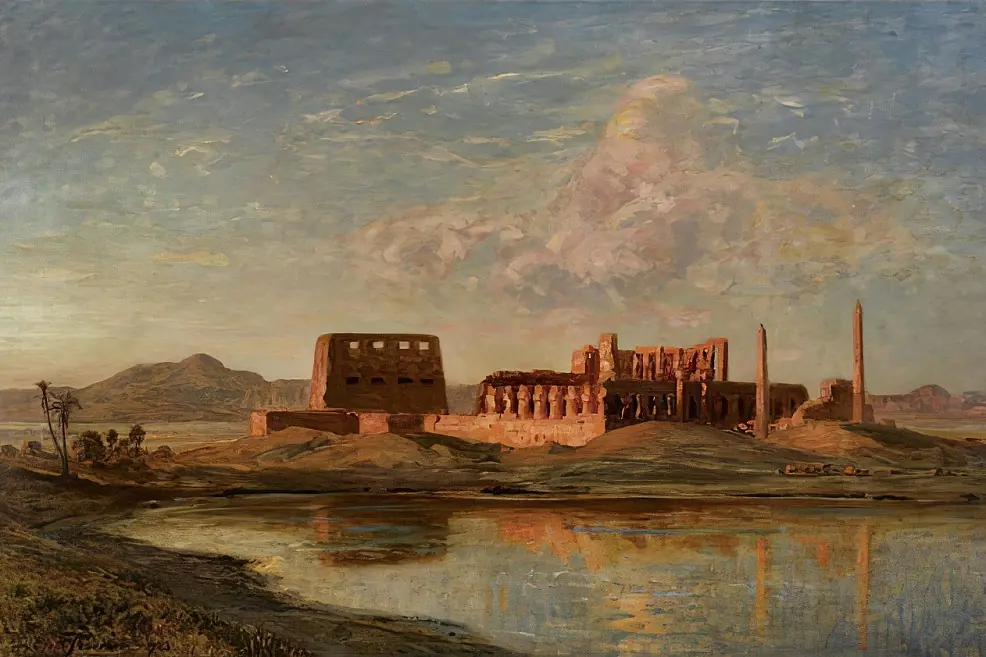
The Temple of Karnak at Luxor
Ernst Karl Eugen Koerner, 1923 (uncertain) · medium: Oil on canvas (approx. 84.4 × 126.4 cm) · collection or source: Current location unknown · artwork: public domain
Ernst Koerner was a German landscape painter whose Egyptian views often present monumental ruins in theatrical light. This large canvas shows Karnak, the largest temple complex in Egypt, built and extended over roughly 2,000 years, mainly for the god Amun-Ra. The date is uncertain, though 1923 has been suggested, and the painting’s current location is unknown.
Forests of Columns
The Great Hypostyle Hall, shown here by Roberts, Stanier and Koerner. For the hall as it is today, see our Great Hypostyle Hall guide.
View looking across the Hall of Columns, Karnak
David Roberts (lithographed by Louis Haghe), drawn 27 November 1838; lithograph issued 1846–49 · medium: Tinted lithograph, two tints (483 × 326 mm) · collection or source: Royal Academy of Arts (RA object no. 05/622) · artwork: public domain
David Roberts drew Karnak’s Great Hypostyle Hall in November 1838, on his return journey down the Nile, and Louis Haghe later turned the drawing into a tinted lithograph for Egypt and Nubia, issued in parts between 1846 and 1849. The towering columns, carved with hieroglyphic reliefs, give a dramatic sense of scale, reinforced by the small human figures in the foreground.
View of Karnak
Attributed to Henry Stanier, 1868 · medium: Watercolour and bodycolour · collection or source: Current location unknown · artwork: public domain
A loosely handled watercolour of the Great Hypostyle Hall, begun under Seti I around 1290 BCE and completed under Ramesses II. Stanier’s quick brushwork and luminous colour favour atmosphere over architectural detail, in contrast to the more carefully staged views by Roberts and Koerner elsewhere in this gallery. The work is attributed to Henry Stanier, and its current location is unknown.
The Temple of Karnak: The Great Hypostyle Hall
Ernst Karl Eugen Koerner, 1890 · medium: Oil on canvas (31¼ × 18¼ in.) · collection or source: Dahesh Museum of Art, New York (acc. 1995.114) · artwork: public domain
Ernst Karl Eugen Koerner’s 1890 painting presents the Great Hypostyle Hall as a deep architectural space framed by immense columns covered in hieroglyphs. Strong perspective guides the eye toward the lighter courtyard beyond, while small figures underscore the hall’s scale. Koerner visited Egypt in 1873–74 and turned his travel impressions into carefully staged paintings of ancient architecture, so the view reflects studio composition as much as direct observation.
Sphinxes and Ruins
Four views of Karnak’s sphinxes and ruins, from 1847 to 1889.
The Ruins of the Palace of Karnak at Thebes
Jacob Jacobs, 1847 · medium: Oil on panel (97.2 × 142.6 cm, unframed) · collection or source: Private collection; previously offered at auction · artwork: public domain
Signed and dated 1847, this panel by the Belgian painter Jacob Jacobs shows the ruins of what was then called the Palace of Karnak at Thebes. Architectural remnants and small contemporary figures give the archaeological site a human scale. Jacobs travelled through the eastern Mediterranean and made a number of views of historical monuments; this composition was exhibited in Brussels in 1848.
A Ram’s-Head Sphinx at the Temple of Amun, Karnak
Carl Friedrich Heinrich Werner, 1865 · medium: Pencil, watercolour and gouache on paper (15 × 25 cm) · collection or source: Offered by Colnaghi, London · artwork: public domain
Signed and dated 23 February 1865, Carl Werner’s sheet shows a ram-headed sphinx in the precinct of Amun at Karnak. He combines pencil drawing with watercolour and gouache, using colour to distinguish the weathered stone from the surrounding ground. The small format makes it a focused study of one monument rather than a panoramic temple view.
The Sphinx 1867
Carl Werner, 1867 · medium: Watercolour on cardboard (57.2 × 95.2 cm) · collection or source: Private collection · artwork: public domain
This large watercolour, signed and dated by Carl Werner in 1867, has traditionally been titled The Sphinx. It should not be confused with the Great Sphinx at Giza: published discussion connects the image to sculptural figures at the Temple of Mut, in the part of the Karnak complex south of the main Amun precinct (see our Mut Temple guide). Werner’s view records ancient statuary as nineteenth-century visitors met it, though the title is broad rather than precise.
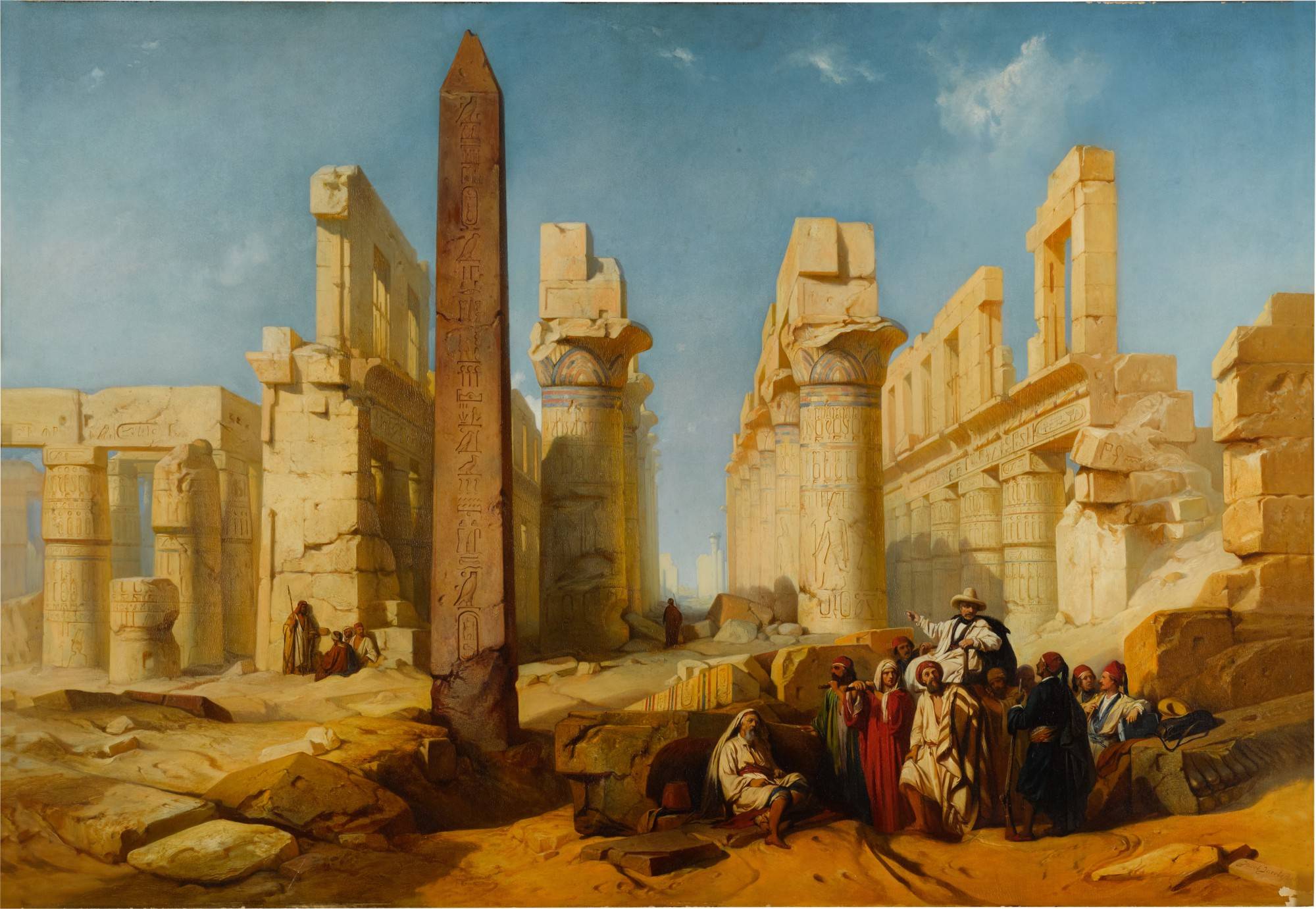
The Temple of Karnak
Ernst Karl Eugen Koerner (Ernst Koerner), 1889 · medium: Oil on canvas (77 × 56 cm) · collection or source: Private collection; sold at Sotheby’s, The Orientalist Sale, London, 7 April 2020, lot 39 (previously Leo Spik, Berlin, 2017) · artwork: public domain
Ernst Koerner’s 1889 painting shows the Karnak ruins in intense sunlight, with a tall obelisk and an unfinished pylon rising behind weathered stonework. Two local figures sit among the remains, giving scale and setting human presence against monumental architecture. Koerner travelled to Egypt in 1873–74 and returned to Egyptian subjects throughout his career.
“Artwork: public domain” describes the painting, print or drawing itself, not any photograph of it. The images here are reproductions from museum, auction and archive sources, and reuse terms for those photographs can differ. Medium, size and date for each work are given in its caption. Found a mistake? See our corrections policy and sources.
The South Gate, Karnak — Paul Rudolf Linke, 1889 (uncertain). Source: Private collection.
An Entranceway at Karnak — Attributed to Carl Friedrich Heinrich Werner (formerly attributed to David Roberts), 1864 (as inscribed). Source: The Morgan Library & Museum, New York (acc. 1977.24); purchased as the gift of Mrs. Vincent Astor.
The Temple of Karnak at Luxor — Ernst Karl Eugen Koerner, 1923 (uncertain). Source: Current location unknown.
View looking across the Hall of Columns, Karnak — David Roberts (lithographed by Louis Haghe), drawn 27 November 1838; lithograph issued 1846–49. Source: Royal Academy of Arts (RA object no. 05/622).
View of Karnak — Attributed to Henry Stanier, 1868. Source: Current location unknown.
The Temple of Karnak: The Great Hypostyle Hall — Ernst Karl Eugen Koerner, 1890. Source: Dahesh Museum of Art, New York (acc. 1995.114).
The Ruins of the Palace of Karnak at Thebes — Jacob Jacobs, 1847. Source: Private collection; previously offered at auction.
A Ram’s-Head Sphinx at the Temple of Amun, Karnak — Carl Friedrich Heinrich Werner, 1865. Source: Offered by Colnaghi, London.
The Sphinx 1867 — Carl Werner, 1867. Source: Private collection.
The Temple of Karnak — Ernst Karl Eugen Koerner (Ernst Koerner), 1889. Source: Private collection; sold at Sotheby’s, The Orientalist Sale, London, 7 April 2020, lot 39 (previously Leo Spik, Berlin, 2017).