Painting Gallery · West Bank, Luxor

Colossi of Memnon in Paintings: Artists’ Views

Ten works showing the two giant statues on the Theban plain, from desert dusk to the Nile flood.

The two Colossi of Memnon have stood on the west bank plain for more than 3,400 years, and Nile travellers regularly stopped to paint and sketch them. These ten works show them with camels and caravans at their feet, travellers sketching and resting, a royal party in 1869, and the plain under the annual Nile flood. Several were worked up in Europe from earlier sketches, so see how to read Orientalist paintings of Egypt. For the history, the singing legend and visitor details, see our guide to the Colossi.

Caravans and Legend

Four paintings of camels and caravans crossing the plain, from Gérôme’s studies after his first Egyptian journey to Benwell’s caravan of 1876.

Memnon and Sesostris

Painting of Memnon and Sesostris, Jean-Léon Gérôme, 1856
Jean-Léon Gérôme, 1856 · medium: Oil on canvas (35 × 49.5 cm) · collection or source: Auction record (Sotheby’s); current location not confirmed · artwork: public domain

“Memnon” refers to the Colossi of Memnon, two seated statues of Pharaoh Amenhotep III near modern Luxor. “Sesostris” is a legendary king of Egypt mentioned by Herodotus, often confused in Western art and literature with great pharaohs such as Ramesses II or Senusret I; travellers sometimes paired the two names for the statues. Gérôme’s large Salon picture of 1857, a view of the plain of Thebes with the Colossi (now in Nantes), followed his first journey to Egypt in 1856. This small canvas, catalogued as Memnon and Sesostris, belongs to the group of studies and related pictures he made from his Egyptian sketches.
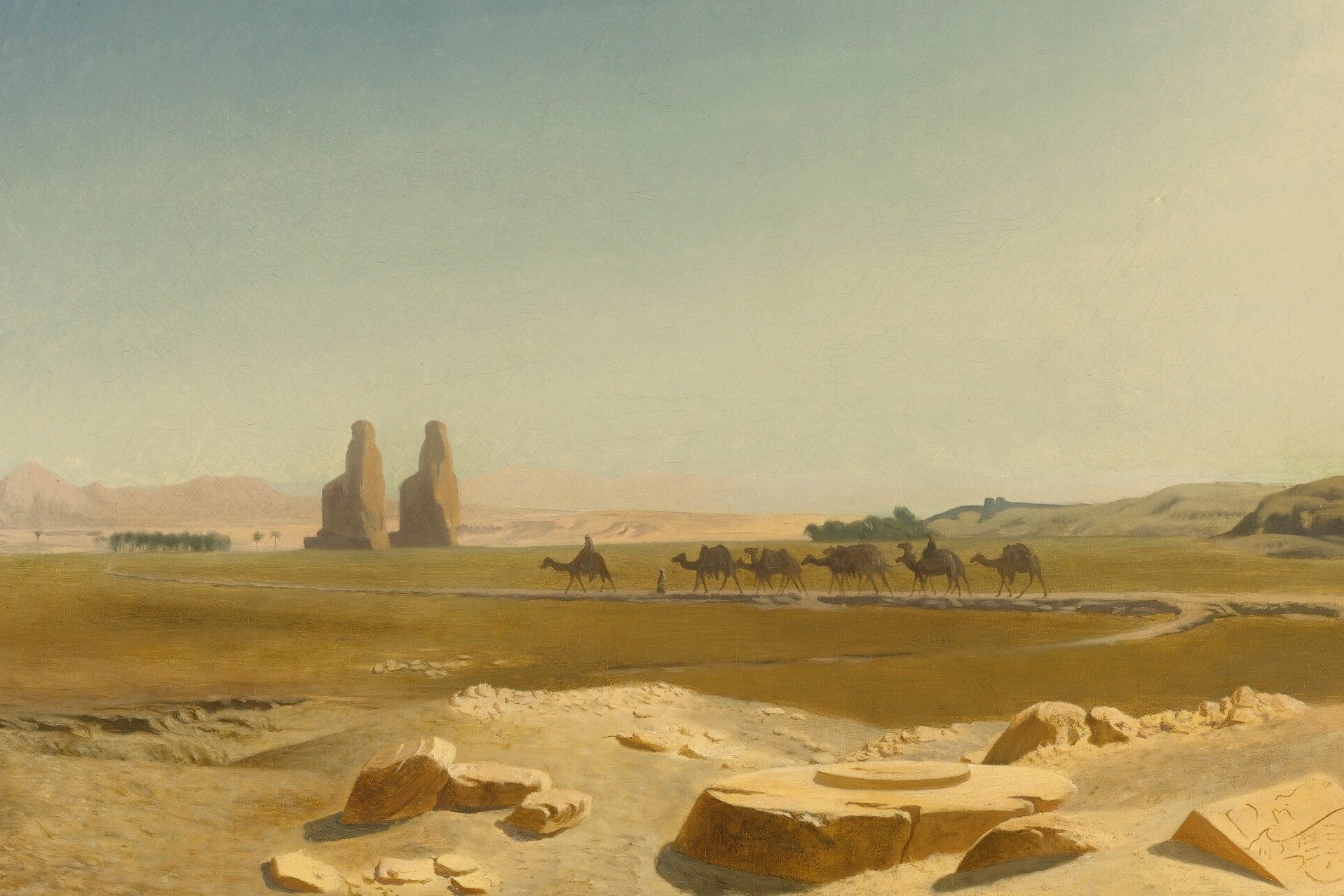
Caravan Passing the Colossi of Memnon, Thebes

Painting of Caravan Passing the Colossi of Memnon, Thebes, Jean-Léon Gérôme, 1856
Jean-Léon Gérôme (1824–1904), 1856 · medium: Oil on canvas (40 × 62 cm) · collection or source: Musée cantonal des Beaux-Arts, Lausanne (acquired 2015) · artwork: public domain

A small caravan of camels and travellers crosses the quiet plain of Thebes on the west bank of Luxor, passing in front of the Colossi of Memnon, the massive stone statues of Pharaoh Amenhotep III. The Lausanne museum describes the canvas as an early finished study for Gérôme’s large View of the Plain of Thebes (Musée d’arts, Nantes), shown at the Salon of 1857. In both, he chose to show the statues from behind and at a distance, an unusually still and quiet composition for him.

The Colossus of Memnon

Painting of The Colossus of Memnon, Jean-Léon Gérôme, 1857
Jean-Léon Gérôme (1824–1904), 1857 · medium: Oil on canvas (64.8 × 81.3 cm) · collection or source: Private collection · artwork: public domain

The painting depicts one of the massive quartzite statues known as the Colossi of Memnon, representing Pharaoh Amenhotep III, standing in the Theban Necropolis across the Nile from Luxor, surrounded by a desert landscape and resting camels. Gérôme returned to the statues again and again: auction-catalogue research counts at least six compositions of them between 1856 and 1904.

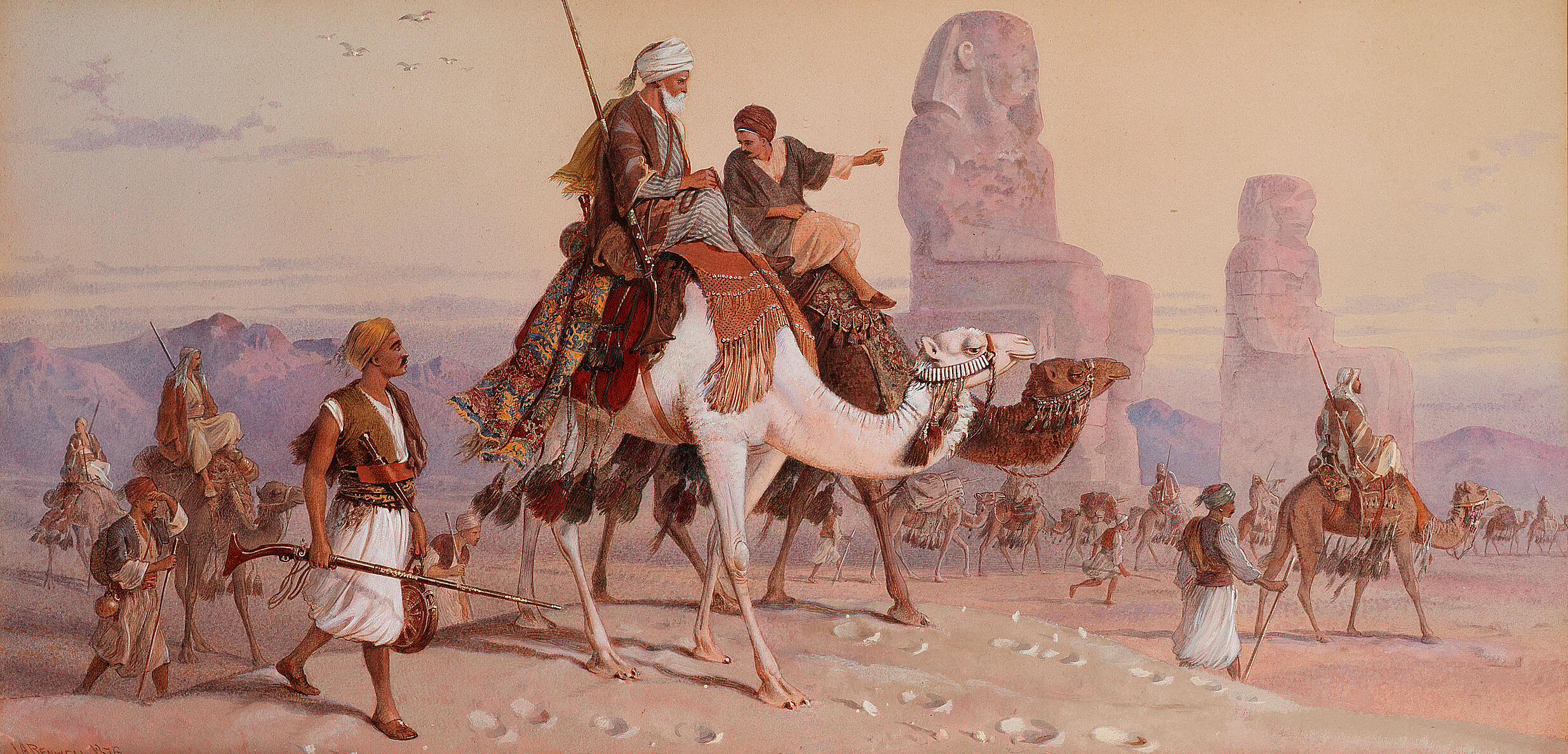
A Caravan Passing the Colossi at Memnon, Thebes

Painting of A Caravan Passing the Colossi at Memnon, Thebes, Joseph Austin Benwell, 1876
Joseph Austin Benwell (1816–1886), 1876 · medium: Watercolour · collection or source: Current location unknown · artwork: public domain

Joseph Austin Benwell worked for the East India Company and the Illustrated London News before travelling in Egypt, Syria and Palestine in the mid-1860s, and he built a long series of Orientalist watercolours from the sketches he made then. This view of a caravan passing the Colossi is dated 1876, about a decade after his journey, a reminder that many such pictures were made in Britain from earlier drawings. Camels with richly patterned saddle blankets were a favourite Benwell motif, and he returned to this subject more than once: a related watercolour dated 1869 has passed through Christie’s.

Visitors and Views

Three views by travellers who came to see the statues for themselves, from Lear’s sketch of 1854 to a royal visit in 1869.

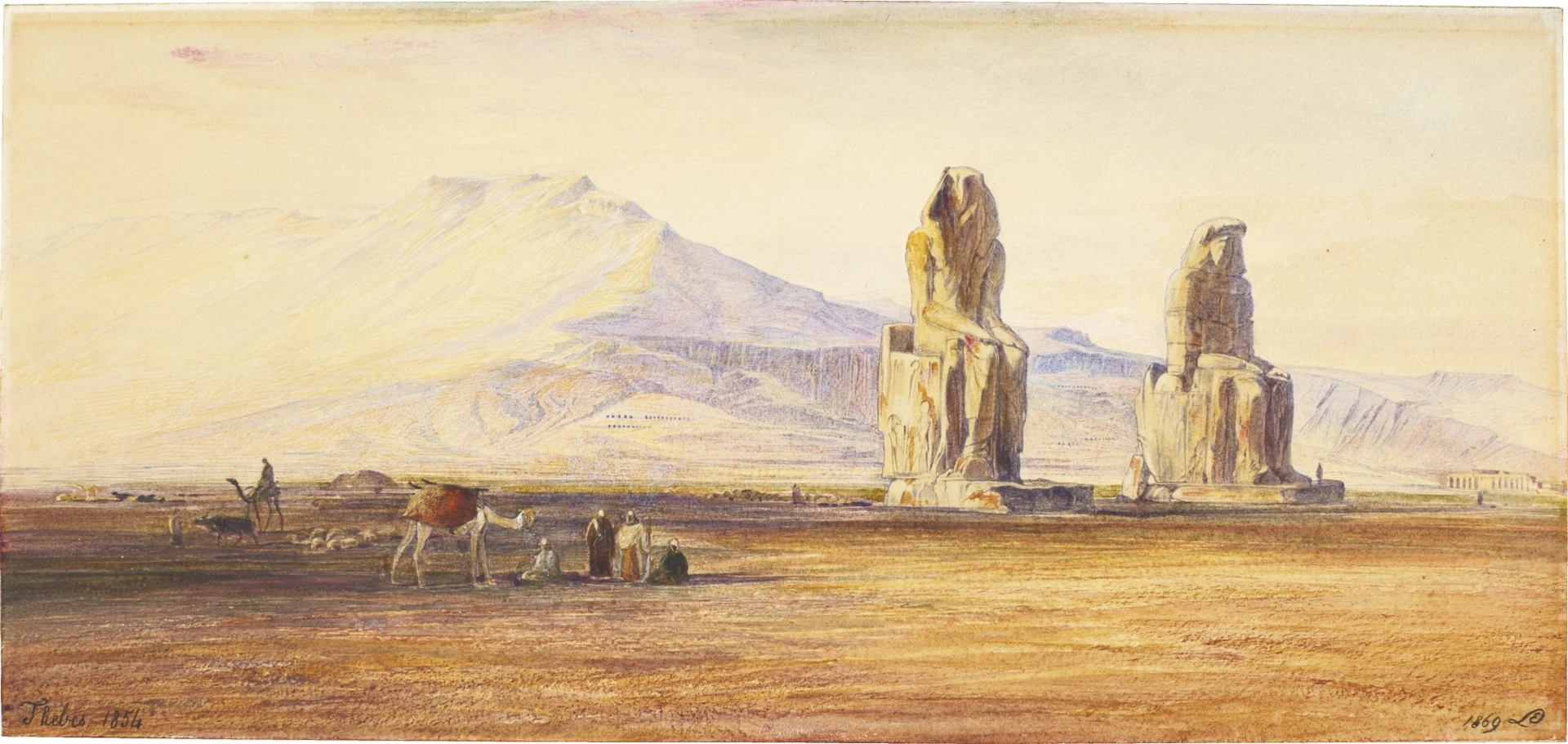
The Colossi of Memnon, Thebes, Egypt

Watercolour of The Colossi of Memnon, Thebes, Egypt, Edward Lear, 1869, inscribed Thebes 1854
Edward Lear (1812–1888), monogrammed 1869 and inscribed “Thebes 1854” · medium: Watercolour over pencil, heightened with bodycolour and gum arabic (177 × 377 mm) · collection or source: Offered at Sotheby’s, Old Master Drawings, London, 2019 (lot 430); current owner not recorded · artwork: public domain

Edward Lear, now best remembered as a poet and nonsense writer, was also a professional landscape painter who first visited Egypt in 1848 and returned three more times. He reached Luxor in February 1854 and spent about ten days among Karnak and the temples of Thebes. This watercolour is inscribed “Thebes 1854” and bears his monogram with 1869, which suggests he worked up his early sketch into a finished picture some fifteen years later.

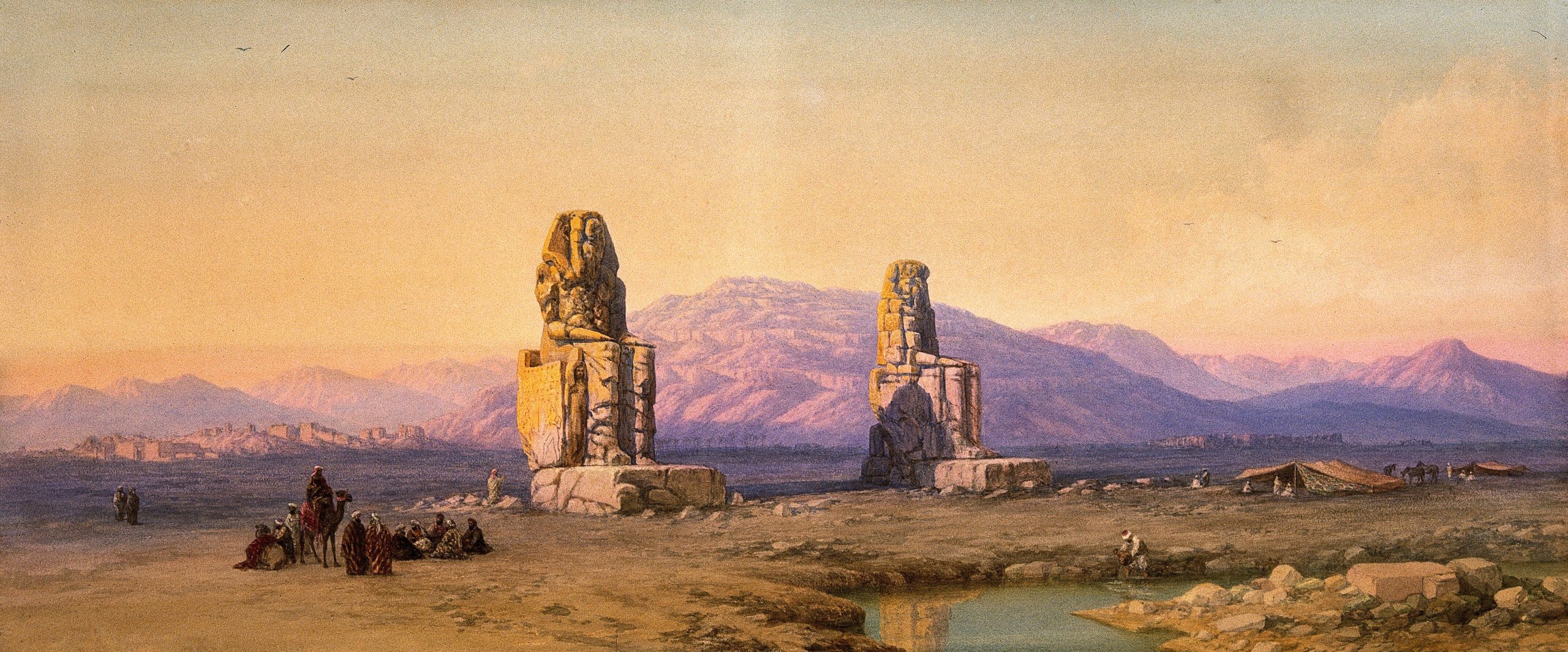
The Statues of Memnon (Pharaoh Amenhotep III)

Watercolour of The Statues of Memnon (Pharaoh Amenhotep III), Charles Vacher, 1864
Charles Vacher (1818–1883), 1864 · medium: Watercolour on paper (sight 43.2 × 99 cm) · collection or source: Wellcome Collection, London (ref. 45057i) · artwork: public domain

Charles Vacher was a British watercolourist who toured Italy, Sicily, Algeria and Egypt, making sketches that he turned into highly finished studio drawings. This long, panoramic sheet is lettered “Thebes Charles Vacher 1864”. The Colossi rise against a mountain backdrop while travellers and local people rest nearby in warm sunset light.

Thebes: Colossi of Memnon

Watercolour of Thebes: Colossi of Memnon, Oswald Walters Brierly, 18 February 1869
Oswald Walters Brierly (1817–1894), 18 February 1869 · medium: Watercolour on paper (25.6 × 41.7 cm) · collection or source: Royal Collection Trust (RCIN 921100) · artwork: public domain

Painted on 18 February 1869 during Brierly’s travels in Egypt with Albert Edward, Prince of Wales, and Alexandra, Princess of Wales. Their royal party is shown gathered on the left side of the composition, in front of the two statues. A label apparently written by the artist is mounted with the drawing and describes the archaeological repairs to the Colossi.

Flood and Fields

Before the Aswan High Dam was completed in 1970, the Nile spread across the plain every summer. Three works show that vanished landscape.

Colossi of Memnon in Egypt

Painting of Colossi of Memnon in Egypt, Hubert Sattler, 1846
Hubert Sattler, 1846 · medium: Oil on canvas · collection or source: Salzburg Museum · artwork: public domain

The painting depicts the statues during the annual Nile flood (inundation), surrounded by water that reflects the monuments, with the Theban hills in the background. Today the plain around the statues is farmland, and excavation of the mortuary temple that once stood behind them is continuing.

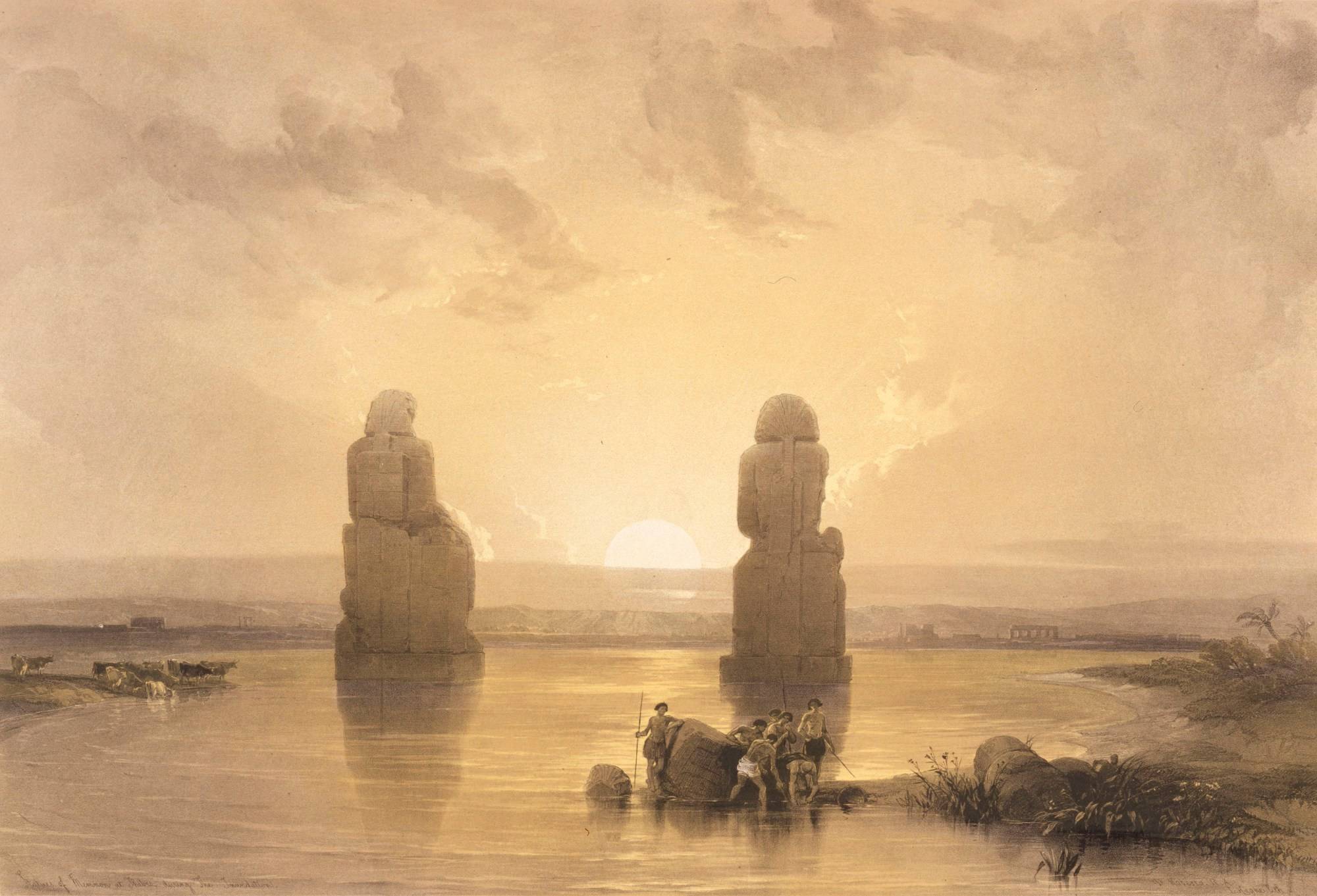
Statues of Memnon at Thebes During the Inundation

Lithograph of Statues of Memnon at Thebes During the Inundation, David Roberts, 1848
David Roberts (1796–1864), lithographed by Louis Haghe, 1848 · medium: Tinted lithograph (348 × 506 mm) · collection or source: Library of Congress · artwork: public domain

The massive stone statues of Pharaoh Amenhotep III stand in the flooded plains of Thebes (modern-day Luxor) during the annual Nile inundation. Roberts drew the scene on his 1838–39 journey; the lithograph appeared in his Egypt and Nubia series in the late 1840s.

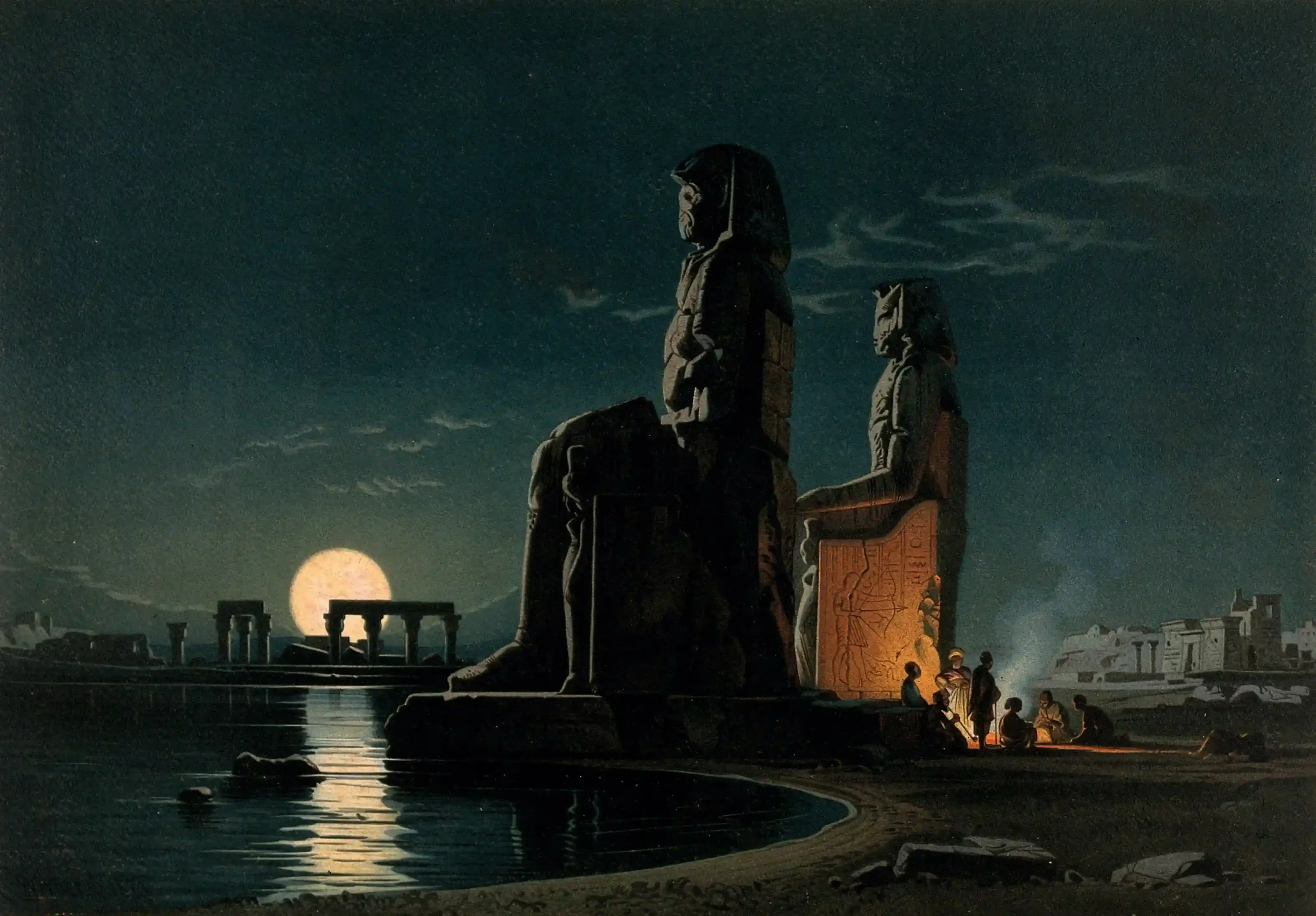
The Colossi of Memnon

Colour lithograph of The Colossi of Memnon, Carl Friedrich Heinrich Werner, c. 1878, after a watercolour of 1871
Carl Friedrich Heinrich Werner (1808–1894), watercolour of 1871; colour lithograph by G.W. Seitz, c. 1878 · medium: Colour lithograph after a watercolour (approx. 26.2 × 37.7 cm) · collection or source: Wellcome Collection, London (ref. 40355i); from Carl Werner’s Nile-sketches, published by G.W. Seitz · artwork: public domain

The scene shows the Colossi of Memnon, two massive stone statues of the New Kingdom Pharaoh Amenhotep III in the Theban Necropolis, west of the Nile at Luxor (ancient Thebes). The twin stone giants are bathed in moonlight during the annual Nile flood, and a small group of figures gathers around a campfire near the base of one statue. This is a reproduction rather than an original: Werner’s watercolour of 1871 was copied as a colour lithograph by Gustav W. Seitz for the portfolio Carl Werner’s Nile-sketches, which presented facsimiles of his watercolours.

Image credits and sources

“Artwork: public domain” describes the painting, print or drawing itself, not any photograph of it. The images here are reproductions from museum, auction and archive sources, and reuse terms for those photographs can differ. Medium, size and date for each work are given in its caption. Found a mistake? See our corrections policy and sources.

  • Memnon and Sesostris — Jean-Léon Gérôme, 1856. Source: Auction record (Sotheby’s); current location not confirmed.
  • Caravan Passing the Colossi of Memnon, Thebes — Jean-Léon Gérôme (1824–1904), 1856. Source: Musée cantonal des Beaux-Arts, Lausanne (acquired 2015).
  • The Colossus of Memnon — Jean-Léon Gérôme (1824–1904), 1857. Source: Private collection.
  • A Caravan Passing the Colossi at Memnon, Thebes — Joseph Austin Benwell (1816–1886), 1876. Source: Current location unknown.
  • The Colossi of Memnon, Thebes, Egypt — Edward Lear (1812–1888), monogrammed 1869 and inscribed “Thebes 1854”. Source: Offered at Sotheby’s, Old Master Drawings, London, 2019 (lot 430); current owner not recorded.
  • The Statues of Memnon (Pharaoh Amenhotep III) — Charles Vacher (1818–1883), 1864. Source: Wellcome Collection, London (ref. 45057i).
  • Thebes: Colossi of Memnon — Oswald Walters Brierly (1817–1894), 18 February 1869. Source: Royal Collection Trust (RCIN 921100).
  • Colossi of Memnon in Egypt — Hubert Sattler, 1846. Source: Salzburg Museum.
  • Statues of Memnon at Thebes During the Inundation — David Roberts (1796–1864), lithographed by Louis Haghe, 1848. Source: Library of Congress.
  • The Colossi of Memnon — Carl Friedrich Heinrich Werner (1808–1894), watercolour of 1871; colour lithograph by G.W. Seitz, c. 1878. Source: Wellcome Collection, London (ref. 40355i); from Carl Werner’s Nile-sketches, published by G.W. Seitz.