
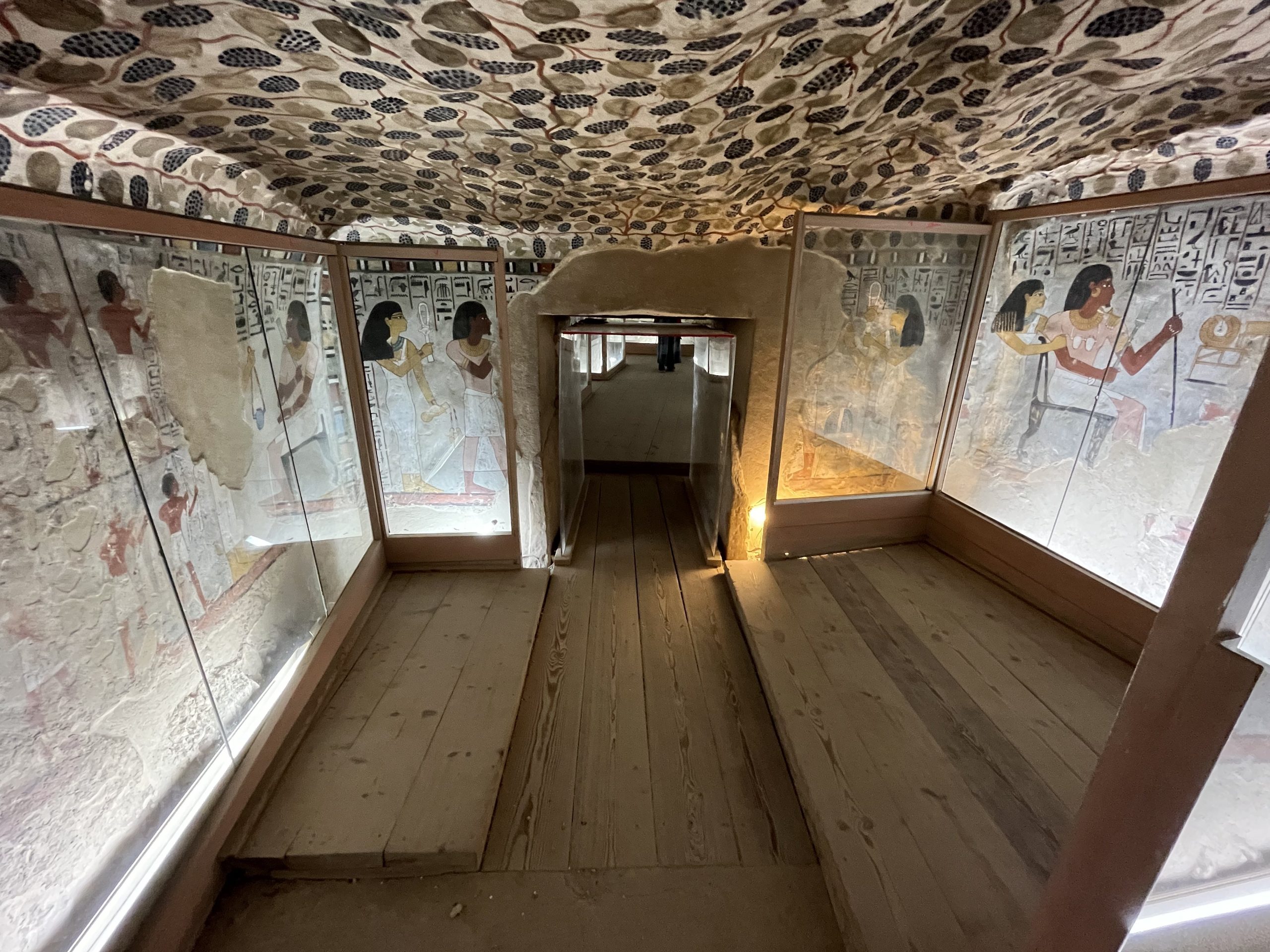
The ceiling is what stops you. Painted directly onto the uneven limestone rock above the burial chamber, grapevines spread in every direction — clusters of deep purple fruit hanging between twisting stems and painted leaves. The surface the artists worked on wasn’t smooth; it was irregular, fractured rock. They turned that unevenness into an advantage, using the natural contours of the stone to give the vines a sense of movement and depth that a flat surface wouldn’t have allowed. After 3,400 years, the grapes still look ready to pick.
The Tomb of Sennefer — TT96, known as the Tomb of the Vineyards — is one of the most beautiful painted chambers in the Theban Necropolis, and one of the most consistently surprising to first-time visitors who arrive expecting something more formal.
Who Was Sennefer?
Sennefer held two significant offices during the reign of Amenhotep II (c. 1427–1401 BCE): Mayor of Thebes and Overseer of the Granaries, Fields, Gardens, and Cattle of Amun. Together these roles placed him at the intersection of municipal government and the economic management of Karnak’s agricultural estates — one of the most powerful administrative positions in New Kingdom Thebes.
His personal connections reinforced his status: his cousin was the vizier Amenemope, whose own tomb (TT29) lies nearby on the Sheikh Abd el-Qurna hillside. The family’s interconnected positions within Theban administration are part of why Sennefer could commission a tomb of this quality.
Architecture: Two Connected Parts
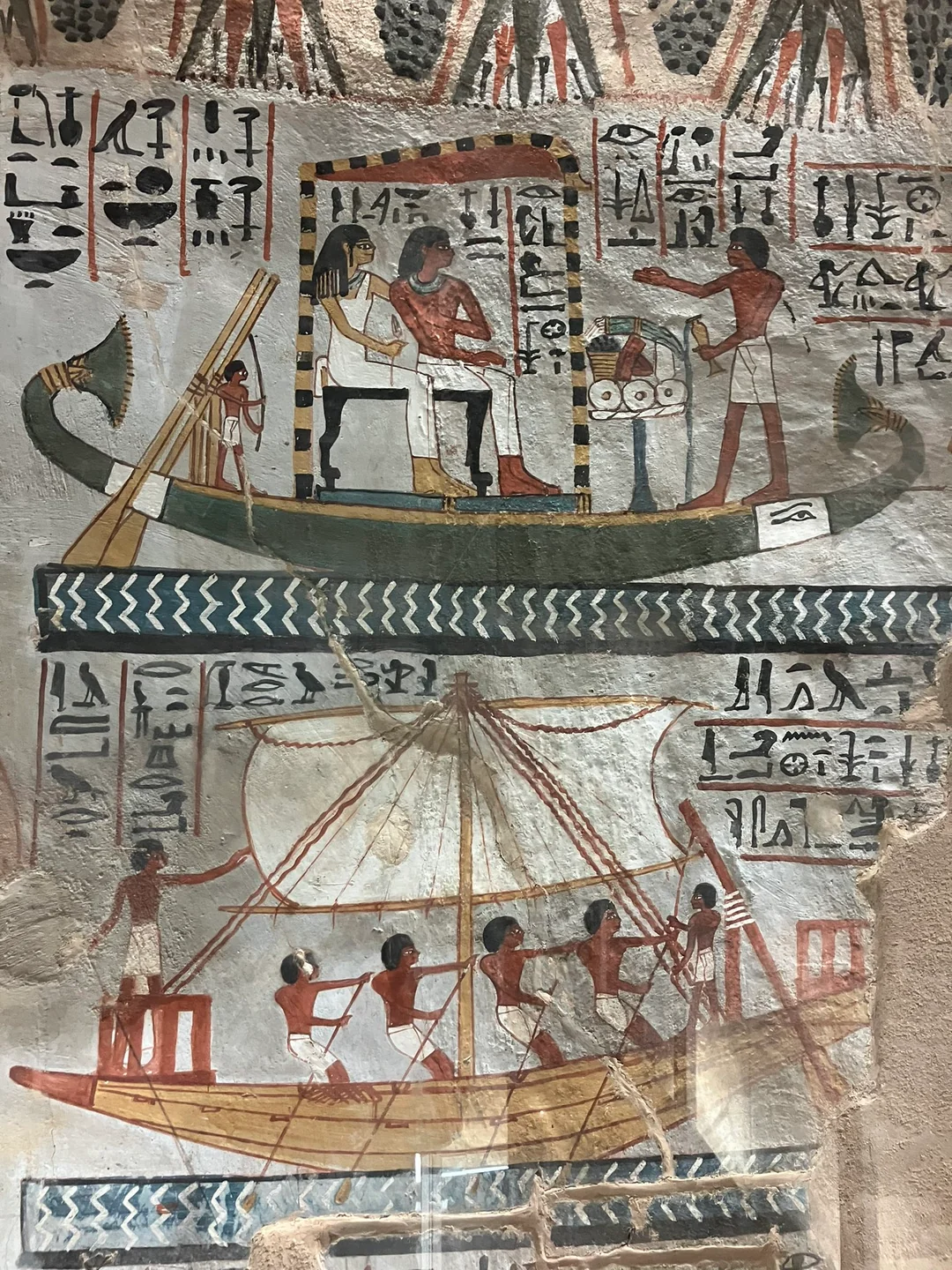
TT96 consists of two distinct sections:
TT96A — the surface chapel, currently under conservation. This was the public-facing part of the tomb, where offerings were made to Sennefer’s spirit by family members and priests. Access is not available while restoration work is ongoing.
TT96B — the underground burial chambers, currently open to visitors. Reached by a steep staircase and narrow passages, this descent into the hillside is itself part of the experience — ancient Egyptian tomb architecture understood the transition from surface to underground as a representation of the boundary between the living world and the realm of the dead.
The low ceilings throughout TT96B require visitors to crouch at points. Wear shoes with grip; the worn stone floors are uneven underfoot.
The Paintings: What to Look For
The Vineyard Ceiling
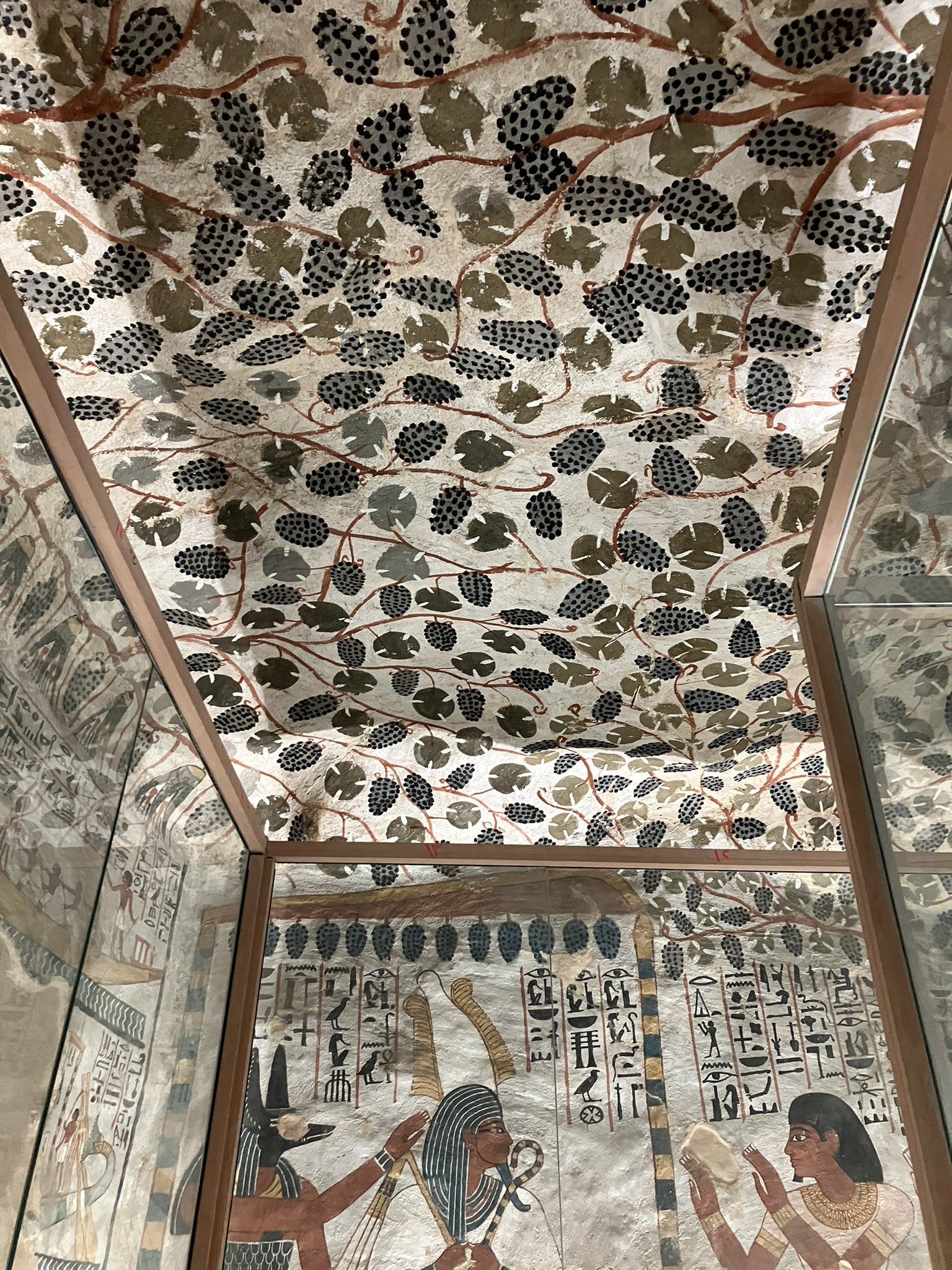
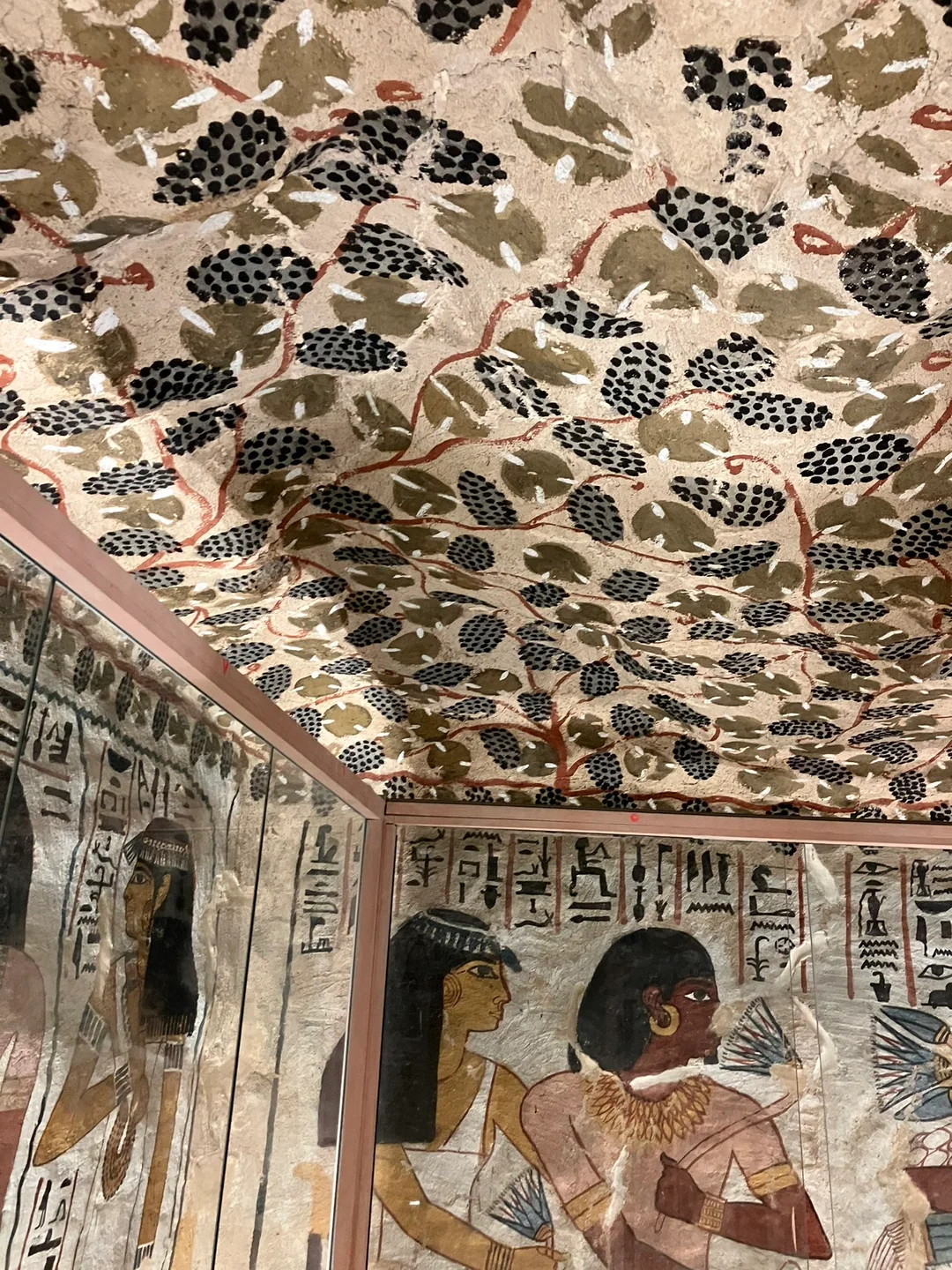
The burial chamber’s painted ceiling is the defining feature of TT96 and the most discussed image in the entire Sheikh Abd el-Qurna necropolis. Grapevines cover every surface, with clusters of fruit in greens and purples, leaves detailed with individual veins, and stems that respond to the contours of the rock beneath. The artists worked on an irregular surface and produced something that reads as dynamic rather than constrained.
In Egyptian funerary symbolism, vines and grapes represented fertility, abundance, and eternal nourishment — a promise that Sennefer would never want for sustenance in the afterlife. The choice of this imagery for a ceiling directly above the sarcophagus was deliberate and specific, not decorative. For the wider logic behind tomb decoration, see Funerals in Ancient Egypt.

Religious Rituals and the Gods
Sennefer and his wife Merit are depicted making offerings to Osiris (the god of the afterlife) and Anubis (guardian of the dead) throughout the chamber. These scenes were functional, not decorative — by depicting the offering ritual in paint, the artists ensured it would continue in perpetuity regardless of whether living priests maintained the practice.
Feasts and Daily Life
Scenes of abundant food — bread, beer, flowers, roasted meat — line the walls alongside the religious imagery. The banqueting scenes reflect the elite pleasures of Sennefer’s earthly life and their promised continuation in the afterlife.
Funerary Processions
Priests are shown carrying out the Opening of the Mouth ceremony and leading the funeral cortège — the rituals necessary for Sennefer’s soul to be received into the afterlife. These scenes work in tandem with the offering scenes: the ritual preparation and the ongoing sustenance are both guaranteed by being rendered permanent in paint. For the ritual’s wider context, see Funerals in Ancient Egypt.

The Mysteries
TT96 raises questions that archaeologists haven’t resolved:
- No grave goods were found. Unlike many New Kingdom official tombs, TT96 contained no burial assemblage — no ushabtis, no jewelry, no funerary equipment. Whether this means the tomb was thoroughly robbed in antiquity or was never actually used for Sennefer’s burial remains unknown.
- Was Sennefer buried here? The absence of grave goods opens the question of whether he was interred elsewhere, or whether TT96 served a different function than a conventional burial. No consensus exists.
- The question of multiple wives. Inscriptions in the tomb reference more than one woman in a spousal context alongside Sennefer. This has generated discussion about New Kingdom elite marriage practices, though interpretations vary significantly.
These unresolved questions are part of what makes TT96 interesting to Egyptologists beyond the paintings.
Visiting the Tomb of Sennefer
TT96 is sold within the Sheikh Abd el-Qurna Tombs of the Nobles cluster ticket system, alongside Rekhmire (TT100). Which tombs are bundled together shifts periodically, so check the current grouping and pricing on our Tombs of the Nobles guide and entrance fees page rather than relying on a fixed price.
Combining visits: TT100 (Rekhmire) is on the same ticket and directly adjacent — the vizier’s tomb is the most historically detailed in the Theban Necropolis and pairs naturally with TT96. TT29 (Amenemope, Sennefer’s cousin) is nearby for visitors interested in following the family connection.