Ancient Thebes
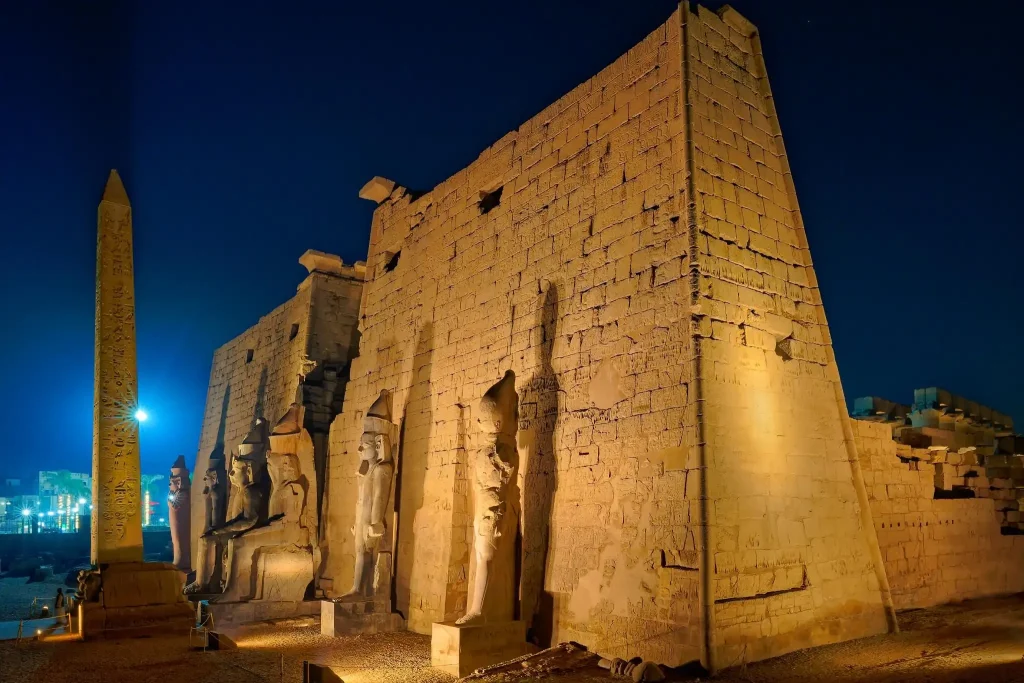
Close your eyes and breathe in the scent of sun-scorched limestone and river-cooled air. Imagine a horizon dominated by towering obelisks that bleed gold at dawn—monolithic spikes of granite that pierce the sky. This is Waset, the “City of the Scepter,” where the barrier between the mortal and divine is nonexistent.
On the banks of the eternal Nile, the ancient Egyptians created a capital designed to capture the power of the gods. The sun’s rhythmic journey defined Thebes: a bustling metropolis on the East Bank, celebrating life, and a silent necropolis on the West Bank, where the sun “died” into golden hills. Here, great rulers were laid to rest in secret, surrounded by gold and spells in lapis ink. This city faced death and chose to build a legacy that transcended its civilization, where artisans served eternity, and every stone was a prayer for everlasting life.
Geography of Ancient Thebes
To understand Ancient Thebes, it is essential to recognize the Nile River’s profound significance. It was more than a water source; it represented a spiritual boundary. The city was divided into two realms reflecting the sun’s cycle:
The East Bank (The Land of the Living): Home to the main city, royal palaces, busy markets, and state temples, it was a hub of noise, celebration, and politics.
The West Bank (The Land of the Dead): Reserved for the Theban Necropolis, this area contained the pharaohs’ mortuary temples and burial sites, ensuring their passage to the afterlife.
This geographical duality shaped daily life in Thebes, with citizens witnessing the sun “die” and “be reborn,” symbolizing their longing for eternal life.
The East Bank: Monuments to the Living
The East Bank of Ancient Thebes housed two monumental religious structures that were vital to the empire’s economy and politics:
1. Karnak Temple Complex
Karnak is the largest religious building ever constructed, covering over 200 acres. For 1,500 years, pharaohs added to its grandeur. Key features include:
– The Great Hypostyle Hall: A “forest” of 134 towering sandstone columns, evoking a sense of awe.
– The Sacred Lake: Used by priests for purification before rituals for Amun-Ra.
– Obelisks of Hatshepsut and Thutmose I: Tall granite structures designed to capture sunlight.
2. Luxor Temple
Located two miles south of Karnak, Luxor Temple was not dedicated to a specific god but was the center for the Opet Festival. During this event, statues of the Theban Triad were paraded from Karnak to reaffirm the pharaoh’s divine right to rule.
The West Bank: Secrets of the Necropolis
Cross the Nile to the West Bank, where the lush riverbank quickly transforms into the scorched limestone of the Libyan Plateau. This area, known for the “Beautiful Festival of the Valley,” was a popular picnic spot near ancestral tombs.
1. The Valley of the Kings
By the New Kingdom, pharaohs stopped building pyramids and began hiding their tombs in a desolate wadi, overseen by al-Qurn mountain. Key tombs include:
– Tutankhamun’s Tomb (KV62): Discovered in 1922, it revealed a wealth of treasures.
– Tomb of Seti I: Renowned for its detailed astronomical charts.
– Ramses VI: Features the striking “Book of the Heavens” on the ceiling.
2. The Valley of the Queens
While less well-known, this valley houses stunning art. Queen Nefertari’s tomb is called the “Sistine Chapel of Ancient Egypt” for its vibrant colors and intricate designs.
3. The Mortuary Temples
Pharaohs constructed “Houses of Millions of Years” to commemorate themselves rather than for burials. Notable sites include:
– Deir el-Bahari: Hatshepsut’s exquisite three-tiered temple built into a cliff.
– Medinet Habu: Ramses III’s temple, famous for its grand pylons and battles against the “Sea Peoples.”
– Colossi of Memnon: Two towering statues of Amenhotep III, remnants of the largest mortuary temple in Thebes.
Luxor Tours & Activities
Looking to save some costs on your travel? Why not join a shared group tour to explore Luxor, Egypt? Here are some activities you might be interested in:
The Rise and Fall of a Capital: A Brief History
The story of Thebes is one of resilience, transforming from a riverside village into a grand capital over centuries.
1. Unification and the Middle Kingdom: Thebes emerged during the 11th Dynasty when Mentuhotep II unified Egypt, ending the First Intermediate Period. It became a royal seat and a religious hub as the local god Amun rose to national prominence.
2. War of Liberation (17th Dynasty): The most dramatic era began when the Hyksos occupied northern Egypt. Theban princes, including Seqenenre Tao, Kamose, and finally Ahmose I, fought to reclaim the land, establishing Thebes as the capital of the New Kingdom.
3. Imperial Zenith (New Kingdom): For 500 years, Thebes thrived. Wealth from conquests fueled monumental constructions like Karnak and Luxor Temple, solidifying its status as a center of global power.
4. Long Twilight and Assyrian Sack: The Third Intermediate Period fractured Theban power, with the High Priests of Amun gaining significant influence. The Assyrian sack in 663 BCE marked the end of its dominance, though it remained a revered site for centuries.
The Human Element: Daily Life Beyond the Pharaohs
While history often highlights the “Great Men” of Thebes, the true essence of the city lay in the lives of artisans, merchants, and temple workers. The archaeological site of Deir el-Medina offers insight into the middle class:
1. Literacy of the Working Class: The tomb builders of Deir el-Medina were literate, using ostraca to write love letters, laundry lists, and excuses for missing work.
2. Women’s Rights: Women in Ancient Thebes had significant freedoms, including ownership of property, legal rights to take court action, and the ability to initiate divorce, securing their financial independence.
3. Religious Life: Commoners enjoyed a personal connection to the divine, maintaining household shrines for gods like Bes and Taweret and leaving “ear stelae” at temples to ensure their prayers were heard.
4. Leisure: Daily life revolved around the Nile and local taverns. Senet, a popular board game, was played across social classes. Thebes celebrated festivals with free food and beer, and beer was a staple in daily life.
Why Ancient Thebes Still Matters
Ancient Thebes is not just a place where an empire fell; it reflects human ambition. It shows what a society can achieve when it brings together political power, artistic talent, and spiritual beliefs to aim for a single goal: immortality.
Today, Thebes is a UNESCO World Heritage site that draws millions of visitors. Whether you are standing in a royal tomb or watching the sunset over the Nile, you can still feel the city’s spirit. Thebes reminds us that while empires fall apart, the beauty we create and the stories we share can last for thousands of years.
Got a Question?
F.A.Qs
Ancient Thebes was located along the Nile River in Upper Egypt, about 500 miles south of the Mediterranean Sea. Today, the modern city of Luxor stands directly on top of and around the ancient ruins.
“Thebes” is actually a Greek name. When the Greeks arrived in Egypt, they associated the city with their own “Thebes” in Greece. The ancient Egyptians knew it as Waset (The City of the Scepter) or Niwt-Amun (The City of Amun).
By the time of the New Kingdom in Thebes, pyramids had become easy targets for grave robbers. To protect their treasures and their mummies, the Pharaohs began carving “hidden” tombs into the limestone cliffs of the Valley of the Kings, relying on secrecy and rugged terrain rather than massive, visible monuments for protection.
No, they are two distinct sites about 2 miles apart.
- Karnak was the primary residence of the god Amun-Ra and the center of the Egyptian empire’s administration.
- Luxor Temple was a smaller, more elegant site primarily used for the Opet Festival, where the Pharaoh’s divine right to rule was spiritually “recharged.”
Yes! However, to preserve the delicate wall paintings from humidity and carbon dioxide, the Egyptian government rotates which tombs are open to the public. Famous tombs like those of Tutankhamun and Seti I often require a separate special ticket.
The “King of the Gods,” Amun-Ra, was the supreme deity of Thebes. He was often worshipped alongside his wife, Mut, and their son, Khonsu (the moon god), together forming the Theban Triad.
Thebes fell from grace due to a combination of factors:
Political Shifts: The capital eventually moved north to the Nile Delta (cities like Tanis and Alexandria).
Invasions: The city was brutally sacked by the Assyrians in 663 BCE.
Natural Forces: Centuries of Nile floods and earthquakes gradually brought down many of the mud-brick palaces, though the great stone temples endured.
Did you know that
By purchasing through our links, you support us at no additional cost.
Thank you for your support. ♥️