
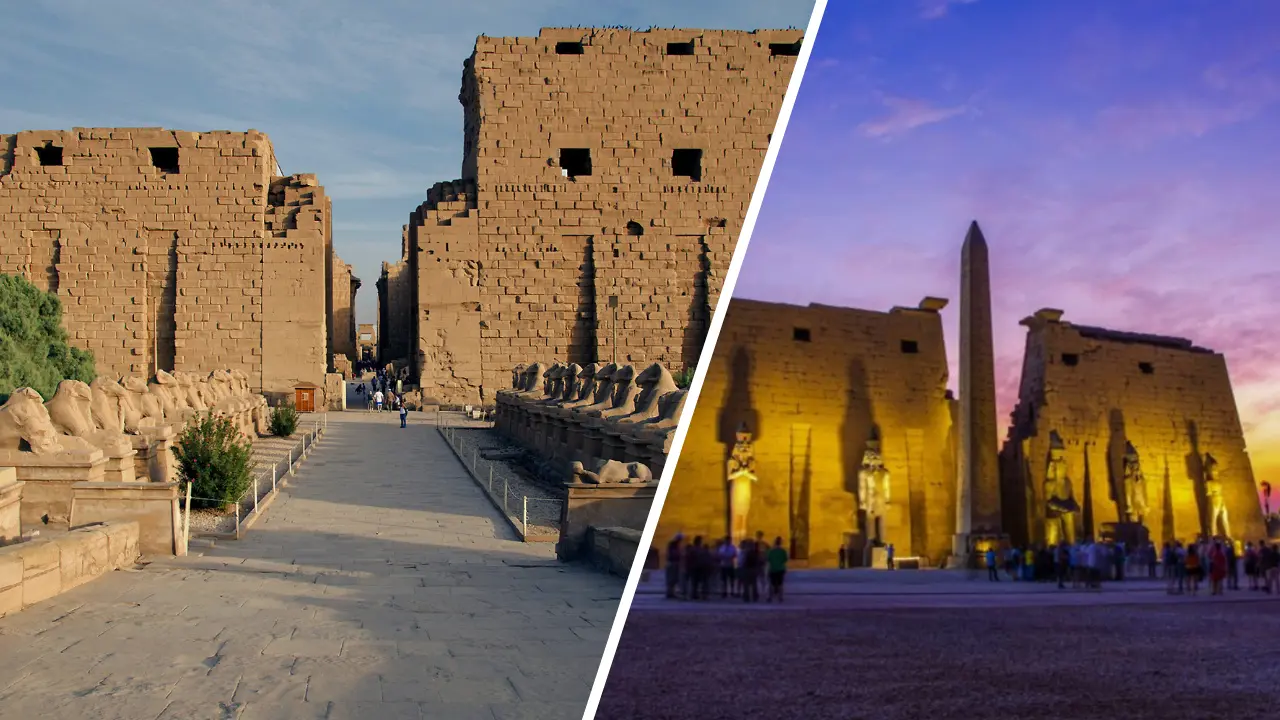
Luxor Temple and Karnak Temple are connected by the same 2.7-kilometre processional road, dedicated to the same chief deity, and built in the same city within a few centuries of each other. They are not, however, the same kind of building. Karnak was Egypt’s primary divine sanctuary — the house of Amun-Ra, maintained by a vast priesthood, receiving daily offerings and ritual attention for nearly two millennia. Luxor Temple was something different: a temple of kingship, built specifically for the ceremony through which the pharaoh renewed his divine authority to rule. Understanding that distinction changes what you see when you visit both.
What Luxor Temple Was Actually For
Luxor Temple was built by Amenhotep III in the 14th century BCE and significantly expanded by Ramesses II. Unlike Karnak, it was not designed for daily worship of a resident deity. Its primary function was the Opet Festival — the annual ceremony held during the Nile’s flood season in which the statues of Amun, Mut, and Khonsu traveled from Karnak along the Avenue of Sphinxes to Luxor Temple, where rituals were performed to recharge the pharaoh’s divine authority.
In Egyptian theology, the pharaoh wasn’t simply a political ruler — he was a god on earth, and that divine status required periodic renewal. Luxor Temple was where that renewal happened. The ceremonies conducted in its innermost chambers confirmed that the king’s connection to the divine had been refreshed for another year, legitimizing his continued rule.
The temple’s architecture reflects this ceremonial purpose. Its layout is designed for movement and procession rather than for the housing of a resident cult statue in the way Karnak’s inner sanctuaries are. The great colonnade of Amenhotep III — one of the most impressive single architectural features in Luxor — was specifically designed as a processional route.
What Karnak Was For
Karnak was Egypt’s primary religious complex — the permanent home of the Amun-Ra cult, the institutional center of the most powerful priestly organization in Egypt, and the physical expression of the state’s relationship to the divine. Priests performed daily rituals here: waking the deity, clothing the cult statue, making offerings, performing the ceremonies that were understood to maintain cosmic order. The temple’s scale — 200 acres, nearly 2,000 years of continuous building by roughly 30 pharaohs — reflects its status as the center of Egyptian religious life.
Where Luxor Temple was activated periodically for a specific ceremony, Karnak operated continuously. It had permanent staff, an administrative structure, agricultural estates that funded its operations, and a theological importance that made it the effective co-capital of Egypt during the New Kingdom.
The Complementary System
The two temples were not in competition — they were two parts of a single system. Karnak housed and empowered the gods. Luxor confirmed the pharaoh’s right to govern in their name. During the Opet Festival, the divine power resident at Karnak was physically conveyed to Luxor, transferred to the king through ceremony, and the now-renewed pharaoh returned in procession to Karnak. Both temples were necessary for the cycle to function.
This dual structure explains a feature of Egyptian kingship that surprises many visitors: the pharaoh was not simply a political leader who claimed divine backing. His divine authority was understood to be genuinely renewed through the Opet rituals at Luxor Temple — not metaphorically, but in the religious framework of New Kingdom Egypt, literally. Karnak gave divine power; Luxor validated the king’s right to hold it.
How They Differ for Today’s Visitor
At Karnak, you are in the most architecturally complex religious site in Egypt — a place built over two millennia by rulers who each added their signature to an expanding complex. The sheer scale is the primary experience. Sub-temples (the Khonsu Temple, the Ptah Temple, the Mut Precinct) each have their own character, but all exist within the framework of an institutional religious center.
At Luxor Temple, the experience is more coherent and more layered. The processional axis from the entrance pylon to the inner sanctuary is still legible as a unified ceremonial path. The multiple layers of civilization (pharaonic, Roman, Coptic, Islamic — the Abu Haggag Mosque still in active use within the ancient court) are concentrated in a smaller, more intimate space. Many visitors find Luxor Temple easier to understand as a single place, even though its history is equally complex.
Karnak is best experienced in the morning, when the Great Hypostyle Hall’s scale is most impressive in the early light. Luxor Temple is best experienced at sunset or in the evening, when the floodlights make the sandstone glow and the crowds thin after the tour buses depart.
In short: visit Karnak for the divine; visit Luxor Temple for the human. Both are necessary. Neither is a smaller version of the other.