
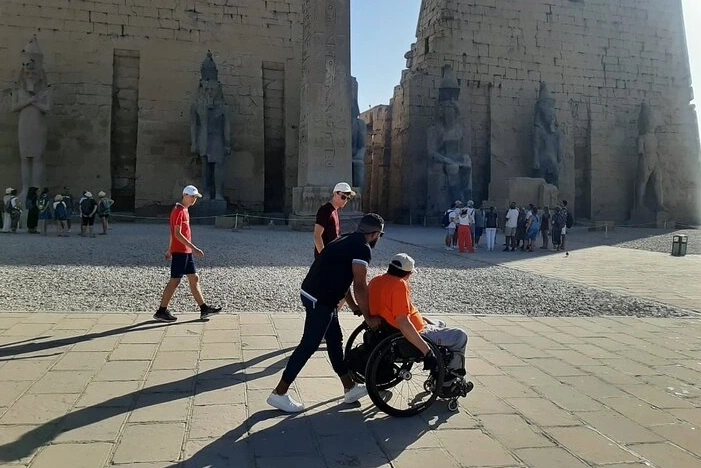
Luxor was not built with modern access needs in mind. Some tombs can’t be entered on wheels, and a site marked “accessible” may not match your idea of the word.
It is still worth the effort. The Hypostyle Hall at Karnak, one of the most extraordinary rooms people have ever built, can be reached in a wheelchair. So can the Colossi of Memnon. And watching the sun set behind the West Bank cliffs from the Nile needs no ramp at all.
This guide rates each major site, with timing and photography notes, and explains the decision that shapes the whole trip: which side of the Nile to base yourself on. Ticket prices and opening hours change often, so we link to our entrance fees guide rather than repeat them here.
The short answer
Partly. The East Bank, home to Karnak, Luxor Temple, the Corniche, the museums and most hotels, works for many wheelchair users. The West Bank is harder: rough ground, steps into most tombs and long distances between sites. There, a private adapted vehicle and a guide who knows which tombs to skip are essential.
Luxor wheelchair access at a glance
| Site | Access | Best time |
|---|---|---|
| Karnak Temple | Mostly accessible (main route) | 6 am opening |
| Luxor Temple | Mostly accessible | Late afternoon into evening |
| Luxor Museum | Reported step-free | Check the day’s hours |
| Mummification Museum | Unclear, call ahead | Check the day’s hours |
| Valley of the Kings | Partly accessible | 6 am opening |
| Temple of Hatshepsut | Lower terraces only | Early morning |
| Colossi of Memnon | Accessible | Any time, on a West Bank day |
Ratings are our own summary of published sources and visitor reports, not first-hand testing. Conditions change, so tell your guide or operator exactly what you need. Several major sites are reported to take cards only, so bring a bank card; see ticket offices. The Ministry’s free-entry categories for people with disabilities are listed for Egyptian nationals, so don’t count on a discount as a foreign visitor.
Which side of the Nile to stay on
The East Bank is the modern city. It has better roads, more amenities, the main museums and most hotels, and it is where Karnak and Luxor Temple stand. It is easier to navigate and the best base for a wheelchair user.
The West Bank holds the Valley of the Kings, Hatshepsut’s temple and the Colossi of Memnon. Its terrain is difficult and its sites are spread out. Visit it as a day trip from the East Bank. For the full comparison, see Where to Stay in Luxor.
Site-by-site access
Karnak Temple
Access: mostly accessible on the main route. Karnak is the friendliest of the big sites. It has visitor pathways designed for people with physical disabilities, and the main route, from the First Pylon through the Great Court to the Hypostyle Hall, is largely flat.
Past the hall, expect worn stone, gravel and raised thresholds around the Sacred Lake and side chapels. Some ramps are steep, so bring a strong pusher. A wheelchair user’s 2015 review described the visitor centre near the entrance as air-conditioned and ramped; check that it is open on your day.
Time: allow two to three hours for the main Amun precinct; if energy is limited, stick to the main axis. Best time: the 6 am opening. Tour groups arrive later, and by mid-morning the stone holds the heat. Don’t leave it late in the afternoon; check closing times before you go. Photography rules vary, so confirm at the ticket office. See our guide to the Karnak Hypostyle Hall for what you’ll see.
Luxor Temple
Access: mostly accessible. In the city centre, with mostly flat, paved ground. A few uneven stones may need a helping hand.
Time: plan on at least an hour. Best time: late afternoon into evening, when it is cooler, quieter and lit at night. Check the closing time on the day.
Valley of the Kings
Access: partly accessible. Rough terrain and steep stairs into most tombs make this the hardest site on the list, but it is not off-limits. An electric tram runs from the entrance into the valley for a small fee, and the open-air approach is manageable. The set of open tombs rotates, so a local guide who knows which ones have the shortest, easiest descents is worth more here than anywhere else.
Tutankhamun’s tomb is not step-free. The Theban Mapping Project records sixteen steps down to the entrance gate. It also needs its own ticket, so ask your guide before paying for it. See the tomb of Tutankhamun page for what is inside.
Best time: the 6 am opening, before the valley heats up.
Temple of Hatshepsut
Access: lower terraces only. The paths to the lower level are easy and the view of the three terraces from below is impressive. The middle terrace is reached by gentle ramps without handrails, and the upper sanctuary needs two short flights of steps. A shuttle runs from the car park to the temple base (roughly 300 metres).
Best time: early. The terraces have almost no shade and become punishing by mid-morning.
Colossi of Memnon
Access: accessible. The two statues of Amenhotep III stand on flat ground beside the road. It is a quick, rewarding stop, usually around fifteen minutes, and popular for photos. Entry has been free. It sits naturally at the start or end of a West Bank day.
Luxor Museum and Mummification Museum
The Luxor Museum is small, modern and well organised, and recent visitors report that it is wheelchair accessible. Expect roughly an hour. A 2026 reviewer reported card-only payment.
The Mummification Museum sits on the East Bank Corniche near Luxor Temple, and access reports conflict. Some listings mention ramps and an elevator, while a 2026 visitor guide describes an entrance below street level reached by stairs from the Corniche and found no confirmed lift. Call ahead before planning around it.
Both museums have varied their opening hours by season, so check the day’s hours before treating either as a midday escape from the heat.
Sites to skip or check first
- The Ramesseum: our Ramesseum guide describes uneven, sandy ground with no paved routes, so it is not wheelchair accessible.
- Luxor souk: the narrow alleys can be challenging for wheelchairs; see the souk guide.
- Not yet confirmed: we haven’t confirmed access at Medinet Habu, the Valley of the Queens, Deir el-Medina or the Tombs of the Nobles. Ask your operator before adding them to a plan.
Getting around Luxor in a wheelchair
Public buses, crowded minibuses and standard taxis are not wheelchair accessible. What you arrange in advance matters more than anything else on this page.
- Arriving. Flights are the easiest way to reach Luxor if mobility is a concern, and wheelchair assistance is standard at both Cairo and Luxor airports. The sleeper train’s narrow cabin doors make it the hardest option. See Cairo to Luxor: Train, Flight or Bus.
- Private adapted vehicle. This is the best option and, on the West Bank, a necessity. Ask specifically for a vehicle with a ramp or hydraulic lift, and confirm air conditioning. Don’t assume a standard minivan will do, and ask for photos of the exact vehicle.
- Crossing the Nile. Luxor’s road bridge lies south of the centre, and the drive to the West Bank sites by taxi takes roughly 30 to 40 minutes. That is the reliable route for an adapted vehicle.
A cheap public ferry runs near Luxor Temple, but it is a local boat and we could not confirm step-free boarding. Choose it only if your operator has personally taken a wheelchair user across. Feluccas aren’t wheelchair-friendly, though motorboats can be arranged; see Luxor Nile River Ride.
- On-site trams. Electric trams at the Valley of the Kings and shuttles at Hatshepsut’s temple cover the longest walks.
- East Bank Corniche. The riverside promenade is mostly flat and makes an easy walk, especially at dusk when it comes alive.
How to brief a private guide or driver
Send this before you arrive, not on the day:
- Your chair type (manual or power), its width, and whether you can transfer.
- How many steps you or your companion can manage, if any.
- Whether you need accessible toilets, shade and rest stops along the route.
- A request for the day’s open tombs and which have the easiest access, since the list rotates.
Also agree the price, the route and the hours in writing. Our tourist scams guide covers how to do that without being overcharged.
Questions to ask hotels and Nile cruises
Stay on the East Bank; see Best Hotels in Luxor for options. “Accessible room” means different things at different hotels, so ask each one directly:
- Is the shower roll-in, or a bath with grab rails?
- Are there grab bars in the bathroom?
- Do lifts reach every floor?
- How wide are the door frames and bathroom entrance?
- How far is accessible parking from reception?
For a Nile cruise between Luxor and Aswan, ships vary widely and marketing photos rarely show the details. Before you book, ask:
- What is the exact gangway width at boarding?
- Are there any steps between decks that the lift does not reach?
- Has a wheelchair user completed this cruise on this particular ship?
Work with a specialist accessible-travel operator who has inspected the ship in person.
When to go and how to pace it
Winter, from roughly October to April, is far more comfortable than summer, when highs regularly pass 40°C. See the best times to visit Luxor. In any season, go early: sites open at 6 am, the light is soft, the heat is manageable and the crowds are thin. Plan a hotel break in the middle of the day and return to the East Bank temples in the late afternoon.
A multi-day Luxor Pass is sold for the main sites. Compare its price with the sites you will actually enter before buying, because a wheelchair itinerary that skips most tombs may not need one.
A workable two-day shape (our standard two-day itinerary covers the full version):
- Day 1, East Bank: Karnak at opening, back to the hotel for the middle of the day, Luxor Temple in the late afternoon, then a slow walk along the Corniche at dusk.
- Day 2, West Bank: leave early in your adapted vehicle for the Valley of the Kings with the tombs your guide picks, then the lower terraces of Hatshepsut’s temple, and the Colossi of Memnon on the way back.