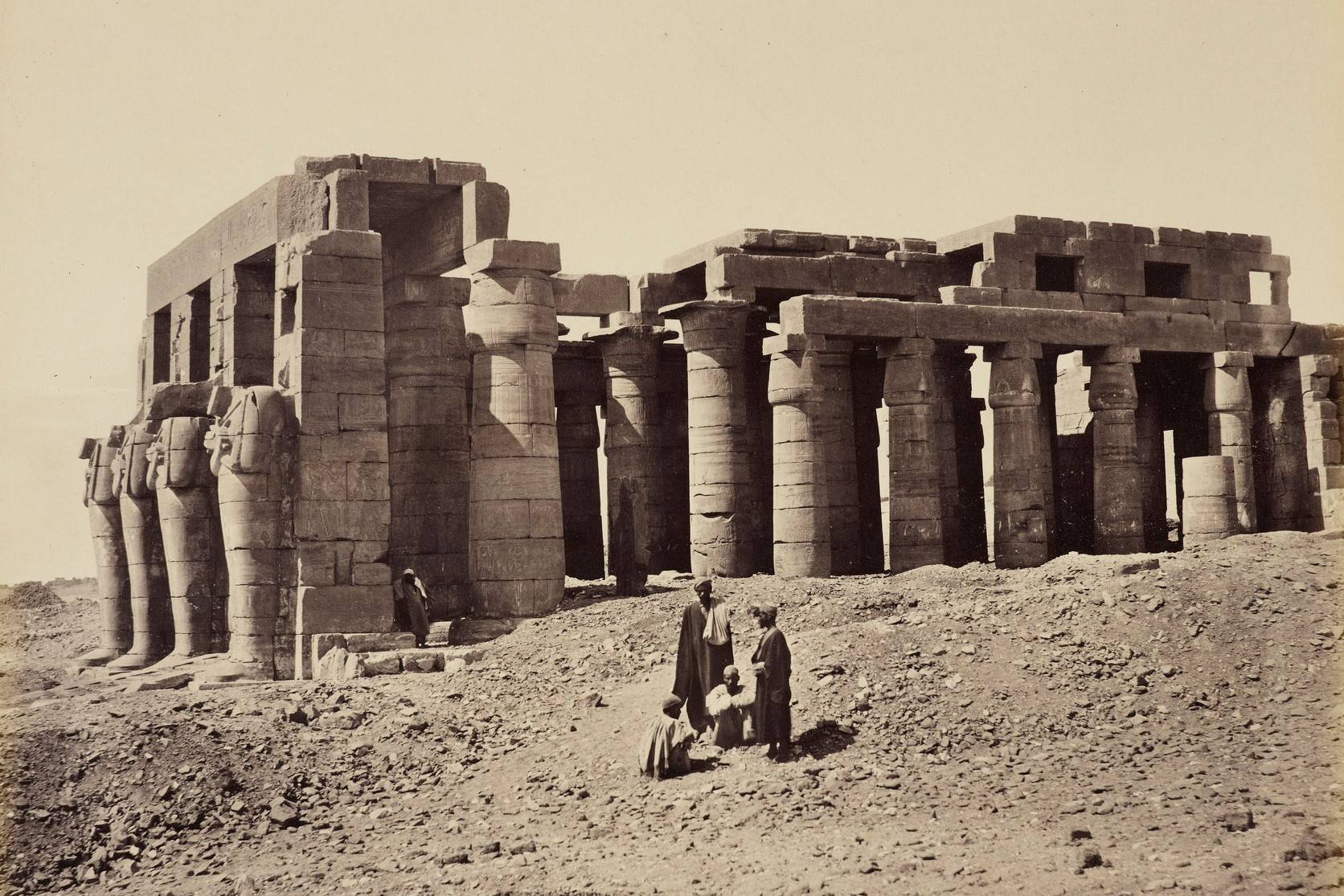
Photo Gallery · Luxor West Bank

The Ramesseum and Colossi of Memnon in Old Photos

Fourteen photographs of the Ramesseum, the old “Memnonium”, and the Colossi of Memnon, made between 1851 and 1862.

In these views the Ramesseum is a field of broken columns and fallen stone, with a giant statue of the king lying in pieces. Early travellers called the temple the “Memnonium”, so old titles blur it with the Colossi of Memnon, two seated statues that stand apart at the edge of the fields; the first section below explains how to read the old names. To plan a visit, see our Colossi of Memnon guide and Ramesseum guide.

Memnonium or Colossi of Memnon? Reading the old titles

The Colossi of Memnon and the Memnonium are different sites. The Colossi of Memnon are the two seated statues of Amenhotep III at the edge of the fields. In the old titles on this page, the “Memnonium” is the Ramesseum, the temple of Ramesses II. The name was not always applied consistently, so check each caption.

Titles that read “Gournah” or “Goorneh” refer to today’s Qurna. One portico at Qurna in Frith’s series is not confirmed as the Ramesseum.

Osiride pillars, which carry statues of the king as Osiris, belong to several west-bank temples. One undated view whose site is not confirmed is in the Medinet Habu gallery.

Colossi of Memnon

Four views of the two seated statues of Amenhotep III on the Theban west bank.

Colossi of Memnon: upright view, 1857

The two seated Colossi of Memnon in an upright view, 1857
Francis Frith, 1857 · albumen print · Old title: “The Statues of Memnon; Upright View 1857”

The Colossi of Memnon, the two seated statues of Amenhotep III on the Theban west bank, in an upright view from Frith’s 1857 series. See the size of the figures against the flat ground. They once stood before his mortuary temple and still stand at the edge of the fields.

Colossi of Memnon: the pair of statues, 1857

The pair of Colossi of Memnon on the Theban west bank, 1857
Francis Frith, 1857 · albumen print · Old title: “The Statues of Memnon 1857”

A second view of the pair of Colossi of Memnon in Frith’s 1857 series. Compare it with the upright view to see how the framing changes the sense of scale.

Colossi of Memnon: the Vocal Memnon

The northern Colossus of Memnon, Colossi of Memnon
Francis Bedford, date not stated · Old title: “The Vocal Memnon”

The statue known as the Vocal Memnon, the northern of the two colossi, so called because ancient visitors reported that it sounded at dawn. Greek visitors linked the sound to the hero Memnon. No exact date is recorded. Observe the weathered seated figure.

Colossi of Memnon: the right-hand colossus, 1851–52

The right-hand Colossus of Memnon, photographed at Qurna
Félix Teynard, 1851–1852 (photographed); printed 1853–1854 · salted paper print from paper negative · 23.9 × 30.5 cm · The Metropolitan Museum of Art, accession 1976.607.40 (object 261839) · Old title: “Gournah (Thebes); Colossi – the Right-Hand Colossus, Called Memnon”

The right-hand Colossus of Memnon at Gournah, today’s Qurna, on the west bank, photographed by Teynard in 1851–52 and printed in 1853–54. Note the size of the statue. The pair once stood before the mortuary temple of Amenhotep III.

The Ramesseum, the “Memnonium”

Ten views of the temple of Ramesses II, from Teynard, Frith and Bedford. One, a portico at Qurna, is not confirmed as the Ramesseum.

The Ramesseum: the fallen colossus, c. 1857

The fallen colossus of the Ramesseum
Francis Frith, c. 1857 · albumen print · Old title: “The Memnonium – The Fallen Colossus”

The fallen colossus of the Ramesseum, which the old title calls the Memnonium, in Frith’s view of around 1857. The Ramesseum is the temple of Ramesses II, and the broken giant is a statue of the king himself, lying in pieces where it fell. See how large the fragments are beside the walls and columns around them. The colossus lies broken inside the temple today.

The Ramesseum: north portico and the fallen colossus, 1862

The north portico and the ruins of the fallen colossus, The Ramesseum
Francis Bedford, 1862 · albumen print · Old title: “North Portico and Fallen Colossus; Thebes – 1862”

The north portico of the Ramesseum with the fallen colossus, photographed by Bedford in 1862. Compare it with Frith’s view of the colossus to see the same ruin about five years later.

The Ramesseum: general view from the south-east, 1862

A general view of the Ramesseum from the south-east
Francis Bedford, 1862 · albumen print · Old title: “General View from the South East; Thebes 1862”

A general view of the Ramesseum from the south-east, photographed by Bedford in 1862. Notice how the ruined walls and columns sit in open ground. The temple lies on the west bank, not far from the Colossi.

The Ramesseum: the second court, 1857

The second court of the Ramesseum with its Osiris pillars, 1857
Francis Frith, 1857 · albumen print · 15.6 × 20.9 cm · Royal Collection Trust, acquired by King Edward VII when Prince of Wales · Old title: “The Memnonium 1857”

The second court of the Ramesseum, Ramesses II’s mortuary temple on the west bank, with its Osiris pillars, in Frith’s 1857 series. The “Memnonium” of the title is this temple, not the Colossi of Memnon. See the row of pillars along the court.

The Ramesseum: Osiride pillars of the second court, 1851–52

Osiride pillars of the second court of the Ramesseum
Félix Teynard, 1851–1852 (photographed); printed 1853–1854 · salted paper print from paper negative · 24.5 × 30.1 cm · The Metropolitan Museum of Art, accession 1976.607.42 (object 261841) · British Library 74/Cup.652.m.2, 1(42), 239 × 310 mm (another print) · Old title: “Gournah (Thebes); Palace Known as the Memnonium”

Teynard’s plate, titled “Gournah (Thebes); Palace Known as the Memnonium”, shows four of the Osiride pillars of the second court of the Ramesseum, according to the British Library’s catalogue, which also gives the Ramesseum as the mortuary temple of Rameses II in western Thebes, also known as the Memnonium. It was photographed in 1851–52 and printed in 1853–54. Observe the row of pillars and the walls behind them.

The Ramesseum: Osiride portico, first view, 1857

The Osiride portico of the Ramesseum
Francis Frith, 1857 · albumen print · Old title: “The Memnonium – Osiride Portico 1857”

The Osiride portico of the Ramesseum, in Frith’s 1857 series, where the pillars are fronted by figures of the king as Osiris. Note the row of pillars and the figures against them.

The Ramesseum: Osiride portico, second view, c. 1857

A second view of the Osiride portico of the Ramesseum
Francis Frith, c. 1857 · albumen print · 15.7 × 20.5 cm · Royal Collection Trust, acquired by King Edward VII when Prince of Wales · Old title: “The Memnonium – Osiride Portico”

A second view of the Osiride portico of the Ramesseum, taken from a distance, in Frith’s series of around 1857. Compare it with the previous picture to see how the viewpoint changes the row of pillars.

The Ramesseum: south portico, 1862

The south portico of the Ramesseum with its Osiride columns
Francis Bedford, 17 March 1862 · albumen print · Old title: “The South Portico; Thebes 1862”

The south portico of the Ramesseum with its Osiride columns, dated 17 March 1862 and photographed by Bedford. See the columns and the figures that front them.

Qurna: the portico, reverse view, c. 1857

The portico at Qurna seen from behind
Francis Frith, c. 1857 · albumen print · Old title: “Goorneh – The Portico; Reverse View”

The portico of the temple at Goorneh, today’s Qurna, seen from behind, in Frith’s series of around 1857. The catalogue does not confirm which west-bank temple this is: Qurna is best known for the mortuary temple of Seti I, so it may not be the Ramesseum. Observe the back of the pillars.

The Ramesseum: hall of columns, c. 1857

The hall of columns of the Ramesseum
Francis Frith, c. 1857 · albumen print · 16.1 × 20.1 cm · Royal Collection Trust, acquired by King Edward VII when Prince of Wales · Old title: “The Memnonium – Hall of Columns”

The Hall of Columns of the Ramesseum, in Frith’s series of around 1857. Note the columns that remain standing and those that have fallen. The hall lies inside the temple, beyond the courts.

About these Ramesseum and Colossi photographs

Who and when. Three photographers made the pictures on this page. Eight views are from Francis Frith’s 1857 Nile series. Three are catalogued by Royal Collection Trust, which holds the prints; five are matched by title and series. Four are from Francis Bedford’s 1862 tour with the Prince of Wales. Félix Teynard, who worked on the west bank in 1851–52, made two plates published as Égypte et Nubie in about 1858.

Reading the photographs. Start with scale: the statues and the fallen colossus are far larger than the people who stood beside them. Compare Frith’s fallen colossus of about 1857 with Bedford’s north portico of 1862. The headings here use the modern names.

Credits and sources for the Ramesseum and Colossi photographs

Medium, size and old title for each picture appear under the photograph itself. Links go to the holding institution’s record where one is available.

  • Colossi of Memnon: upright view, 1857 — Francis Frith, 1857.
  • Colossi of Memnon: the pair of statues, 1857 — Francis Frith, 1857.
  • Colossi of Memnon: the Vocal Memnon — Francis Bedford, date not stated.
  • Colossi of Memnon: the right-hand colossus, 1851–52 — Félix Teynard, 1851–1852. The Metropolitan Museum of Art, accession 1976.607.40 (object 261839).
  • The Ramesseum: the fallen colossus, c. 1857 — Francis Frith, c. 1857.
  • The Ramesseum: north portico and the fallen colossus, 1862 — Francis Bedford, 1862.
  • The Ramesseum: general view from the south-east, 1862 — Francis Bedford, 1862.
  • The Ramesseum: the second court, 1857 — Francis Frith, 1857. Royal Collection Trust, acquired by King Edward VII when Prince of Wales.
  • The Ramesseum: Osiride pillars of the second court, 1851–52 — Félix Teynard, 1851–1852. The Metropolitan Museum of Art, accession 1976.607.42 (object 261841); British Library 74/Cup.652.m.2, 1(42).
  • The Ramesseum: Osiride portico, first view, 1857 — Francis Frith, 1857.
  • The Ramesseum: Osiride portico, second view, c. 1857 — Francis Frith, c. 1857. Royal Collection Trust, acquired by King Edward VII when Prince of Wales.
  • The Ramesseum: south portico, 1862 — Francis Bedford, 17 March 1862.
  • Qurna: the portico, reverse view, c. 1857 — Francis Frith, c. 1857.
  • The Ramesseum: hall of columns, c. 1857 — Francis Frith, c. 1857. Royal Collection Trust, acquired by King Edward VII when Prince of Wales.