Photo Gallery · Karnak Temple, Luxor

Karnak’s Hypostyle Hall in Old Photos

Sixteen photographs of the Great Hypostyle Hall at Karnak, taken between 1851 and 1862, when the hall was still half-buried in sand and decades before its 1899 collapse.

In these views the “Great Hall” and “Hall of Columns” of the old titles stand half-buried, with sand and rubble between the columns and around the walls. Eleven columns of the hall’s northern wing fell on 3 October 1899, and every photograph here was made before that collapse. For the pylons, obelisks and granite sanctuary beyond the hall, see Karnak’s pylons, obelisks and granite sanctuary in old photos; for the sphinx avenue, the Great Court and general views, see Karnak in old photos. To see the hall as it is now, read our Hypostyle Hall guide; for tickets and the route round the precinct, see the Karnak Temple guide.

The hall from outside and above

Five views of the hall as a whole, from Frith’s 1857 series and Teynard’s 1851–52 plates.

Karnak: Exterior of the Great Hall, 1857

The outside of the Great Hypostyle Hall, Karnak
Francis Frith, 1857 · albumen print · Royal Collection Trust, acquired by King Edward VII when Prince of Wales · Old title: “Carnac – Exterior of the Great Hall 1857”

Frith’s 1857 view of the outside of Karnak’s Great Hypostyle Hall, showing part of the north-eastern outer wall. Its carvings include a scene of Seti I striking a group of prisoners with his mace. See the rough ground around the walls, which later clearance has changed. The hall lies between the Second and Third Pylons, in the middle of the precinct.

Karnak: the Hall of Columns from the south-east, c. 1857

The Hypostyle Hall seen from the south-east, Karnak
Francis Frith, c. 1857 · albumen print · 16.3 × 21.0 cm · Royal Collection Trust, acquired by King Edward VII when Prince of Wales · Old title: “Carnac – The Hall of Columns from the West”

Frith’s “Hall of Columns from the West”, around 1857. Despite the title, Royal Collection Trust says the view is actually from the south-east. The camera looks at the hall from the Third Pylon, which lies in two large heaps of debris in the foreground, and two local men stand where its gateway used to be. See how the dense ranks of columns rise above the rubble.

Karnak: the Great Hall from the Sacred Lake, c. 1857

The Hypostyle Hall seen across the Sacred Lake at Karnak, with the ruined Fourth and Fifth Pylons on the right
Francis Frith, c. 1857 · albumen print · 15.7 × 20.5 cm · Royal Collection Trust, acquired by King Edward VII when Prince of Wales · Old title: “Carnac – The Great Hall etc, from the Salt Lake”

Frith’s view from the shore of the Sacred Lake, which his title calls the Salt Lake, looking across the water. The Hypostyle Hall stands in the background on the left. On the right are the remains of the Fourth and Fifth Pylons with the obelisks of Hatshepsut and Thutmose I. Observe the hall rising behind the water and the pylons beside it; the Karnak pylons gallery has more views of the lake.

Karnak: Hypostyle Hall, side galleries, first view, 1851–52

The interior of the Great Hypostyle Hall, Karnak
Félix Teynard, 1851–1852 (photographed); printed 1853–1854 · salted paper print from paper negative · 30.2 × 25.0 cm · The Metropolitan Museum of Art, accession 1976.607.56 (object 261856) · Old title: “Karnak (Thebes); Palace – Hypostyle Hall – Window and Capitals of the Side Galleries (Met 1976.607.56)”

Windows and capitals of the side galleries of the Hypostyle Hall, photographed by Teynard in 1851–52 and printed in 1853–54. Notice how crowded the columns are and how much debris lies between them.

Karnak: Hypostyle Hall, general view, 1851–52

A general view of the Great Hypostyle Hall, Karnak
Félix Teynard, 1851–1852 · salted paper print from paper negative · plate also in the British Library, 74/Cup.652.m.2, 1(52), 248 × 306 mm · Old title: “Karnak (Thebes); Palace – Hypostyle Hall – General View Taken from Point Q”

A general view of the Great Hypostyle Hall taken from Point Q on Teynard’s survey plan, dated 1851–52. The British Library catalogue describes it as a view from the 4th pylon, looking north-westwards towards the columns of the hypostyle hall. See how many columns fill the frame. The hall lies between the Second and Third Pylons, at the heart of the temple.

The central colonnade and the aisles

Seven views of the tall central columns and the lower aisles beside them, by Teynard, Frith and Bedford.

Karnak: Hypostyle Hall, central colonnade, 1851–52

The central colonnade of the Great Hypostyle Hall, Karnak
Félix Teynard, 1851–1852 · salted paper print from paper negative · Old title: “Karnak (Thebes); Palace – Hypostyle Hall – Central Colonnade”

The central colonnade of the Hypostyle Hall, photographed in 1851–52. It is the tallest part of the hall: twelve columns about 21 metres high form the main aisle. Note their open papyrus capitals beside the smaller columns. The colonnade runs along the temple’s main axis.

Karnak: Hypostyle Hall, central colonnade capitals, 1851–52

The capitals of the central colonnade, Karnak
Félix Teynard, 1851–1852 · salted paper print from paper negative · British Library 74/Cup.652.m.2, 1(55); 040-003224438 · 313 × 256 mm · Old title: “Karnak (Thebes); Palace – Hypostyle Hall – Central Colonnade Capitals”

The capitals of the central colonnade, shaped like open papyrus flowers, photographed in 1851–52. The British Library describes it as a “close view of capitals in the hypostyle hall of the Temple of Amun-Ra.” Notice how far each capital spreads beyond the shaft below.

Karnak: columns of the Great Hall, c. 1857

Columns of the Great Hypostyle Hall, Karnak
Francis Frith, c. 1857 · albumen print · 21.1 × 16.2 cm · Royal Collection Trust, acquired by King Edward VII when Prince of Wales · Old title: “Carnac – Columns of the Great Hall”

Columns of the Great Hypostyle Hall in Frith’s series, around 1857. Royal Collection Trust describes the view as from the south, with large stones in the foreground that once formed the Third Pylon. Note the surface of the shafts and at the height of the blocks resting above them.

Karnak: columns of the Great Hall, other side, c. 1857

Columns of the Great Hypostyle Hall seen from the opposite side, Karnak
Francis Frith, c. 1857 · albumen print · 21.0 × 16.5 cm · Royal Collection Trust, acquired by King Edward VII when Prince of Wales · Old title: “Carnac – Columns of the Great Hall; Other Side”

The same columns of the Great Hypostyle Hall seen from the other side, around 1857. Compare it with the previous picture to see how the light and the standing blocks change between the two viewpoints.

Karnak: interior of the Hall of Columns, c. 1857

The interior of the Hall of Columns, Karnak
Francis Frith, c. 1857 · albumen print · 21.0 × 16.6 cm · Royal Collection Trust, acquired by King Edward VII when Prince of Wales (RCIN 2701254) · Old title: “Carnac – Interior View in Hall of Columns”

The interior of the Hall of Columns, around 1857: a passageway between two rows of columns carved with hieroglyphs, with a leaning column in the background and large blocks of fallen masonry beyond it. A local man holding a stick stands in the foreground. See how little open floor shows between the columns.

Karnak: inside the Hypostyle Hall, 1862

The interior of the Great Hypostyle Hall with its papyrus-form columns, Karnak
Francis Bedford, 16 March 1862 · albumen print; mounted on card · 28.7 × 23.2 cm (image); 46.9 × 58.4 cm (mount) · signed, captioned and dated in the negative “F Bedford Karnak”; Day & Son series no. 29 · Royal Collection Trust RCIN 2700883, acquired by the Prince of Wales (later King Edward VII) in 1862 · Royal Collection title: “In the Hall of Columns, Karnak [Hypostyle Hall, Temple of Amun, Karnak]” · Old title: “Inside the Hall of Columns; Karnak – 1862”

Bedford photographed the interior of the Great Hypostyle Hall on 16 March 1862, the date recorded in the catalogue. Notice how closely the columns stand. Royal Collection Trust says the hall was begun by Seti I and completed by Ramesses II; our Hypostyle Hall guide has the fuller account. The eleven columns that fell in 1899 were later rebuilt under Georges Legrain.

Karnak: the Hall of Columns, side view, c. 1857

A side view of the Hall of Columns, Karnak
Francis Frith, c. 1857 · albumen print · Old title: “Carnac – The Hall of Columns; Side View”

The Hall of Columns seen from the side, around 1857, looking along the aisles rather than down the main axis. See how the lower side columns stand against the taller central ones.

Details and carved walls

Four details: a window, carved walls, small columns and the ruined colonnades behind the hall.

Karnak: Hypostyle Hall, side galleries, second view, 1851–52

A window and capitals of the side galleries in the Great Hypostyle Hall, Karnak
Félix Teynard, 1851–1852 (photographed); printed 1853–1854 · salted paper print from paper negative · 30.7 × 25.5 cm · The Metropolitan Museum of Art, accession 1976.607.57 (object 261857) · Old title: “Karnak (Thebes); Palace – Hypostyle Hall – Window and Capitals of the Side Galleries (Met 1976.607.57)”

A window and capitals in the side galleries of the Hypostyle Hall, photographed in 1851–52 and printed in 1853–54. See the stone grille; light entered the hall through openings like this. The side galleries lie on either side of the central aisle.

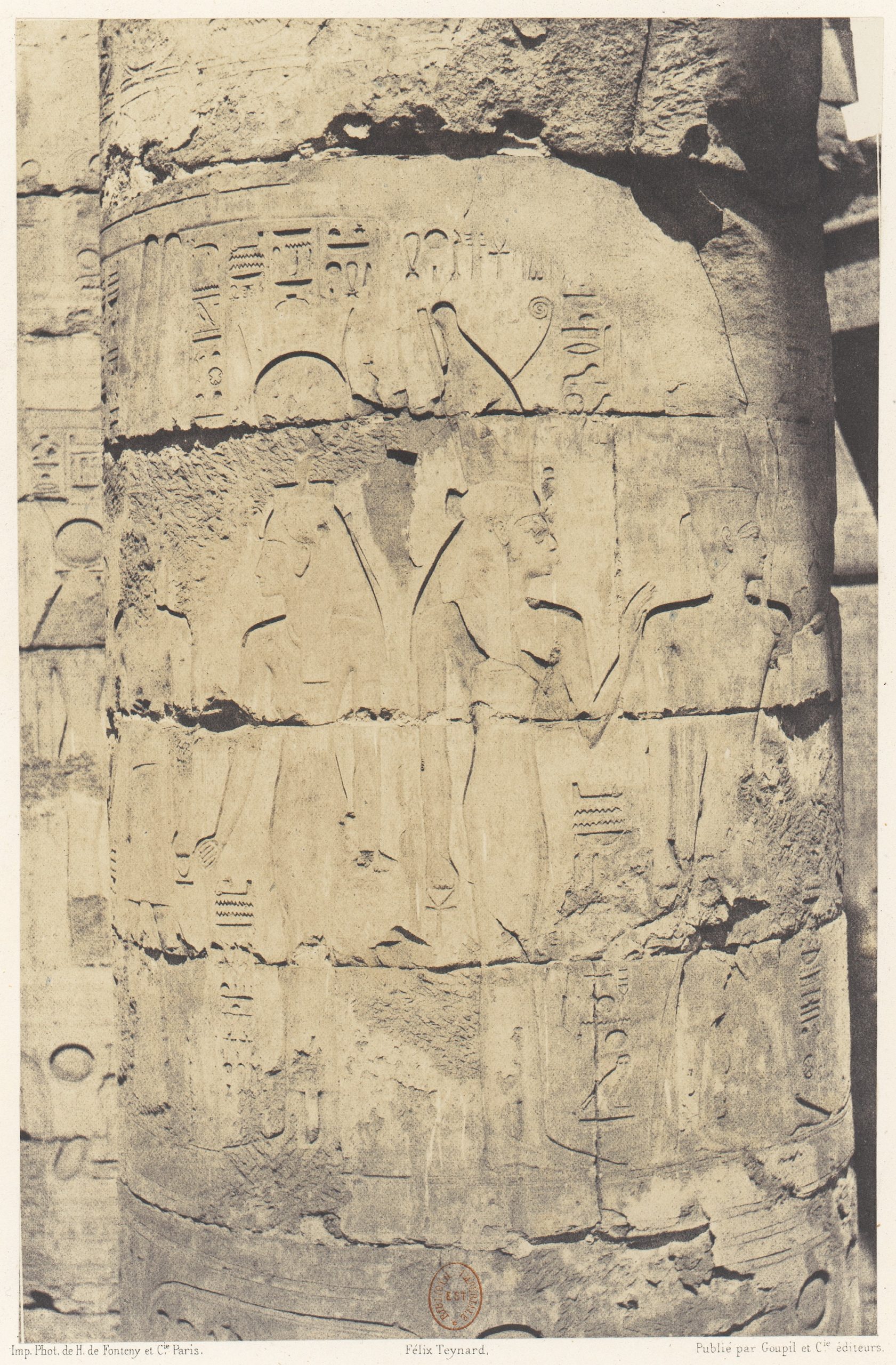
Karnak: Hypostyle Hall, decoration of the inner wall, 1851–52

Carved decoration on an inner wall of the Great Hypostyle Hall, Karnak
Félix Teynard, 1851–1852 (photographed); printed 1853–1854 · salted paper print from paper negative · 23.3 × 30.5 cm · The Metropolitan Museum of Art, object 261859 · Old title: “Karnak (Thebes); Palace – Hypostyle Hall – Decoration of the Inner Wall at Point M”

Decoration on an inner wall of the Hypostyle Hall, taken from Point M on Teynard’s plan in 1851–52 and printed in 1853–54. Notice how the relief runs in bands across the stone; the catalogue does not name the scene.

Karnak: three of the smaller columns, c. 1857

Three of the smaller columns, Karnak
Francis Frith, c. 1857 · albumen print · 20.7 × 16.0 cm · Royal Collection Trust, acquired by King Edward VII when Prince of Wales · Old title: “Carnac – Three of the Smaller Columns”

Three of the smaller columns of the Great Hall, in Frith’s series of about 1857. Royal Collection Trust describes the interior of the Hypostyle Hall: three columns carved with hieroglyphs still stand among large sections of fallen masonry from the columns and lintels around them. Note their size beside the great central columns shown elsewhere in this gallery.

Karnak: rear of the temple, colonnade fragments, 1851–52

Fragments of colonnades in the rear part of the temple, Karnak
Félix Teynard, 1851–1852 (photographed); printed 1853–1854 · salted paper print from paper negative · 23.9 × 30.6 cm · The Metropolitan Museum of Art, accession 1976.607.62 (object 261863) · British Library 74/Cup.652.m.2, 1(62), 241 × 307 mm (another print) · Old title: “Karnak (Thebes); Palace – Rear Part – Fragment of Colonnades Seen from Point S”

Part of a colonnade in the rear portion of the temple, taken from Point S on Teynard’s plan in 1851–52 (print 1853–54). The British Library catalogue describes four standing lotiform columns, with the architrave still in place, in the Festival Hall of Thutmose III at the eastern end of the Temple of Amun-Ra. See how the architrave still spans the columns.

About these Hypostyle Hall photographs

Who and when. Three photographers made the pictures on this page. Félix Teynard worked at Karnak in 1851–52 and published his plates as Égypte et Nubie in about 1858. Eight views are from Francis Frith’s 1857 Nile series. Seven are catalogued by Royal Collection Trust, which holds the prints; the eighth is matched by title and series. Francis Bedford took the single 1862 view on the Prince of Wales’s tour. Together they cover the hall over little more than a decade.

Reading the photographs. Early travellers called the whole complex a “palace”; it is in fact a group of temples, and this hall belongs to the great precinct of Amun. A few old titles end in a letter, such as “Point Q”; that letter marks a spot on Teynard’s survey plan, so the headings name the view instead. For what to look for: the tall central columns end in open papyrus flowers and the lower ones in closed buds, and comparing Teynard’s 1851–52 views with Frith’s of 1857 shows how the debris changes.

Credits and sources for the Hypostyle Hall photographs

Medium, size and old title for each picture appear under the photograph itself. Links go to the holding institution’s record where one is available.

  • Karnak: Exterior of the Great Hall, 1857 — Francis Frith, 1857; Royal Collection Trust, acquired by King Edward VII when Prince of Wales.
  • Karnak: the Hall of Columns from the south-east, c. 1857 — Francis Frith, c. 1857. Royal Collection Trust, acquired by King Edward VII when Prince of Wales.
  • Karnak: the Great Hall from the Sacred Lake, c. 1857 — Francis Frith, c. 1857. Royal Collection Trust, acquired by King Edward VII when Prince of Wales.
  • Karnak: Hypostyle Hall, side galleries, first view, 1851–52 — Félix Teynard, 1851–1852. The Metropolitan Museum of Art, accession 1976.607.56 (object 261856).
  • Karnak: Hypostyle Hall, general view, 1851–52 — Félix Teynard, 1851–1852. British Library 74/Cup.652.m.2, 1(52).
  • Karnak: Hypostyle Hall, central colonnade, 1851–52 — Félix Teynard, 1851–1852.
  • Karnak: Hypostyle Hall, central colonnade capitals, 1851–52 — Félix Teynard, 1851–1852. British Library 74/Cup.652.m.2, 1(55); 040-003224438.
  • Karnak: columns of the Great Hall, c. 1857 — Francis Frith, c. 1857. Royal Collection Trust, acquired by King Edward VII when Prince of Wales.
  • Karnak: columns of the Great Hall, other side, c. 1857 — Francis Frith, c. 1857. Royal Collection Trust, acquired by King Edward VII when Prince of Wales.
  • Karnak: interior of the Hall of Columns, c. 1857 — Francis Frith, c. 1857. Royal Collection Trust RCIN 2701254, acquired by King Edward VII when Prince of Wales.
  • Karnak: inside the Hypostyle Hall, 1862 — Francis Bedford, 16 March 1862, 46.9 × 58.4 cm (mount). Royal Collection Trust RCIN 2700883.
  • Karnak: the Hall of Columns, side view, c. 1857 — Francis Frith, c. 1857.
  • Karnak: Hypostyle Hall, side galleries, second view, 1851–52 — Félix Teynard, 1851–1852. The Metropolitan Museum of Art, accession 1976.607.57 (object 261857).
  • Karnak: Hypostyle Hall, decoration of the inner wall, 1851–52 — Félix Teynard, 1851–1852. The Metropolitan Museum of Art, object 261859.
  • Karnak: three of the smaller columns, c. 1857 — Francis Frith, c. 1857. Royal Collection Trust, acquired by King Edward VII when Prince of Wales.
  • Karnak: rear of the temple, colonnade fragments, 1851–52 — Félix Teynard, 1851–1852. The Metropolitan Museum of Art, accession 1976.607.62 (object 261863).