Photo Gallery · Luxor town and the Nile

Luxor Town and the Nile in Old Photos

Thirteen photographs of Luxor’s river front, boats and townspeople, made between 1851 and 1898.

This gallery is about the town rather than the temple: the river front and landing place, the yearly flood, passenger and merchant boats, dovecotes among the houses, and the people who lived and worked there. River boats carried people and goods, and the Nile flooded the fields every year. For old views of the temple itself, see Luxor Temple in old photos; for the village and palm groves at Karnak, see Karnak in old photos.

The Nile and the town

Nine views of the river front, the flood, the boats and the gardens around Luxor.

Luxor: the landing place, 1857

The landing place on the Nile bank at Luxor
Francis Frith, 1857 · albumen print · 15.6 × 20.5 cm · Acquired by the Prince of Wales (later King Edward VII); current holding institution not identified · Old title: “The Landing Place”

The landing place at Luxor, from Frith’s 1857 Nile series. See the line of the bank where boats came in; the river linked the town, fields and ancient sites. Today a road and promenade run along the river front.

Luxor: during the Nile flood, 1860s

Floodwater reaching the edge of Luxor town during the annual Nile flood, 1860s
Antonio Beato, 1860–1869 · albumen print (per source) · New York Public Library Digital Collections, ID 510d47d9-6039-a3d9-e040-e00a18064a99 · Old title: “Luxor During the Nile Flood”

Luxor during the annual Nile flood; the catalogue title reads “pendant l’inondation”. Photographed by Antonio Beato, 1860s. See how the water reaches the edge of the town. The yearly flood no longer reaches the town now that the river is controlled by dams.

Luxor: panoramic view

A wide view of Luxor town and the temple area
Photographer not identified, 1864 (per source caption; unverified) · New York Public Library Digital Collections, ID 510d47d9-6064-a3d9-e040-e00a18064a99 · Old title: “Panoramic View of Luxor”

A panoramic view of Luxor town and the temple area on the Nile’s east bank; the catalogue gives 1864 from the source caption, which is unverified, and the photographer is not identified. Notice how the buildings are grouped along the river front.

Luxor: from the riverbank, 1860s

Luxor and its temple from the Nile bank
Antonio Beato, 1860–1869 · albumen print (per source) · New York Public Library Digital Collections, ID 510d47d9-605d-a3d9-e040-e00a18064a99 · Old title: “Luxor from the Riverbank”

Luxor and its temple from the Nile bank in the 1860s, when village houses still stood among the ruins. Photographed by Antonio Beato. Observe the houses crowded beside the temple. Today the temple is cleared and the houses stand beyond its walls.

Luxor: view from the north, 1860s

Luxor and its temple seen from the north
Antonio Beato, 1860–1869 · albumen print · 21 × 26.5 cm · New York Public Library Digital Collections, ID 510d47d9-605f-a3d9-e040-e00a18064a99 · Old title: “Luxor; View from the North”

Luxor and its temple seen from the north; the catalogue title reads “vue du nord”. Photographed by Antonio Beato, 1860s. Compare it with the riverbank view to see the town from a second side.

Luxor: passenger boat

A passenger boat on the Nile at Luxor, photographed by Teynard, 1851–52
Félix Teynard, 1851–1852 · salted paper print from paper negative · Old title: “Luxor Passenger Boat”

A passenger boat on the Nile at Luxor, photographed by Félix Teynard, 1851–52. See how the boat is built for the river. River traffic was central to movement through the region, and boats still carry visitors up and down the Nile from Luxor.

Luxor: dovecotes

Traditional dovecotes, or pigeon towers, among the houses of Luxor
Photographer not identified (RCT album compiled by Rev. J. N. Dalton), 1879–82 · albumen print · 22.0 × 27.5 cm · Old title: “Luxor Dovecotes”

The traditional dovecotes, or pigeon towers, of Luxor, which combined practical animal keeping with a distinctive local building form. The photographer is not identified; the picture comes from a Royal Collection Trust album compiled by Rev. J. N. Dalton, dated 1879–82. Note the shape of the towers.

Luxor: date palms and the garden of the Luxor Expedition, 1851–52

Date palms in the garden of the Luxor Expedition, 1851–52
Félix Teynard, 1851–1852 · salted paper print from paper negative · Old title: “Luxor; Date Palms and Garden of the Luxor Expedition”

Date palms and the garden of the Luxor Expedition, photographed in 1851–52. The title names the French mission that removed an obelisk to Paris in the 1830s. See the palms in the foreground.

The Nile: merchant boats

Merchant sailing boats on the Nile at Luxor
Photographer not identified, date not stated · Old title: “Merchant Boats of the Nile”

Merchant boats on the Nile at Luxor; the catalogue gives no photographer or date. Notice how the sails and hulls are arranged. Sailing boats still work the river today.

People of Luxor

Four pictures of people. They are named only where the source names them, and the source names none of these individuals.

Luxor: musicians

Musicians at Luxor, photographed by Antonio Beato
Antonio Beato, 1864 (per source caption; unverified) · albumen print (per source) · Old title: “Arab Musicians – Luxor”

Arab musicians at Luxor, a scene of music-making, with the audience unknown; the catalogue gives 1864 from the source caption, which is unverified. Photographed by Antonio Beato. The people are not named in the source. See how the group is arranged for the camera.

Luxor: water carriers

Water carriers beside the Nile at Luxor, photographed by Antonio Beato
Antonio Beato, 1864 (per source caption; unverified) · albumen print (per source; process unconfirmed) · Old title: “Water Carriers; Luxor”

Water carriers at Luxor, a scene of water carrying beside the Nile; the catalogue gives 1864 from the source caption, which is unverified. Photographed by Antonio Beato. The source does not name the people. Notice how the scene is arranged for the camera.

Luxor: Cameron Highlanders at the station, 1898

Cameron Highlanders having breakfast on the Luxor station platform
Photographer not identified (album from Francis Gregson papers), 1898 · Cambridge University Library GBR/0115/RCS/Y3042C/217 · Old title: “Camerons Breakfasting at Luxor Station”

The Camerons having breakfast on the platform of Luxor railway station in 1898, with their rifles stacked in front of them. The photographer is not stated; the picture comes from an 1898 Nile campaign album at Cambridge University Library. The station belongs to a later phase of travel, when rail was reshaping journeys in Upper Egypt.

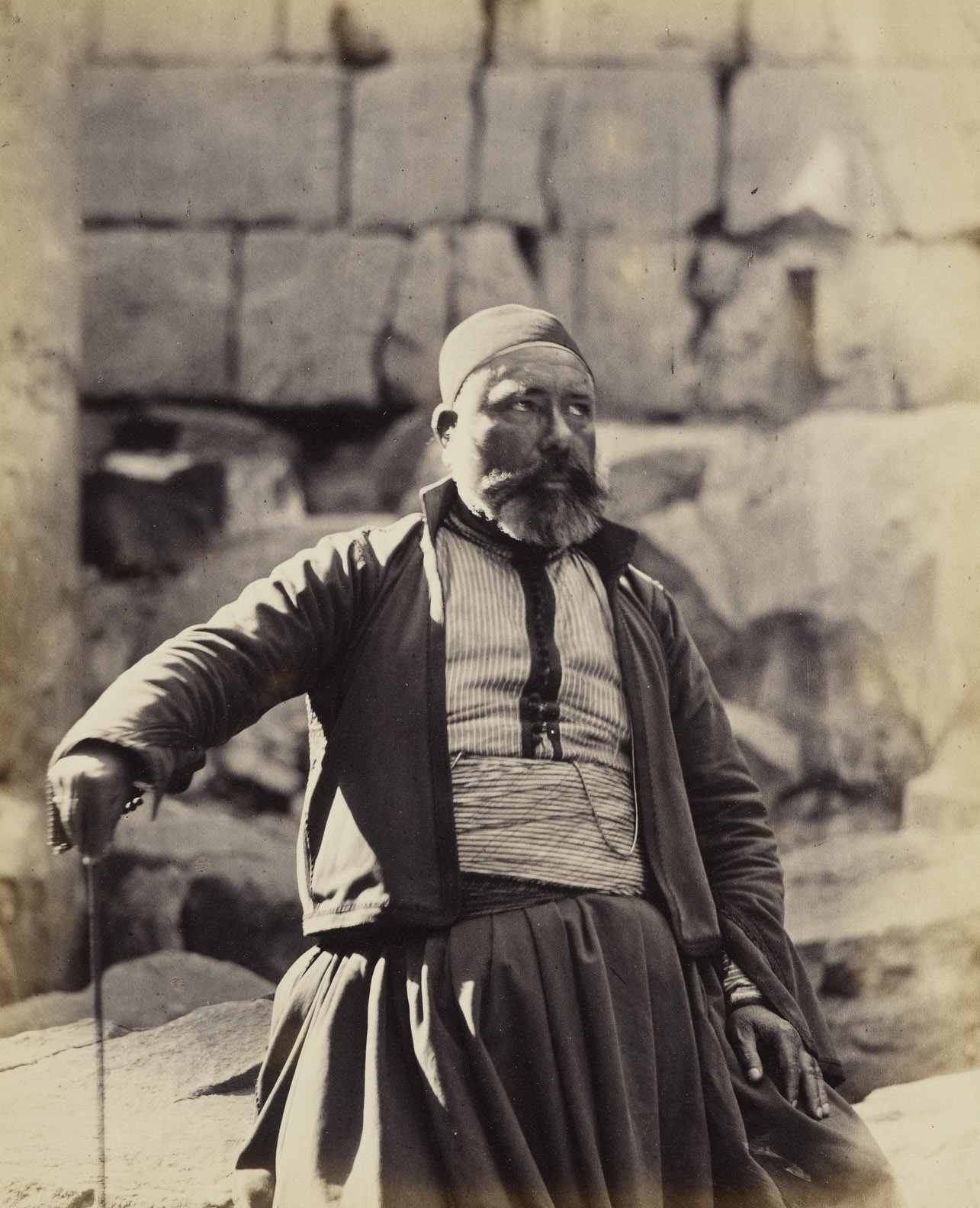
Portrait of an unidentified man, 1862

An unidentified Egyptian man photographed by Francis Bedford in 1862
Francis Bedford, March 1862 · albumen print; mounted on card · 19.8 × 16.0 cm (image); 46.9 × 58.4 cm (mount) · unsigned and uncaptioned; not part of the Day & Son series · Royal Collection Trust RCIN 2700895, acquired by the Prince of Wales (later King Edward VII) in 1862 · Royal Collection title: “Portrait [Egyptian Man, Medinet Habu temple, Thebes]” · Old title: “Portrait: Egyptian Man; Medinet Habu Temple; Thebes”

A portrait of an unidentified Egyptian man, photographed by Bedford in March 1862. Royal Collection Trust says he may have helped the royal party or been a local inhabitant. Royal Collection Trust’s title names Medinet Habu, but its own text says Karnak, so the place is not settled. The print is unsigned and uncaptioned, and Royal Collection Trust notes that a second print (RCIN 2861552) is signed “F Bedford Karnak”. Portraits like this show how people were represented in early travel photography, alongside the temple views.

About these Luxor town photographs

Who and when. The pictures come from several hands. Félix Teynard’s two views of 1851–52 were published as Égypte et Nubie in about 1858, and the landing place is from Francis Frith’s 1857 Nile series. Five are by Antonio Beato in the 1860s, and one is Francis Bedford’s portrait of March 1862. Four have no named photographer: a panorama, merchant boats, a view of dovecotes from an album of the 1879–82 voyage of HMS Bacchante, and soldiers at the station in 1898.

Reading the photographs. Start with the river front, then see how the houses sit against the temple in the views from the bank and from the north. The last section shows people; they are named only where the source names them, and the source names none of them. Some dates come from source captions that the catalogues mark as unverified.

Credits and sources for the Luxor town photographs

Medium, size and old title for each picture appear under the photograph itself. Links go to the holding institution’s record where one is available.

  • Luxor: the landing place, 1857 — Francis Frith, 1857. Acquired by the Prince of Wales (later King Edward VII); current holding institution not identified.
  • Luxor: during the Nile flood, 1860s — Antonio Beato, 1860–1869 (per source). New York Public Library Digital Collections, ID 510d47d9-6039-a3d9-e040-e00a18064a99.
  • Luxor: panoramic view — Photographer not identified, 1864 (per source caption; unverified). New York Public Library Digital Collections, ID 510d47d9-6064-a3d9-e040-e00a18064a99.
  • Luxor: from the riverbank, 1860s — Antonio Beato, 1860–1869 (per source). New York Public Library Digital Collections, ID 510d47d9-605d-a3d9-e040-e00a18064a99.
  • Luxor: view from the north, 1860s — Antonio Beato, 1860–1869. New York Public Library Digital Collections, ID 510d47d9-605f-a3d9-e040-e00a18064a99.
  • Luxor: passenger boat — Félix Teynard, 1851–1852.
  • Luxor: dovecotes — Photographer not identified (RCT album compiled by Rev. J. N. Dalton), 1879–82.
  • Luxor: date palms and the garden of the Luxor Expedition, 1851–52 — Félix Teynard, 1851–1852.
  • The Nile: merchant boats — Photographer not identified, date not stated.
  • Luxor: musicians — Antonio Beato, 1864 (per source caption; unverified) (per source).
  • Luxor: water carriers — Antonio Beato, 1864 (per source caption; unverified) (per source; process unconfirmed).
  • Luxor: Cameron Highlanders at the station, 1898 — Photographer not identified (album from Francis Gregson papers), 1898. Cambridge University Library GBR/0115/RCS/Y3042C/217.
  • Portrait of an unidentified man, 1862 — Francis Bedford, March 1862. Royal Collection Trust RCIN 2700895.