Photo Gallery · Karnak Temple, Luxor

Karnak in Old Photos

Twenty-two early photographs of Karnak’s sphinx avenue, gateways, Great Court and wider ruins, made between 1851 and the 1860s, plus one undated stereograph of the ram avenue.

Karnak’s way in was an avenue of ram-headed sphinxes leading to great gateways, with a village at the temple’s feet and palm groves around it. Houses stood close to the walls, and much of the ground inside was covered in rubble. This page is the starting point for our three Karnak galleries: it holds the approaches, gateways and general views, and the other two are listed just below. The long avenue joining Karnak to Luxor Temple, opened to the public on 25 November 2021, has its own Avenue of Sphinxes guide. For tickets and the route round the site, see the Karnak Temple guide.

The avenue of sphinxes

Five views of the rows of sphinxes that lead to Karnak, from Teynard in 1851–52 to Beato in the 1860s.

Karnak: Avenue of Ram-Headed Sphinxes

The avenue of ram-headed sphinxes leading to the First Pylon, Karnak
Antonio Beato, 1864 (per source caption; unverified) · Old title: “Avenue of Ram-Headed Sphinxes; Karnak”

The avenue of ram-headed sphinxes leading towards the First Pylon, Karnak’s western entrance; the catalogue gives 1864 from the source caption, which is unverified. See the row of statues, each with the ram’s head of Amun and a small figure of the king between its paws. Sphinx avenues organised ceremonial movement between sacred spaces and were used for processions.

Karnak: Avenue of Rams

The great avenue of ram-headed sphinxes, Karnak
Underwood & Underwood, date not stated · Old title: “Grand Avenue of Rams”

The avenue of ram statues approaching the temple. No exact date is recorded; the catalogue suggests a stereograph view of about 1910, not confirmed. See how the avenue runs away from the camera.

Karnak: Avenue of Sphinxes, c. 1857

Two rows of headless sphinxes on the avenue at Karnak, with the Ptolemaic gateway behind, c. 1857
Francis Frith, c. 1857 · albumen print · 15.5 × 20.9 cm · Royal Collection Trust, acquired by King Edward VII when Prince of Wales · Old title: “Carnac – The Avenue of Sphinxes”

The avenue of sphinxes in Frith’s view of around 1857, seen from the south-west with two rows of headless sphinxes and some local men in the foreground. The largely intact Ptolemaic gateway in the south-western wall of the precinct stands in the middle ground, with the pylon of the Temple of Khonsu behind it and the remains of the Ninth Pylon on the right. Notice how many statues are broken.

Karnak: Avenue of Sphinxes, 1851–52

Teynard’s general view of the sphinx avenue at Karnak, 1851–52
Félix Teynard, 1851–1852 (photographed); printed 1853–1854 · salted paper print from paper negative · 24.1 × 30.5 cm · The Metropolitan Museum of Art, accession 1976.607.67 (object 261868) · Old title: “Karnak (Thebes); Avenue of Sphinx – General View Taken from Point G” (Met title: “Karnak (Thèbes), Avenue de Sphinx – Vue Générale Prise du Point G”)

Teynard’s view of the sphinx avenue, made in 1851–52 and printed in 1853–54, years before Frith and Beato. Compare the three pictures to see how the statues and the ground around them change. It is a general view taken from Point G on Teynard’s survey plan.

Karnak: sphinxes with human and ram heads, 1851–52

Sphinxes with human and ram heads, Karnak
Félix Teynard, 1851–1852 (photographed); Met impression printed 1853–1854 · salted paper print from paper negative · 24.0 × 30.6 cm (Met impression); 24.0 × 30.9 cm (Musée d’Orsay impression) · The Metropolitan Museum of Art, accession 1976.607.68 (object 261869); related impressions at Musée d’Orsay, PHO 1986 132 68, and the Cleveland Museum of Art, 1992.331 · Old title: “Karnak (Thebes); Sphinxes with a Human Head and a Ram’s Head (Point Y)”

Sphinxes with human and ram heads, seen from Point Y on Teynard’s plan, 1851–52. See how the two kinds differ: one has a human face, the other the ram’s head of Amun. The Cleveland Museum of Art, which holds another print of the plate, says the ram-headed sphinx is only nine feet long and held a statue of a human between its paws.

Karnak’s gateways

Six views of the gateways of Karnak, from the Ptolemaic Gate to the great northern and southern gates. The numbered pylons, including Teynard’s “First” and “Third” Pylon plates, are in Karnak’s pylons, obelisks and granite sanctuary in old photos.

Karnak: Ptolemaic Gate, 1860s

The Ptolemaic gate at Karnak, photographed in the 1860s
Antonio Beato, 1860–1869 · albumen print · 39.5 × 26 cm · New York Public Library Digital Collections, ID 510d47d9-6024-a3d9-e040-e00a18064a99 · Old title: “Ptolemaic Gate at Karnak”

The Ptolemaic gate at Karnak, dated to the 1860s. It was built when Greek-speaking kings ruled Egypt, and the old title spells it “Plotomae”. Notice how the gate stands against the ground around it.

Karnak: Great Northern Gate, 1851–52

The Great Northern Gate at Karnak and the walls that frame it, photographed by Teynard in 1851–52
Félix Teynard, 1851–1852 (photographed); printed 1853–1854 · salted paper print from paper negative · 23.7 × 30.6 cm · The Metropolitan Museum of Art, accession 1976.607.64 (object 261865); British Library 74/Cup.652.m.2, 1(64), 240 × 309 mm · Old title: “Karnak (Thebes); Great Northern Gate” (Met title: “Grande Porte du Nord Vue du Point X”)

The Great Northern Gate at Karnak, photographed by Teynard in 1851–52. Observe the size of the gateway and the walls that frame it. As its name says, it lies on the north side of the complex: the British Library describes the view as looking south-westwards towards the propylon leading to the precinct of the Temple of Montu, north of the Amun-Ra complex. The plate was taken from Point X on Teynard’s plan.

Karnak: Great Southern Gate, 1851–52

The Great Southern Gate at Karnak, seen from Point C on Teynard’s plan, 1851–52
Félix Teynard, 1851–1852 (photographed); printed 1853–1854 · salted paper print from paper negative · 24.0 × 30.3 cm · The Metropolitan Museum of Art, accession 1976.607.45 (object 261844) · Old title: “Karnak (Thebes); Great Southern Gate Seen from Point C”

The Great Southern Gate at Karnak, seen from Point C on Teynard’s plan, 1851–52. Compare it with the northern gate in the previous picture. It is a separate plate from the Tenth Pylon in the pylons gallery. The Library of Congress record for Teynard’s general view from Point B lists the Great Southern Gate together with the avenue of rams and the temple he calls the “Grand Temple du Sud”. The catalogue entries do not say which gateway it is, so this gallery does not identify it further.

Karnak: the first gateway, c. 1857

The largely intact Ptolemaic gateway in Karnak’s south-western wall, with the pylon of the Khonsu temple beyond, c. 1857
Francis Frith, c. 1857 · albumen print · 15.3 × 20.6 cm · Royal Collection Trust, acquired by King Edward VII when Prince of Wales · Old title: “Carnac – The First Gateway”

The first gateway at Karnak in Frith’s series, around 1857. Royal Collection Trust identifies it as the largely intact Ptolemaic gateway in the south-western wall of the precinct of Amun-Re, with the pylon of the Temple of Khonsu behind it and some local men beside the gateway. Remains of sphinxes lie in the foreground, and the Ninth and Eighth Pylons are partly visible on the right. Note the line of the walls rising above the rubble.

Karnak: sculptured gateway and figures, first view, c. 1857

A sculptured gateway and figures, Karnak
Francis Frith, c. 1857 · albumen print · Old title: “Carnac – Sculptured Gateway and Figures (2)”

A sculptured gateway and figures at Karnak, in Frith’s series of around 1857. See the carved figures on the stone and at how the gateway frames the opening.

Karnak: sculptured gateway and figures, second view, 1857

A second view of the sculptured gateway and figures, Karnak
Francis Frith, 1857 · albumen print · Old title: “Carnac – Sculptured Gateway and Figures 1857”

A second view of the sculptured gateway and figures, dated 1857. The two pictures share one old title. Compare them to see what changes with the camera’s position.

Karnak’s courts and general views

Nine wide views of the ruins and the courts in front of the temple, including the Great Court.

Karnak: general view from the south, 1862

The Karnak temple complex seen from the south
Francis Bedford, 1862 · albumen print; mounted on card · 23.9 × 29.1 cm · Old title: “General view from the south; Karnak 1862”

A broad view of Karnak from the south, photographed on the Prince of Wales’s 1862 tour. See how much of the precinct is still rubble and sand, with walls and columns rising from the debris.

Karnak: the Temple of Amun, 1862

Standing walls and fallen blocks in the Temple of Amun precinct at Karnak, 1862
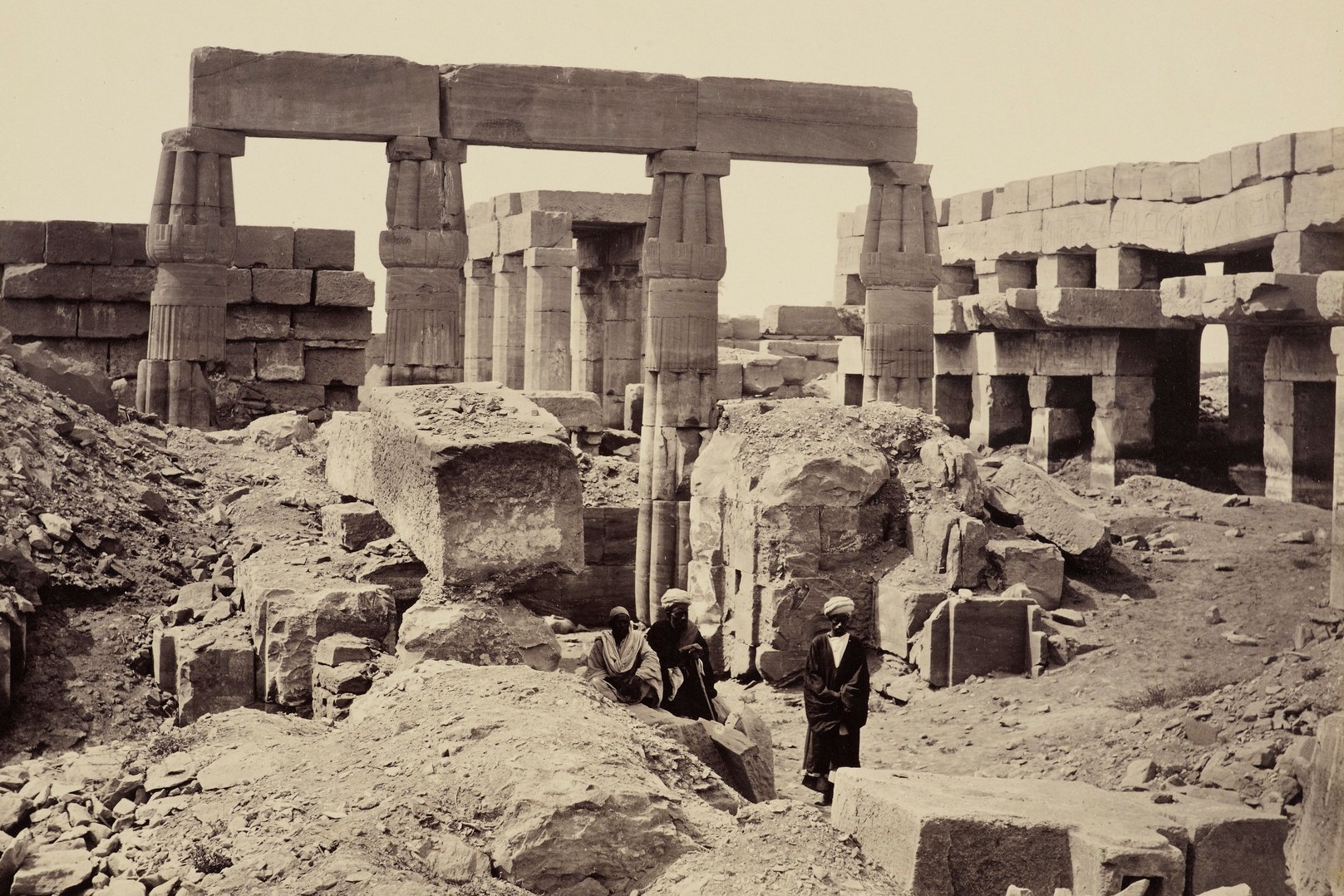
Francis Bedford, 1862 · albumen print; mounted on card · 23.0 × 28.7 cm · Old title: “Karnak [Temple of Amun] 1862”

The Temple of Amun precinct at Karnak, dated 1862. Observe the mix of standing walls and fallen blocks, which shows how little had been cleared by 1862.

Karnak: general view, 1857

A wide view of the ruins at Karnak in Frith’s 1857 series
Francis Frith, 1857 · albumen print · Old title: “Carnac 1857”

A general view at Karnak, titled simply “Carnac” in Frith’s series of 1857. Note the broad spread of ruins rather than any single building.

Karnak: general view of the ruins, 1851–52

The Karnak ruins seen from the western sphinx avenue, looking north-east, 1851–52
Félix Teynard, 1851–1852 (photographed); printed 1853–1854 · salted paper print from paper negative · The Metropolitan Museum of Art, accession 1976.607.44 (object 261843) · British Library 74/Cup.652.m.2, 1(44), 239 × 308 mm (another print) · Old title: “Karnak (Thebes); General View of the Ruins Taken from Point B”

The ruins at Karnak viewed from Point B on Teynard’s plan, photographed in 1851–52 (print 1853–54). The British Library catalogue describes a view from the western avenue of ram-headed sphinxes, looking north-eastwards towards the pylon of the Temple of Khons at the south-west corner of the Amun-Ra Temple complex, with a free-standing propylon in the foreground and the ruins of the main temple on the skyline. Notice how the ruins spread across the ground.

Karnak: general view from the north-east, 1851–52

A general view of the Karnak ruins from the north-east
Félix Teynard, 1851–1852 · salted paper print from paper negative · British Library 74/Cup.652.m.2, 1(47), 240 × 311 mm (another print) · Old title: “Karnak (Thebes); General View of the Ruins Taken from the Northeast” (British Library English title: “General view of ruins taken from the north-east at point V (on plan)”)

Karnak’s ruins viewed from the north-east, photographed by Teynard in 1851–52. Compare it with the south view of 1862 at the start of this section. Together they show the precinct from two sides. The British Library describes this view as taken from a point on the north-east perimeter wall, looking south-westwards towards the main body of the Temple of Amun-Ra, with the obelisks in the middleground, right of centre.

Karnak: in front of the temple, 1851–52

The area in front of the temple, Karnak
Félix Teynard, 1851–1852 · salted paper print from paper negative · Old title: “Karnak (Thebes); In Front of the Palace”

The area in front of what old titles call the palace at Karnak, 1851–52. See the open ground between the camera and the walls.

Karnak: in front of the temple, second view, 1851–52

The area in front of the temple seen from survey point H, Karnak
Félix Teynard, 1851–1852 · salted paper print from paper negative · Old title: “Karnak (Thebes); In Front of the Palace; Seen from Point H”

A second view in front of the palace, taken from Point H on Teynard’s plan, 1851–52. Compare it with the previous picture to see how the camera position changes the scene.

Karnak: courtyard of the temple, 1851–52

The forecourt at Karnak looking south-east towards the Second Pylon, 1851–52
Félix Teynard, 1851–1852 (photographed); printed 1853–1854 · salted paper print from paper negative · 30.7 × 25.2 cm · The Metropolitan Museum of Art, accession 1976.607.51 (object 261851) · British Library 74/Cup.652.m.2, 1(51), 309 × 254 mm (another print) · Old title: “Karnak (Thebes); Palace – Courtyard – View Taken from Point I”

The courtyard of the temple, seen from Point I on Teynard’s plan and photographed in 1851–52 (print 1853–54). The British Library describes it as a view from the forecourt looking south-east towards the second pylon, with a long colonnade leading to the great hypostyle hall and a lone surviving papyrus column in the right foreground. See how the walls enclose the open space.

Karnak: the Court of Shishak, c. 1857

The Court of Shishak in the Great Court, Karnak
Francis Frith, c. 1857 · albumen print · 16.1 × 20.9 cm · Royal Collection Trust, acquired by King Edward VII when Prince of Wales · Old title: “Carnac – The Court of Shishak”

The old title calls this the Court of Shishak, around 1857. Shishak is the biblical form of Shoshenq I, a king of the 22nd Dynasty whose building is linked with the great court at Karnak; Royal Collection Trust describes a view across the forecourt of the precinct, with the entrance to the Hypostyle Hall in the middle ground. Observe the mix of standing columns and broken walls. The Great Court is the large open space visitors cross just after the First Pylon.

Palms and the village

Two pictures of the green setting around the temple, and of the village that stood beside it.

Karnak: a group of date palms, 1851–52

A group of date palms beside Karnak, seen from Point A on Teynard’s plan, 1851–52
Félix Teynard, 1851–1852 · salted paper print from paper negative · Old title: “Karnak; Group of Date Palms Seen from Point A”

A group of date palms at Karnak, seen from Point A on Teynard’s plan, 1851–52. Notice how green the setting beside the temple was. Palm groves and villages formed part of the cultivated landscape around the monuments.

Karnak: the village, 1860s

The village of Karnak beside the temple
Antonio Beato, 1860–1869 · albumen print · 21 × 26.5 cm · New York Public Library Digital Collections, ID 510d47d9-6085-a3d9-e040-e00a18064a99 · Old title: “Village of Karnak”

The village beside the Karnak temple precinct, dated to the 1860s, with palms and, according to the source record, the Nile waterfront. See how close the houses stand to the ruins. Today the temple is a fenced site with a ticketed entrance, and the village lies outside it.

About these Karnak gateway and avenue photographs

Who and when. Five sources lie behind these pictures. Félix Teynard photographed Karnak in 1851–52 and published his plates as Égypte et Nubie in about 1858; ten of his views are here. Six are from Francis Frith’s 1857 Nile series. Three are catalogued by Royal Collection Trust, which holds the prints; three are matched by title. Francis Bedford made two views in 1862, and Antonio Beato three in the 1860s. One more, of the ram avenue, may be a stereograph by Underwood & Underwood and is undated.

Reading the photographs. The early pictures here show the sphinxes near Karnak itself, long before the Karnak–Luxor avenue was excavated; for early views of the temple at the avenue’s other end, see Luxor Temple in old photos. Old titles such as “Point C” are Teynard’s survey-plan references, so the headings describe each view instead. Note the rows of sphinxes and count how many survive in each picture, and compare Teynard’s avenue of 1851–52 with Beato’s view of the 1860s.

Credits and sources for the Karnak gateway and avenue photographs

Medium, size and old title for each picture appear under the photograph itself. Links go to the holding institution’s record where one is available.