

Step into TT56 and the first thing likely to catch your eye isn’t a funeral scene — it’s a king holding a battle axe instead of the usual crook and flail. That one deliberate choice by Userhat’s artists tells you a lot about this tomb: it’s less interested in solemn ritual than in showing off a life fully lived.
Tucked into Sheikh Abd el-Qurna on Luxor’s West Bank, the Tomb of Userhat (TT56) is one of the best-preserved private tombs in the Theban Necropolis, dating to the 18th Dynasty reign of Amenhotep II. Userhat held real administrative weight in his lifetime — Royal Scribe, Overseer and Scribe of the Cattle of Amun, and Bread Counting Scribe of Upper and Lower Egypt — and his tomb reflects it, mixing royal scenes with hunting, fishing, family life, and offerings rather than sticking to formal funerary imagery alone.
An Audience with Amenhotep II
The tomb’s standout scene shows Userhat approaching Amenhotep II, seated in a colorful kiosk with lotus-shaped columns, red, blue, and green paint, gold bands, and a frieze of uraei. The king wears the horned, ostrich-feathered crown and holds an ankh in one hand — but in the other, instead of a crook or flail, he raises a combat axe. Userhat is shown as already deceased while the king remains very much alive and reigning, and the inscriptions lean hard on Userhat’s loyalty and closeness to the royal court.
Hunting and Fishing in the Marshes
Some of TT56’s most attractive paintings show Userhat hunting birds from a papyrus boat, alongside his wife Mutneferet and one of their daughters. He holds a throwing stick overhead, ducks fly up from the reeds, one bird falls mid-strike, and a nest of chicks sits threatened by a predator — genuine movement and tension in a 3,400-year-old wall. A nearby scene shows the same trio fishing, Userhat spearing two large fish with a harpoon while ducks scatter across the water.


Marshes carried real symbolic weight in Egyptian funerary art — water, vegetation, and abundant wildlife stood for fertility and rebirth — so having his wife and daughter present in both scenes adds a family dimension that’s easy to miss on a quick look. For the wider repertoire of scenes like these, see Egyptian Tomb Paintings.

The Desert Hunt
A third major scene switches setting entirely: Userhat draws his bow from a light chariot pulled by two horses across open desert, gazelles, hares, and hyenas fleeing, wounded, or already down. The artist gives the animals real motion and panic rather than the static poses common elsewhere, making this one of the tomb’s most dynamic compositions.

Userhat and Mutneferet
A quieter, more personal scene shows the couple seated together, finely dressed with perfume cones and large necklaces, Mutneferet’s arm resting around her husband — an unusually intimate gesture for Egyptian tomb art. A Hathoric mirror beneath her chair ties the scene to Hathor, goddess of beauty and love, while carefully rendered baskets and Userhat’s own scribal equipment round out the domestic detail.
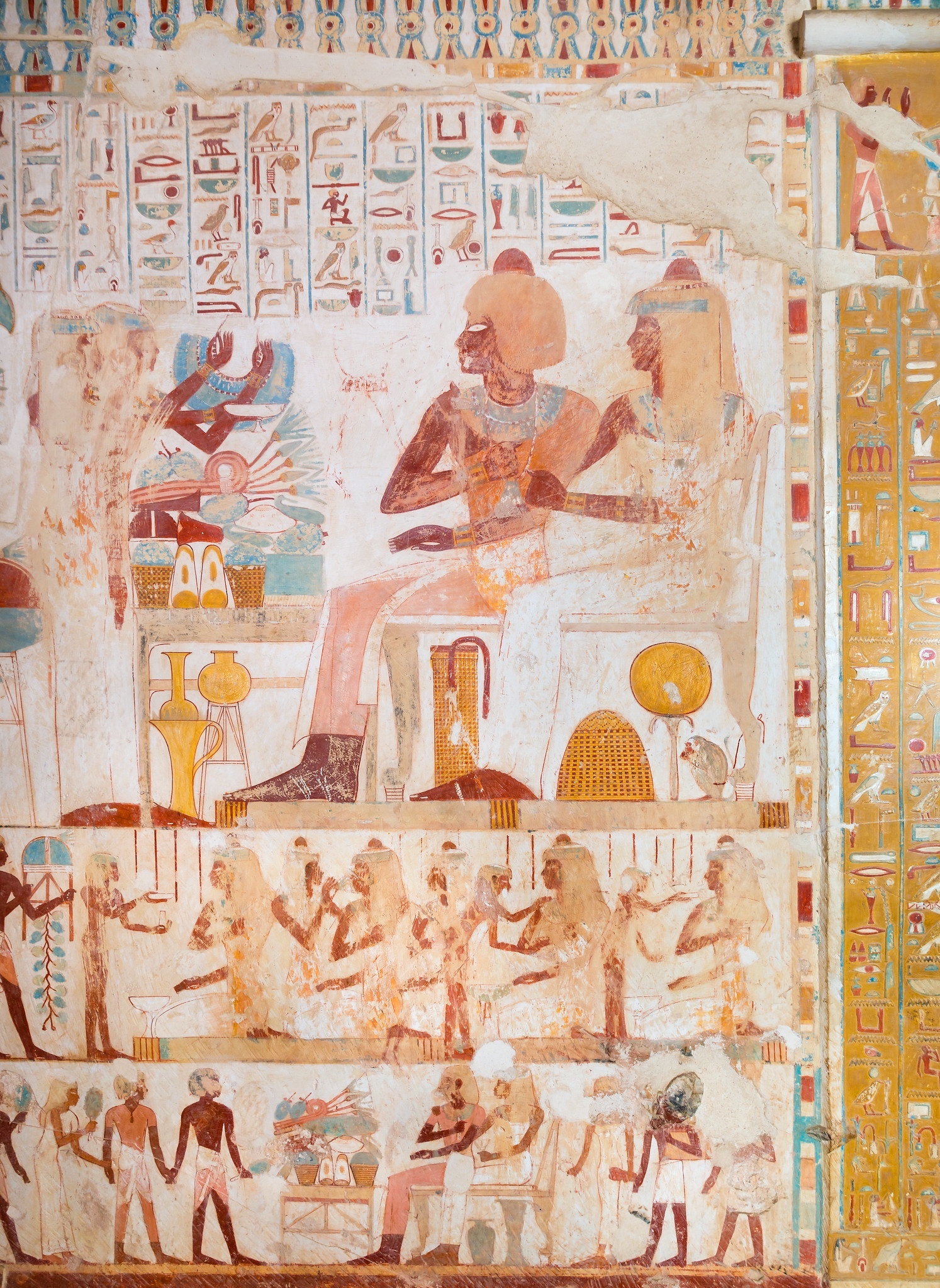

The Family’s Offerings
Userhat’s children appear bringing offerings to their parents: two daughters present wine and jewelry, their brother carries a floral bouquet. The inscriptions frame this less as ritual obligation and more as ongoing family relationship — the idea that death didn’t end the household, only changed its shape.

Visiting the Tomb of Userhat
- Ticket: TT56 is sold within the Sheikh Abd el-Qurna Tombs of the Nobles cluster ticket system alongside the neighboring tombs of Ramose (TT55) and Khaemhat (TT57) — bought at the ticket office rather than at the tomb itself. For current grouping and pricing, see Luxor Entrance Fees.
- Time needed: TT56 is small; 15–20 minutes covers it well, or closer to an hour if you’re visiting all three tombs in the cluster.
- Accessibility: The tomb is rock-cut into the hillside and reached via unpaved paths with some uneven ground — not wheelchair accessible.
- Best time: Early morning, both for softer light on the paintings and to beat the heat and tour groups. See the best times to visit Luxor.
TT56 rewards a slow look. Combined with its immediate neighbors, it’s one of the clearest windows into how an 18th Dynasty official wanted to be remembered — not just as dutiful, but as someone who’d actually lived.