Tomb of Nefertari
QV66
In Luxor’s Valley of the Queens, under the desert cliffs, you can find one of Ancient Egypt’s most amazing treasures: the Tomb of Nefertari (QV66). Often called the Sistine Chapel of Ancient Egypt, this tomb is famous for its beautiful wall paintings, excellent condition, and the story it tells about a queen known for her beauty and influence. For travelers, historians, and art lovers, QV66 is not just another tomb; it is a true work of art and a piece of cultural history.

Who Was Queen Nefertari?
To understand why Nefertari’s tomb is special, we should first know who she was. Nefertari Meritmut was the Great Royal Wife of Pharaoh Ramesses II. He was one of Egypt’s most powerful pharaohs and ruled for a long time. Her name means “the one for whom the sun shines,” representing her importance and the love she received.
Nefertari was more than just a wife. She helped with diplomatic tasks and communicated with foreign leaders. She received honors that very few queens have ever received. At Abu Simbel, Ramesses II built a temple just for her —a rare honor in Egyptian history. Her high status is reflected in the beauty of her tomb, which is more impressive than almost all others in the Valley of the Queens.
Luxor Tours & Activities
Looking to save some costs on your travel? Why not join a shared group tour to explore Luxor, Egypt? Here are some activities you might be interested in:
Where is the Tomb of Nefertari located?
It lies in the Valley of the Queens on Luxor’s West Bank, not far from the Valley of the Kings and Medinet Habu.

Discovery of the Tomb (QV66)
In 1904, Italian archaeologist Ernesto Schiaparelli discovered the tomb QV66. When his team entered, they were amazed by the bright wall paintings. Unlike many tombs that had been looted or damaged, Nefertari’s burial chamber still showed vivid colors and details.
However, exposure to air and humidity started to harm the delicate pigments. Looting in ancient times had already stripped the tomb of its treasures, but now environmental factors were the main threat. By the mid-20th century, the tomb was closed to visitors to stop further damage.
In the 1980s and 1990s, the Getty Conservation Institute worked with Egypt’s Supreme Council of Antiquities on a major conservation project. They stabilized the paintings, removed salt deposits, and set up monitoring systems. Thanks to their efforts, the tomb reopened in 1995, but with strict limits on visitors to protect it.

Inside the Tomb: A Journey Through Art and Symbolism
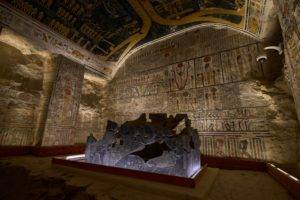
Entering QV66 feels like stepping into a special place between life and eternity. This tomb is beautifully decorated with scenes from the Book of the Dead, which help guide Nefertari on her journey to the afterlife.
Some of the most important features include:
– Nefertari with the Gods: She is shown with deities like Isis, Hathor, Anubis, and Osiris, which emphasizes her divine protection.
– The Astronomical Ceiling: The ceiling is painted deep blue with golden stars, representing the heavens and showing Nefertari’s eternal home among them.
– The Senet Game Scene: One famous image shows Nefertari playing the board game Senet. This symbolizes her journey through the afterlife.
– Funerary Texts: Hieroglyphic inscriptions from the Book of the Dead, including Chapters 17, 94, 144, and 146, contain spells and guidance for her soul.
– Vivid Colors: The reds, yellows, and blues are still bright, showing the skill of the artisans who painted them over 3,000 years ago.
Every wall tells a story—not just of Nefertari’s journey but also of the artistry and dedication of the craftsmen who created this lasting monument.

Visiting the Tomb of Nefertari Today
The tomb of Nefertari closed to visitors in March 2024. It had limited access before this due to damage to the frescoes.

Why the Tomb of Nefertari Is So Famous
QV66 is an extraordinary tomb for a few key reasons: artistry, size, and historical importance.
First, the artwork in QV66 is some of the best from the New Kingdom. The paintings are vibrant and detailed.
Second, QV66 is one of the largest tombs in the Valley of the Queens. This size shows how important Nefertari was.
Finally, Nefertari was the wife of Ramesses II. Her tomb represents royal devotion and the special honor she received.
Together, these factors make QV66 a significant cultural treasure.

The Eternal Beauty of Nefertari
The Tomb of Nefertari (QV66) is not just a burial site—it celebrates love, art, and dedication. When you enter, you enter a space where mythology meets history. Each brushstroke on the walls tells a story of a queen loved by her people and honored by her husband.
For those visiting Luxor, going to QV66 is more than seeing another tomb—it is about experiencing an incredible piece of ancient art. Whether you love history, enjoy art, or are just curious, the Tomb of Nefertari will give you lasting memories that are as bright as the colors on its walls.
Got a Question?
F.A.Qs
Because of its breathtaking wall paintings, often described as the Sistine Chapel of Ancient Egypt. The artistry, color, and preservation are unmatched among Egyptian tombs.
It lies in the Valley of the Queens on Luxor’s West Bank, not far from the Valley of the Kings and Medinet Habu.
Italian archaeologist Ernesto Schiaparelli uncovered it in 1904.
No, The tomb of Nefertari closed to visitors in March 2024.
Did you know that
By purchasing through our links, you support us at no additional cost.
Thank you for your support. ♥️